

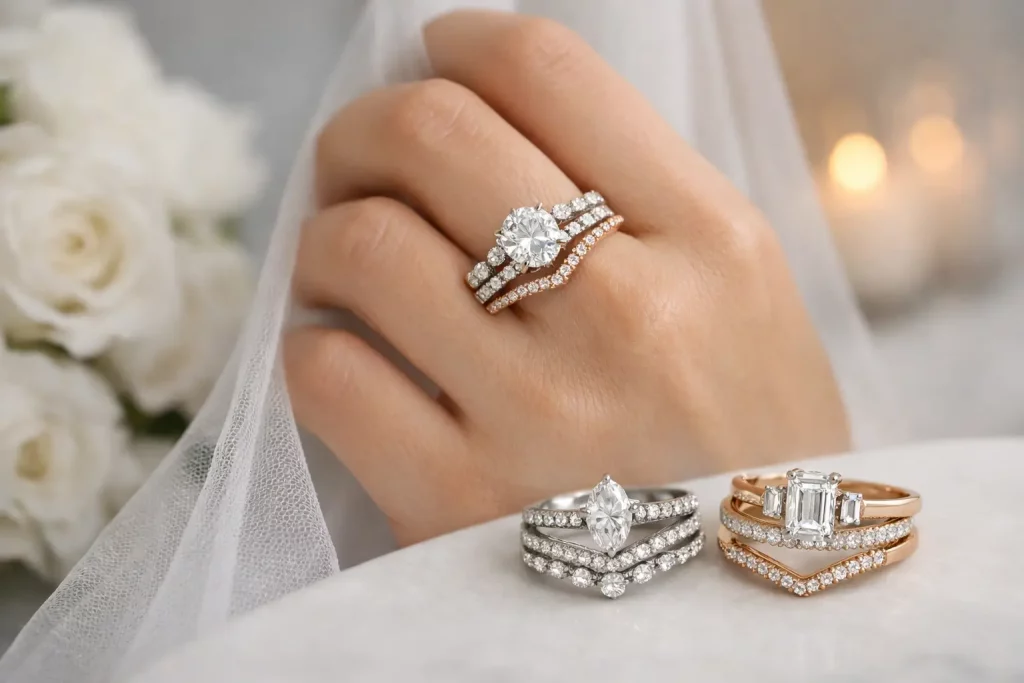
The best wedding ring stacks do more than look beautiful in a photograph. They should sit comfortably through ordinary life, honour the engagement ring you already love, and feel as though both rings were always meant to belong together. That is why the most successful stacks begin with your hand, your ring and the way you want to wear it – not a display tray of ready-made bands.
For some couples, the perfect stack is a slim plain band sitting neatly against a solitaire. For others, it is a curved diamond band following the outline of an oval, pear or marquise centre stone. There is no single right answer. The detail that matters is whether the finished combination feels balanced, secure and unmistakably yours.
What makes a wedding ring stack work?
A wedding ring stack is simply the way your engagement ring and wedding band sit together, sometimes with an additional eternity or anniversary ring added later. A good stack has visual harmony, but practical fit matters just as much. If the rings constantly spin apart, pinch your fingers or leave an awkward gap you did not intend, even a lovely design can become frustrating to wear.
Start by looking closely at the profile of your engagement ring. A high-set centre stone may allow a straight wedding band to sit underneath it. A low setting, prominent basket or unusually shaped gemstone may need a contoured band to avoid rubbing or a visible gap. Neither option is more special than the other. Some people love a deliberate sliver of space between the rings, while others want a close, puzzle-piece fit.
The best choice is the one you will enjoy seeing and wearing every day. Trying to force a standard straight band against a ring that needs more room often creates compromise where there need not be any.
Best wedding ring stacks by engagement ring style
Solitaire engagement rings
A classic solitaire offers the greatest flexibility. If the centre stone is set high enough, a straight band in the same metal can create a clean, timeless stack. A fine diamond set band adds light without competing with the centre stone, while a slightly wider plain band gives the stack a more modern, confident feel.
Pay attention to the height of the setting rather than assuming every solitaire works with every ring. A bespoke band can be made to sit close to the setting, with just enough contour to protect comfort and preserve that satisfying, joined-up look.
Oval, pear and marquise stones
Elongated stones often look particularly lovely with a gently curved or wishbone-shaped wedding ring. The curve can echo the soft lines of an oval or pear, drawing attention towards the centre stone rather than cutting across it.
With a pear or marquise, symmetry is a personal decision. A centred V-shaped band can look crisp and intentional, while an asymmetric curve can follow the stone’s individual silhouette. If your engagement ring has a distinctive setting, a custom-shaped band is usually the clearest route to a close fit.
Halo and vintage-inspired rings
Halo rings, intricate settings and vintage details can make a straight band difficult to place neatly. A shaped wedding ring allows the band to follow the setting instead of pressing against its edges. This is especially helpful where side stones, milgrain, decorative shoulders or a low halo extend beyond the central stone.
The goal is not always to hide every gap. A small gap may protect delicate details and prevent metal-on-metal contact. Your jeweller should explain where a curve is purely aesthetic and where it is needed for the long-term care of the rings.
Emerald, radiant and other angular cuts
Geometric stones pair beautifully with a stack that repeats their clean lines. A straight band may be ideal for a raised emerald-cut ring, while a subtle notch can accommodate a low-set design without losing its tailored appearance. Channel-set diamonds, baguette details or a polished plain band can all complement the structured feel of an angular centre stone.
Avoid adding too many competing shapes at once. If your engagement ring already has strong architectural detail, a quieter wedding band often lets it shine.
Choose proportion before extra sparkle
It is tempting to begin with diamond size, but width and proportion usually make the bigger difference. A very fine engagement ring can be overwhelmed by a thick, heavily set wedding band. Equally, an exceptionally delicate band can disappear beside a substantial centre stone.
Look at the rings from the top and side, not only face-on. Consider the width of the engagement ring shank, the height of its setting and the space between the rings. A difference in width can be striking in a good way, but it should look considered. For example, a narrow diamond band beside a plain, slightly wider engagement ring can create texture without making the stack feel busy.
If you hope to add an eternity ring one day, mention it at the design stage. Leaving room for a future ring can influence the height, curve and thickness of your wedding band. Planning ahead does not mean making every decision now. It simply helps your stack grow naturally with your story.
Match metals thoughtfully, not automatically
Matching metals remains a beautiful choice, particularly if you want the rings to read as one complete set. Yellow gold with yellow gold feels warm and traditional, while platinum offers a cool, enduring finish. Yet a mixed-metal stack can be equally personal.
A yellow gold engagement ring with a platinum setting, for instance, may pair well with either metal depending on which element you want to highlight. White gold or platinum can bring out the brightness of diamonds, while yellow gold can add contrast and softness. The key is to make the mix look intentional.
There is also a practical consideration. Different metals wear at different rates, and rings that rub together repeatedly may need more regular checking or polishing. A well-made shaped band can reduce unnecessary contact, but it is sensible to discuss your everyday routine, work and lifestyle before settling on a delicate finish or very fine setting.
Comfort is part of the design
The prettiest stack in the world is not the best one if it catches on clothing, feels sharp between the fingers or needs removing every time you use your hands. Comfort-fit interiors, carefully softened edges and the right depth of band make a real difference over years of wear.
This is especially relevant with shaped rings. A curve should follow the engagement ring while still sitting naturally around your finger. It should not feel as though it has been bent into place as an afterthought. The fit needs to account for how both rings move, because fingers change slightly with temperature, activity and time.
If you work with your hands, exercise regularly or prefer to sleep in your jewellery, say so. These details help determine whether a finer pavé edge, a low-profile band or a more substantial design will suit you best. Bespoke does not have to mean extravagant. It means the choices are made with you in mind.
Make the stack personal in quieter ways
A wedding ring does not need a dramatic silhouette to carry meaning. An engraving in your own handwriting, a hidden birthstone, a line from a song or a small detail taken from a family heirloom can turn a simple band into something deeply personal.
You might choose to echo the claw shape, side stones or metal tone of the engagement ring. Or you may prefer contrast: a clean polished band beside a detailed vintage ring, for example. Both approaches can work when they reflect your taste rather than a rule about what wedding jewellery should look like.
At BWR London, this is where a one-to-one conversation is especially valuable. A photograph, a few reference images or your engagement ring itself can give a jeweller far more useful information than choosing from a generic size chart. From there, the curve, setting, engraving and finish can be considered as one design.
A simple way to begin your search
Before committing to a style, gather a few images that make you pause. Notice what you are drawn to: close fits or visible gaps, smooth gold or diamond detail, symmetry or softer curves. Then take clear photographs of your engagement ring from above and from both sides, ideally alongside its measurements if you have them.
A consultation should give you space to ask the practical questions as well as the romantic ones. Will the band sit flush? Can it be shaped around the setting? Is the diamond setting secure for daily wear? Can an heirloom stone be included? A good specialist will be honest where a design needs adapting and will guide you towards a result that lasts.
Your wedding ring stack will be part of countless small moments: holding hands on the walk home, making tea, signing cards, celebrating anniversaries. Give it the attention those moments deserve, and choose a design that feels comfortable, considered and completely at home on your hand.