

Your wedding ring will be part of your everyday life: catching the light on the commute, holding a coffee cup, resting beside your engagement ring, and quietly marking the promise you made. That is why learning how to get a custom wedding ring is less about choosing something flashy and more about creating a piece that feels unmistakably yours.
A bespoke ring does not have to mean an intimidating process or an unlimited budget. With the right jeweller, it is a conversation: what you love, how you live, what needs to fit, and which details will still matter decades from now. Whether you have a clear design in mind, a saved collection of inspiration images, or an engagement ring with a shape that makes standard bands impossible, the process can be simple and genuinely enjoyable.
Start with the ring you already love
For many couples, the engagement ring is the natural starting point. Its setting, stone shape, metal colour and proportions will influence the wedding band that sits best beside it. A straight band may leave an awkward gap next to a prominent centre stone, while a shaped-to-fit wedding ring can follow the contours of the setting for a close, considered look.
If your engagement ring has a low setting, an unusual profile, a halo, or side stones, do not assume you must settle for a band that sits apart from it. A custom ring can be gently curved, sharply notched, softly contoured or designed to wrap around the setting. The goal is not always for both rings to sit completely flush. Sometimes a deliberate small gap is the more comfortable and visually balanced choice. What matters is that it looks intentional and feels right on your hand.
Bring your engagement ring to a consultation where possible. If that is not practical, clear photographs from above and from the side, plus its measurements, give a skilled jeweller a useful starting point. They can assess the clearance needed around the setting rather than relying on guesswork.
Decide what personal means to you
Customisation can be as subtle or as expressive as you want it to be. For one person, it is a simple platinum band made to the exact width that feels comfortable. For another, it may be a twisted design, a row of coloured stones, an engraved fingerprint, or gold from a family heirloom thoughtfully incorporated into a new piece.
Before discussing design details, think about the feeling you want when you look at the ring. Perhaps you want it to echo the clean lines of your engagement ring. Perhaps you would prefer contrast: a warm yellow gold band beside white gold, or a softly textured finish against a polished solitaire. There is no rule that says matching must mean identical.
Useful details to consider include the metal, profile, width, finish, stones and engraving. These choices work together. A wider band gives more room for a meaningful engraving but may feel different between the fingers. A highly polished surface looks beautifully bright but can show fine marks more readily than a brushed or hammered finish. Small diamonds can add sparkle, though a plain band may be easier to resize in future.
Choose a metal for real life, not just the photograph
The best metal is partly aesthetic and partly practical. Yellow gold has a classic warmth and can suit both traditional and contemporary designs. Rose gold feels soft and romantic, while white gold offers a bright, cool finish and may need occasional rhodium plating to retain its crisp white appearance. Platinum is naturally white, dense and durable, developing a gentle patina over time rather than losing material in the same way gold can.
Your lifestyle should be part of the conversation. If you work with your hands, go to the gym regularly or simply prefer not to take your jewellery off, a durable design with protected stones and a comfortable, lower profile may be a wise choice. That does not mean your ring has to look plain. It means the design should support the way you actually live.
Ethical sourcing matters to many couples too. Ask where the metal and any diamonds or gemstones come from, and whether recycled precious metal or responsibly sourced stones are available. A ring made to represent your values should feel good in every sense.
Make comfort part of the design brief
A wedding band is not an occasion-only piece. You should be able to wear it through ordinary days without constantly noticing it. This is where a bespoke process makes a meaningful difference.
Ask about the ring’s inner profile. A court-shaped or comfort-fit interior is slightly rounded on the inside, which can make a band easier to wear, particularly in wider widths. A flat profile can offer a sharper, modern appearance, while a softer rounded profile has a more traditional feel. Neither is inherently better. Try samples where possible and pay attention to how they feel when you make a fist or place your fingers together.
Ring size also deserves care. Fingers can change slightly with temperature, time of day, exercise and pregnancy. A professional sizing appointment helps, but it is also sensible to discuss whether the chosen design can be resized later. Highly detailed eternity bands, engraved patterns that run all the way around, and very unusual shapes can be more complicated to alter. That is not a reason to avoid them, only a reason to make the decision with clear expectations.
Set a budget early and use it intelligently
A custom-made wedding ring can be designed around a wide range of budgets. Being open about yours helps a jeweller guide you towards the choices that will have the greatest impact. You may decide that a perfect shaped fit is the priority, then choose a simpler finish. Or you may favour a slightly narrower band to make room in the budget for diamonds or an heirloom engraving.
The price is shaped by more than the metal itself. Ring width, depth, weight, stone setting, complex curves, hand engraving and bespoke fitting all affect the final cost. Ask for an itemised explanation of the design and any changes as it develops. A caring jeweller will not make you feel uncomfortable for having a budget. They will help you use it well.
It is worth leaving enough time before the wedding. Bespoke work involves design, approvals, making, fitting and, occasionally, final refinements. Starting early gives you breathing space and avoids turning a meaningful choice into a last-minute task.
How to get a custom wedding ring with confidence
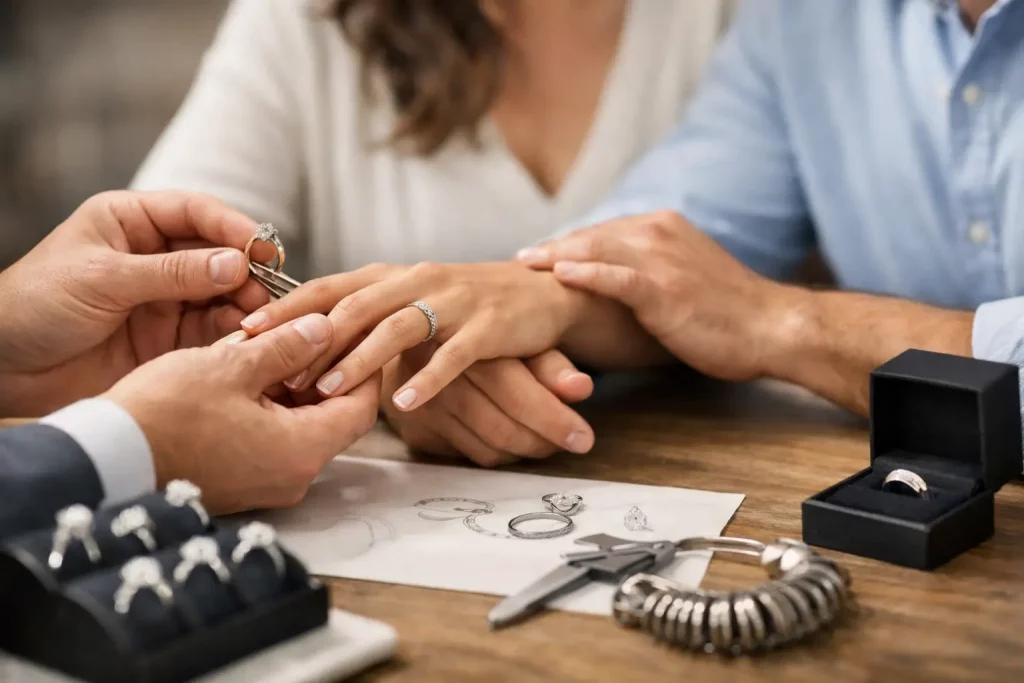
The simplest route is to begin with a proper conversation, not a rushed display-case decision. Share reference images if you have them, but also explain what you like about each one. Is it the shape, the texture, the vintage feel, or the way it sits with another ring? This gives the designer more useful information than a photograph alone.
From there, expect to discuss your engagement ring, preferred metal, ring size, practical needs and budget. A considered proposal or design sketch should make the concept easy to understand before the ring is made. If something feels too ornate, too delicate or not quite like you, say so. The advantage of a bespoke ring is that the details can be refined before they become permanent.
At BWR London, this one-to-one approach is central to the experience. Clients can begin from a completely blank page, provide inspiration images, or bring an existing engagement ring to create a wedding band that has been designed around it. The process is personal because the ring is personal.
Do not overlook the sentimental details
The smallest decisions often become the most cherished. An engraving can hold a wedding date, initials, a private phrase, a line from a song or even the coordinates of where you met. You may choose a hidden gemstone on the inside of the band, use a birthstone, or rework a diamond from a family ring into a design you will wear every day.
Heirloom adaptations need thoughtful handling. Older jewellery may have stones that can be reset, while the metal itself may not always be suitable for melting and remaking. A specialist can assess what is safely possible and suggest ways to retain the story without compromising the strength of the new ring.
There is also value in restraint. You do not need to include every meaningful idea in one band. One beautifully placed detail, chosen with care, can say more than a design crowded with symbols.
Give yourself permission to choose differently
Wedding traditions can be helpful, but they are not design rules. Your rings do not have to match each other exactly. You do not have to choose diamonds. You do not have to wear the same metal as your partner, and you do not have to buy a pre-made band simply because the wedding date is approaching.
A custom wedding ring is your chance to make a practical piece of jewellery feel deeply considered. Bring the photographs, the family story, the engagement ring that needs an unusual curve, or simply a feeling you cannot quite put into words. A good jeweller will listen closely, ask the right questions and help turn that starting point into a ring you will be glad to wear every day.