

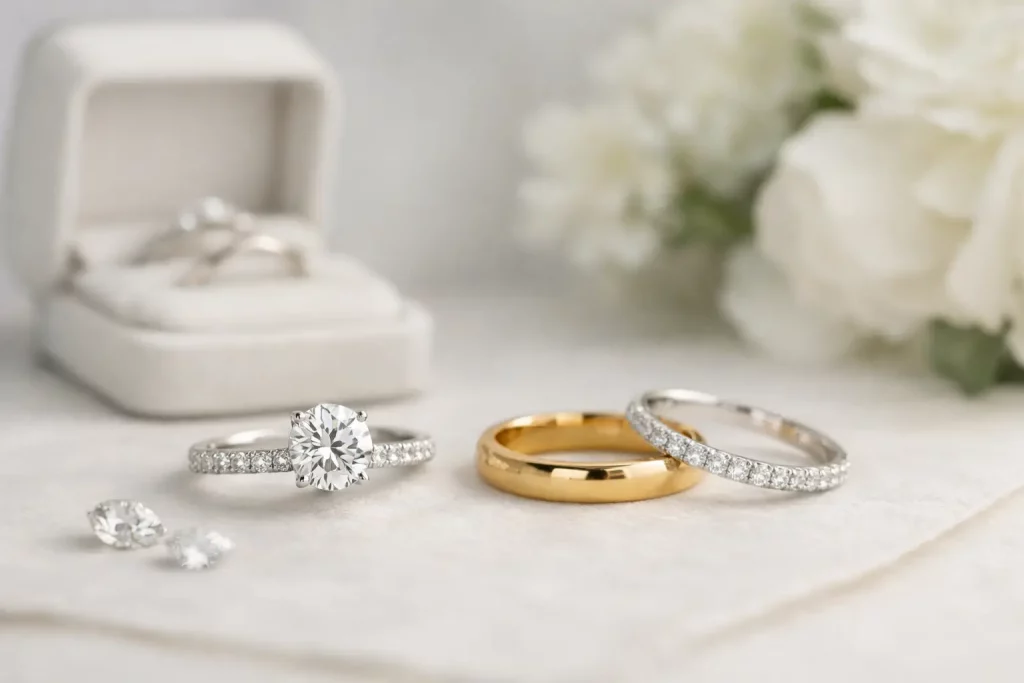
A wedding band may be the quieter half of your ring set, but it changes how your engagement ring looks, feels and sits on your hand every day. Knowing how to match wedding band styles to an engagement ring is less about following a fixed rule and more about finding the balance that feels natural to you. Some couples want a perfectly flush, coordinated set. Others prefer a little contrast, space or texture between the two rings.
The best match considers more than appearance. Your ring should be comfortable enough for real life, secure around delicate settings and meaningful in its own right. Whether your engagement ring is a classic solitaire, a vintage heirloom or an unusual bespoke design, there is usually a beautiful way to pair it.
Start with the way your engagement ring sits
Before choosing a band, look closely at the profile of your engagement ring. The profile is the view from the side, and it tells you whether a straight wedding ring can sit close to the setting.
A high-set solitaire often has enough clearance for a plain, straight band to tuck neatly underneath the centre stone. This creates the traditional joined-up look many people imagine when they picture a bridal set. Low-set rings, prominent galleries and stones that extend beyond the band can make this harder. If you force a straight band against these designs, it may leave a noticeable gap or push against the setting.
Neither result is wrong. A gap can be intentional and give each ring room to stand out. However, if you would like the rings to sit closely together, a shaped-to-fit wedding band is usually the most considered solution. It can be gently curved, notched, pointed or contoured around the engagement ring, following its individual outline rather than asking the engagement ring to behave like a standard design.
Decide whether you want flush, fitted or spaced
There are three common ways to wear a wedding band alongside an engagement ring. A flush fit means the rings sit directly beside one another with little or no space. A fitted look uses a shaped band to create that close connection around the setting. A spaced look leaves a deliberate sliver of skin or air between the rings.
Flush and fitted styles feel tidy and cohesive, but they can require a custom-made band, particularly with halo, trilogy, pear, marquise or cluster engagement rings. A spaced pairing can be more flexible, often allowing a straight band, and has a softer, more individual look. The right choice comes down to what you enjoy seeing on your hand, not what is most conventional.
How to match a wedding band by metal and colour
Matching metals is the simplest route, but it is not the only route. If your engagement ring is platinum, a platinum wedding band gives a cool, consistent tone and similar wearing qualities. Yellow gold beside yellow gold feels warm and classic, while rose gold creates a romantic, softly coloured set.
That said, mixed-metal rings can look especially personal. A yellow gold engagement ring paired with a platinum or white gold band can make the centre stone appear brighter, while a rose gold band adds warmth beside a white metal setting. The key is to make the contrast look deliberate. Repeating a small detail, such as the same finish, diamond setting or band width, helps the two rings belong together.
Consider wear as well as colour. Platinum is naturally white and develops a gentle patina over time. White gold is usually rhodium plated and may need replating occasionally to retain its bright finish. Gold is available in different carats, with higher-carat gold generally softer than lower-carat alloys. When rings rub together daily, choosing materials with similar durability can help reduce uneven wear, although careful design and regular checks matter just as much.
Match the proportions, not only the design
A wedding band does not need to copy the engagement ring exactly. In fact, two identical rings can sometimes compete for attention. What matters most is proportion.
Look at the width of the engagement-ring shank. A very slim band often pairs beautifully with a slim wedding ring, while a substantial engagement band may need a little more weight beside it to avoid looking unbalanced. This does not mean the widths must match millimetre for millimetre. A delicate diamond band can make a wider solitaire band feel lighter, and a plain gold band can ground a detailed engagement ring.
The height of the rings matters too. If one ring sits much higher than the other, the combination can feel awkward against neighbouring fingers. A bespoke band can be made with a profile that complements the engagement ring, including a low, rounded comfort fit or a more defined flat edge.
Try on different widths if you can. A band that looks fine in a photograph may feel surprisingly substantial once it is next to your engagement ring. Your hand shape, finger length and the way you use your hands all influence what feels right.
Choose stones and details with everyday wear in mind
Diamond-set wedding bands are a lovely way to add sparkle, but the setting style should suit your lifestyle and engagement ring. A pavé or micro-set band gives a fine, continuous shimmer. Channel-set diamonds are protected by metal on both sides, creating a smoother surface. Bezel-set stones offer a clean, modern look with excellent protection.
If your engagement ring has a diamond-set shank, you might choose a plain band to let it remain the focal point, or continue the diamonds for a more glamorous paired effect. Both approaches work. The more practical question is whether the stones sit where the two rings touch. Diamonds are hard and can gradually wear against softer metal, so a jeweller should assess the contact points rather than simply placing two rings together.
Small details can create a more personal match without making the set overly busy. A milgrain edge can echo a vintage engagement ring. A brushed finish can contrast beautifully with a polished setting. An engraved wedding band can carry a private message, date or pattern that belongs to the two of you, even if it is only visible when the ring is removed.
When a shaped wedding band is the better answer
A shaped band is not a compromise for a difficult engagement ring. It is a design choice that can make an unusual ring feel even more special. Curved bands work well around round solitaires and halos. Wishbone or chevron bands create a point beneath the centre stone and can lengthen the appearance of the finger. More complex contours can be made around asymmetric stones, ornate settings and heirloom rings.
The benefit of a custom shape is precision. Rather than guessing from measurements or selecting the nearest ready-made curve, the band can be designed around your actual ring. This is particularly reassuring when an engagement ring has sentimental value or a delicate setting that you do not want another ring pressing against.
There is a trade-off: a tightly shaped band may look most complete beside the engagement ring and less conventional when worn alone. If wearing your wedding band by itself matters to you for work, travel or certain occasions, mention this early in the design process. A gentler curve, a symmetrical contour or a design with a strong standalone presence may give you more versatility.
Think about comfort before the wedding day
Your wedding band will be worn through busy mornings, holidays, handwashing, exercise and all the unremarkable moments that become part of married life. Comfort deserves as much attention as sparkle.
A court-shaped or comfort-fit interior is softly rounded inside the band, which many people find easier to wear. A flat profile feels more contemporary but can be less forgiving depending on the width and your finger shape. Make sure the rings can move naturally without pinching, spinning excessively or catching against one another.
Finger size can change with temperature, pregnancy, travel and daily activity. It is wise to have a professional sizing consultation and to try your engagement ring on at the same time. The perfect band should not only fit your finger – it should fit the reality of wearing both rings together.
Bring the engagement ring into the conversation
The most reliable way to find your match is to show the engagement ring to the person designing the band. Clear photographs can be a helpful starting point, especially a view from the top and side, but seeing the ring in person allows for accurate measurements, careful assessment of stone placement and a more confident fit.
At BWR London, the process can begin with your existing ring, a reference image or simply an idea of how you want the set to feel. You may discover that the band you first imagined is exactly right. Or you may find that a subtle contour, a different width or a hidden engraving makes it feel far more like yours.
Give yourself permission to take your time with the choice. The wedding band is not there merely to complete a set; it is a daily reminder of a promise, designed to sit comfortably beside the ring that began the story.