

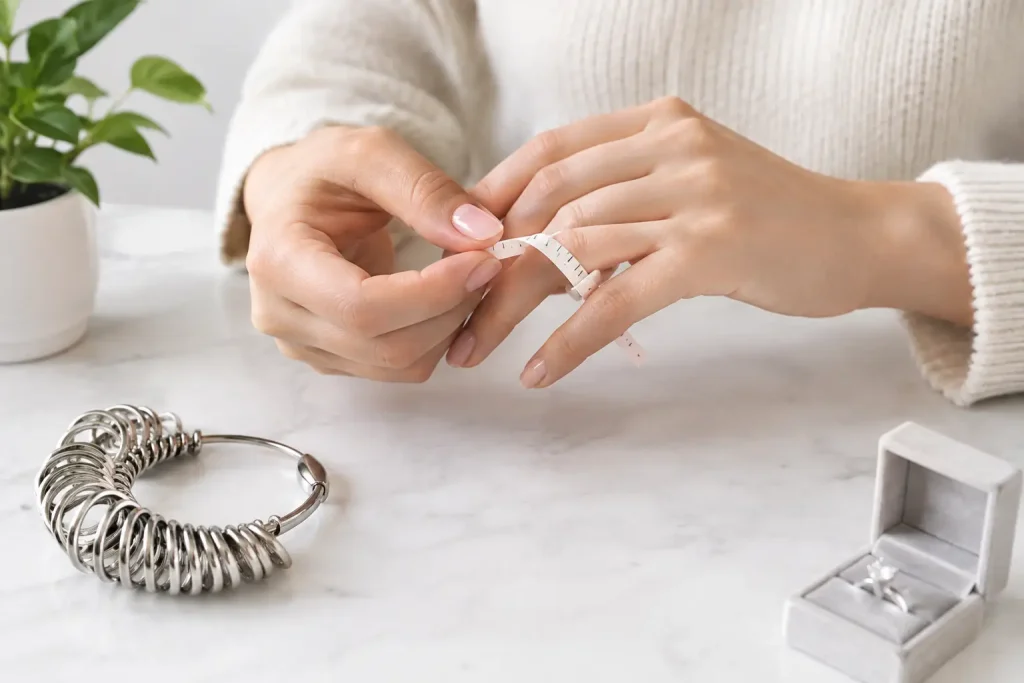
A wedding ring should feel like it belongs on your hand from the first moment you wear it. Knowing how to measure ring size accurately is a valuable starting point, but a truly comfortable fit also depends on the ring’s width, profile, design and the natural changes in your fingers throughout the day.
This matters even more when you are choosing a wedding band to sit alongside an engagement ring. A curved, shaped or wider band can fit differently from a slim straight ring, even when both are technically the same size. Taking a little care now helps avoid a ring that spins, pinches or needs altering after one of the most meaningful purchases you will make.
How to measure ring size at home
The simplest home method is to measure a ring that already fits the intended finger well. Lay it flat on a ruler and measure the inside diameter from one inner edge to the other, in millimetres. It is important to measure the open space inside the band, rather than the outside edges of the metal.
Compare that measurement with a UK ring size chart. As a general guide, an inside diameter of around 16.5mm is commonly close to a UK M, while 17.3mm is around an O. Ring charts vary slightly, so treat a home measurement as a helpful indication rather than a final verdict, particularly for a bespoke ring.
If there is no existing ring to use, wrap a narrow strip of paper around the base of the finger. Mark the point where it overlaps, then lay the paper flat and measure its length in millimetres. This gives the finger circumference, which can also be matched to a UK size chart.
Avoid pulling the paper tightly. It should sit against the skin without digging in, much like a ring that is secure but still able to move over the knuckle. A loose loop will produce a size that feels comfortable at first but may turn constantly once you are wearing the ring.
String can work in a pinch, but paper is usually more reliable because string stretches. Never use a tape measure with a thick or rigid edge, as it can add unnecessary millimetres and distort the result.
Measure more than once
Finger size is not fixed. Warm weather, exercise, salt, alcohol, travelling and even the time of day can make fingers swell slightly. Measure at least two or three times over different days, ideally in the late afternoon or evening when your hands are at a normal temperature.
Do not measure when your hands are very cold, just after a workout, or immediately after a hot bath. In these moments, your fingers may be temporarily smaller or larger than usual. If your results sit between sizes, that is useful information to share with your jeweller rather than a reason to guess.
Why ring width changes the fit
A slim 2mm wedding band and a 6mm band do not feel the same on the finger. Wider rings cover more skin, creating more resistance as they pass over the knuckle. For this reason, some people need a slightly larger size for a broad wedding ring than for a delicate engagement ring.
The inner profile matters too. A comfort-fit band has a gently rounded interior, which often makes a wider ring easier to wear. A flat interior gives a more traditional feel but can feel firmer, especially on hands with more prominent knuckles.
This is one of the reasons an exact number alone cannot tell the whole story. When a ring is made to order, the width, depth, edges and interior profile should all be considered alongside the size. The goal is not merely for the ring to go on, but for it to remain comfortable through ordinary life.
Measuring for a wedding band beside an engagement ring
If your wedding ring will be worn next to an engagement ring, measure with the engagement ring on whenever possible. The two rings share the same space on the finger, and the way they sit together can affect comfort.
A straight wedding band may leave a visible gap beside a setting that sits low or has a prominent centre stone. Some couples love that contrast. Others prefer a shaped-to-fit band that follows the engagement ring’s contours closely. Neither is inherently better, but the choice affects how the rings need to be measured, designed and tried on.
For a shaped band, an in-person fitting or a close inspection of the engagement ring is especially helpful. The curve needs to be designed around the exact shape, height and setting of your ring. A ring that looks right in a photograph may not sit flush in real life, particularly if the engagement ring has an unusual setting, side stones or a detailed basket underneath.
At BWR London, this is where a one-to-one consultation can make the process feel much less uncertain. Bringing in the engagement ring, or sharing clear reference images and measurements, gives the design process a more accurate foundation from the start.
Think about your knuckle
Some fingers are fairly even from base to knuckle. Others have a noticeably larger knuckle, meaning the ring needs enough room to pass over it but should not feel loose once it reaches the base of the finger.
For this shape of hand, sizing is a balance. A jeweller may recommend a particular profile, a carefully judged size adjustment, or in some cases a design solution that makes daily wear easier. It depends on the difference between the knuckle and the base of the finger, as well as the width of the finished band.
What a well-fitting ring should feel like
A well-fitted ring should slide over the knuckle with gentle resistance. Once in place, it should feel secure without leaving a deep indentation or causing discomfort. A little movement is normal, especially in colder conditions, but the ring should not spin freely every time you move your hand.
You should also be able to remove it without a struggle. If it requires soap, cold water or considerable force on an ordinary day, it is too tight. If it slips off when you wash your hands or points stone-side down most of the time, it may be too loose.
Remember that a newly fitted ring can feel unfamiliar simply because you are not used to wearing one. Give yourself a few minutes to notice pressure points, how it sits beside your engagement ring and whether it catches on clothing. Comfort is a practical issue, but it is also personal. Some people prefer a close fit, while others like a little more freedom.
When to ask a jeweller to check your size
Home measuring is useful for an initial conversation, a surprise proposal or narrowing down your options. It is less reliable when the ring is wide, heavily shaped, designed to stack, or intended for a finger with a large knuckle.
Professional sizing allows you to try several ring sizers in different widths. This gives a far more realistic sense of how your chosen design will feel. It is particularly worthwhile if you are investing in engraving, diamonds, heirloom metal or a bespoke shape, where resizing later could be more involved.
If you are ordering for someone else, discreetly borrowing a ring can help, but only if it is worn on the same finger of the same hand. Fingers on the dominant hand are often slightly larger. A ring from the right ring finger is not a dependable guide for the left ring finger, so leave room for a professional check before finalising the design where possible.
A final word before you choose
Your ring size is a detail, but it supports a lifetime of daily wear. Take measurements carefully, allow for the design you truly want and be honest about what feels comfortable on your hand. The best wedding ring is not simply one that fits a chart. It is one that feels considered, personal and easy to wear as your story continues.