

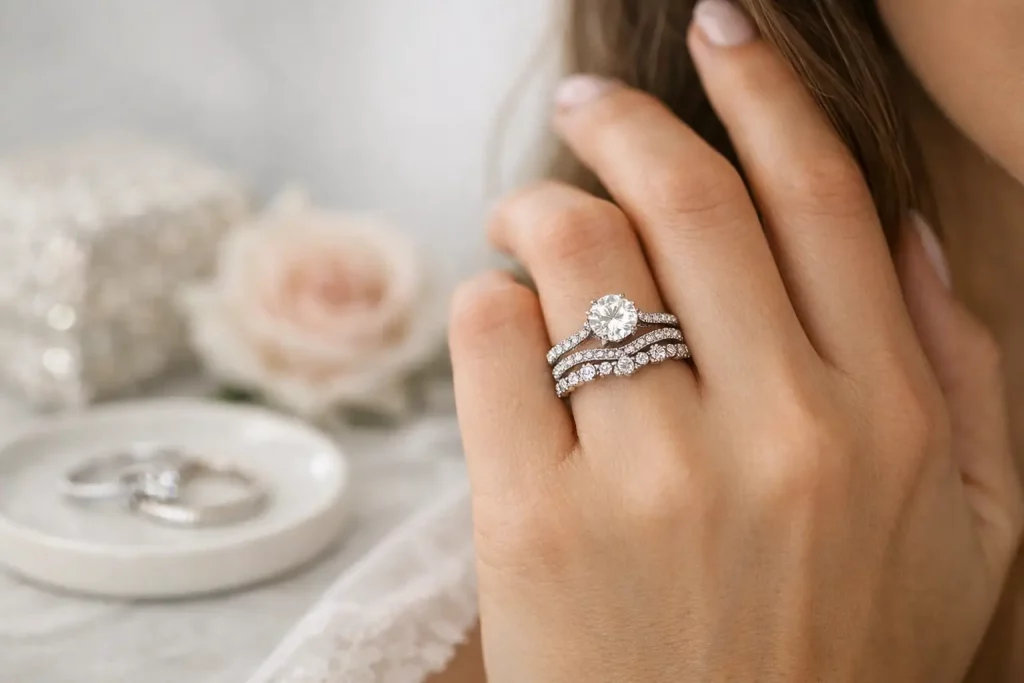
Your wedding ring does not need to sit beside your engagement ring as an afterthought. When you stack wedding rings thoughtfully, the two pieces can feel like they were always meant to be together: balanced, comfortable and completely personal to you. The key is not following a fixed rule, but understanding what will work with your existing ring, your hands and the life you live every day.
For some couples, that means a simple, close-fitting band that lets the engagement ring take centre stage. For others, it means texture, diamonds, a coloured stone, an engraving or a second band added for a future anniversary. A well-considered stack should feel special on the wedding day and just as easy to wear while making breakfast, typing, travelling or holding hands.
Stack wedding rings by starting with the engagement ring
Your engagement ring sets the practical boundaries for the stack. Before falling in love with a wedding band style, look closely at the setting, the height of the centre stone and how the ring sits against your finger. A low-set solitaire may allow a straight wedding band to sit neatly alongside it, while a prominent setting, pear, oval, marquise or trilogy design may need a shaped band to avoid an unwanted gap.
A gap is not automatically a problem. Some people love the lightness and definition it creates. But if you want the rings to sit flush, it is worth having the engagement ring assessed properly rather than guessing from photographs. Tiny details beneath the centre stone, such as the gallery or setting basket, can determine whether a band will fit comfortably.
This is where a bespoke approach makes a real difference. A wedding ring can be shaped around your engagement ring rather than asking you to compromise with a standard design. The curve can be subtle or dramatic, and it can follow the exact outline of your stone while still looking beautiful worn on its own.
Choose a shape that feels intentional
A shaped wedding band is often described as a wishbone, curved, chevron, fitted or notched ring. These terms are useful starting points, but they do not all mean the same thing. A V-shaped wishbone creates a distinct point beneath the engagement ring. A soft curve gently hugs a rounded centre stone. A deeper notch can accommodate a low setting without pushing either ring out of place.
The most flattering option depends on the engagement ring and your own taste. A fine curved band can make a large centre stone appear even more prominent. A wider, sculptural shaped ring may create a stronger, more contemporary look. Neither is better – it depends on whether you want visual contrast or a quieter, closely matched set.
Try not to judge the shape only from an overhead view. Ask to see how it looks from the side and how it feels when you close your hand. A design that looks perfect in a tray can feel too high, too pointed or too delicate once it is on your finger. Comfort is part of the design, not a finishing touch.
Match metals, or create a considered contrast
Matching the metal of your engagement ring is the most traditional choice, and it creates a calm, cohesive result. A platinum engagement ring with a platinum wedding band, for example, will develop and wear at a similar rate. Yellow gold and rose gold bands can also be made to sit beautifully against a matching engagement ring.
Mixed-metal stacks can be equally meaningful. A yellow gold band next to a platinum engagement ring gives clear contrast and can tie in with jewellery you already wear. The important part is that the contrast looks chosen, rather than accidental. Repeating one element, such as a yellow gold edge, a shared engraving style or similar band proportions, can bring the stack together.
Do consider wear over time. Different precious metals have different characteristics, and rings that rub constantly against one another may show marks sooner. A skilled jeweller can advise on metal combinations, edge profiles and spacing so your rings remain comfortable and beautifully proportioned through everyday wear.
Balance width, height and sparkle
A successful ring stack has visual balance. If your engagement ring has a delicate 1.5mm band, a very wide wedding ring may overpower it. That does not mean both bands need to be identical. In fact, a slight difference in width can look more natural and give each ring its own presence.
Diamond-set bands are a popular way to add light without changing the overall silhouette. A fine pavé band can echo the brilliance of a diamond engagement ring, while a channel-set or bead-set design offers a more defined line of sparkle. If your engagement ring already has diamonds along the shoulders, a plain polished band may provide the contrast the set needs.
Think about stone settings as well as stone size. Raised claws and exposed diamonds can sometimes catch against another ring. A lower-profile setting may be the more practical choice for someone who works with their hands, has young children or simply prefers jewellery that asks for less attention during the day.
Let the wedding band tell its own story
The wedding ring is the piece you are most likely to wear every day, so it deserves its own meaning. An engraving can hold a date, initials, a line from a song, a private phrase or coordinates that matter to you both. It is a small detail, but one that turns a beautiful ring into something unmistakably yours.
You might also incorporate heirloom gold or gemstones from a family piece. This can be a lovely way to carry a connection forward, although the original jewellery should be assessed before it is altered. Not every antique setting is suitable for remodelling, and sometimes preserving the original piece while taking inspiration from it is the better decision.
At BWR London, the design conversation often begins with the ring you already have and the story you want the new piece to carry. Reference images are helpful, but they are only the starting point. The finished band should suit your engagement ring, your comfort preferences and the details that matter to you as a couple.
Plan for the stack you may want later
You do not need to buy every ring at once. Many people begin with an engagement ring and wedding band, then add an eternity ring to mark an anniversary, a milestone or the arrival of a child. Leaving a little room visually and physically can make future additions easier.
If you think you may build a wider stack over time, mention it during the wedding ring design process. The jeweller can consider how a future ring might sit beside your current set, whether a shaped band will still work and how the widths will look together. Planning ahead does not make the choice less romantic. It gives you more freedom to let your jewellery grow with your life.
There is also no requirement to wear every ring on the same finger. Some prefer an eternity ring on the opposite hand, particularly if their engagement ring and wedding band are already detailed. Your most meaningful arrangement is the one you genuinely enjoy wearing.
Try the full set before making it final
Photographs can show style, but they cannot tell you whether the rings spin, pinch or sit comfortably when your fingers change size during the day. Try on the engagement ring and wedding band together, and take a few moments to move naturally. Notice whether the rings sit in line, whether the stones catch and whether the combined width feels right.
Sizing also needs extra care with shaped bands. Depending on the curve and the width of the ring, the size that feels right may differ from a simple straight band. A personal fitting gives you the reassurance that the rings will not only look right in the box, but feel right for the years ahead.
The loveliest stacks are rarely the ones that follow a trend exactly. They are the ones that honour the engagement ring you chose, fit your hand with ease and carry the details that make the set feel entirely yours.