

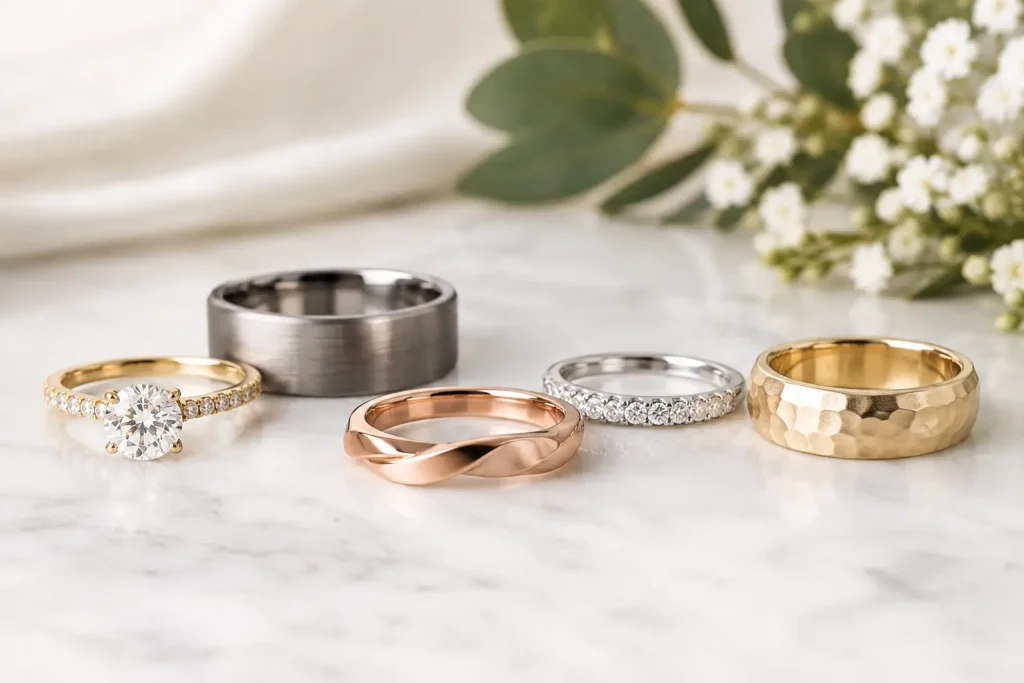
A wedding ring is one of the few things you will wear every day long after the table plans, flowers and first-dance song have become treasured memories. That is why modern wedding ring styles are less about following a passing trend and more about finding a design that feels right on your hand, alongside your engagement ring and within your real life.
For some couples, that means a clean, pared-back band with exceptional proportions. For others, it is a shaped ring that follows every curve of an existing setting, a hidden engraving only the two of you will know about, or a combination of metals that makes an heirloom feel newly yours. The most successful modern designs leave room for personality as well as practicality.
Modern wedding ring styles that feel personal
The modern wedding band has moved well beyond the idea that everyone should choose the same plain, polished gold ring. Classic bands still have enormous appeal, but contemporary choices make space for texture, shape, colour and thoughtful details. The key is choosing features that you will still enjoy seeing years from now.
Sculptural shaped-to-fit bands
A shaped wedding ring is often the answer when an engagement ring has a low setting, an unusually shaped centre stone, or a distinctive cluster or halo. Rather than leaving a noticeable gap, the band can be designed to sit neatly around the setting. It may have a gentle curve, a deeper wishbone, an angular notch or an entirely individual outline.
This is one of the most meaningful forms of custom design because it is made in response to your own ring, not selected from a standard tray. A close fit can make the two rings feel intentionally paired, while still allowing each one its own character.
There is a practical decision to make here. A very close contour creates a beautifully unified look, but it can be less versatile if you later want to wear the wedding ring alone. A softer curve can offer more flexibility. Trying on samples, or discussing how you plan to wear your rings day to day, helps make that choice clearer.
Soft curves and wishbone profiles
Wishbone and chevron bands remain popular because they bring shape without overwhelming an engagement ring. Their pointed profile can frame a solitaire beautifully, draw attention to an oval or pear-shaped stone, or add a little architectural interest to a simple stack.
Modern versions are often subtler than the dramatic chevrons of the past. Think low, soft points, gently rounded edges and fine proportions that sit comfortably against the finger. A wishbone can be plain, diamond-set, engraved or finished in a contrasting metal, depending on whether you want it to blend in or stand out.
Mixed metals with intention
Mixing yellow gold, white gold, rose gold and platinum is no longer a rule-breaking choice. It is a thoughtful way to create contrast, especially when your engagement ring and other jewellery already include different tones.
A yellow gold wedding band beside a platinum engagement ring can make both pieces feel distinct. A slim rose gold detail can add warmth without changing the overall look. The important point is that metal choice affects more than colour. Platinum is naturally white and reassuringly substantial, while gold offers a range of tones and carats. Your lifestyle, budget and preference for patina should all be part of the conversation.
Fine diamonds and discreet sparkle
A diamond-set wedding ring does not have to mean a full, high-shine eternity band. Modern designs often use a delicate row of stones across the top of the band, scattered diamonds placed with a lighter touch, or tiny flush-set stones that sit within the metal.
A half-set band is practical for many people because the diamonds are visible from above while the plain underside can be resized more easily in future. Full eternity styles can look wonderful, but they are harder to alter and may not suit every budget or working routine. If you use your hands a great deal, a lower setting or channel-set design may offer better protection than raised claws.
Texture over ornament
Not every distinctive ring needs a gemstone. Brushed, satin, hammered and lightly patterned finishes bring depth to a simple band and can make a wide ring feel less formal. A softly brushed finish has a quiet, contemporary quality, while a hand-hammered surface catches the light in an organic way.
Texture does evolve with wear, which is part of its charm for many couples. Polished metal will also pick up fine marks over time. Neither is a failure of the ring: they are signs of a piece being lived in. The difference is whether you prefer a finish that highlights those changes or one that disguises them.
Choosing a style around your engagement ring
When your wedding ring will be worn beside an engagement ring, the pair should be considered together from the start. It is tempting to focus only on the wedding band, but width, height, metal tone and stone placement all affect how the rings sit as a set.
A delicate engagement ring may benefit from a narrow band that echoes its fine proportions. A substantial solitaire can carry a wider wedding ring, perhaps with a matte finish or subtle diamonds. If the engagement ring already has plenty of detail, a plain shaped band may give the set breathing room. Equally, a minimal solitaire can be a perfect canvas for an expressive wedding ring.
Bring the engagement ring to every fitting if possible. Photographs are useful, particularly when you are beginning a conversation remotely, but seeing the ring in person allows the fit and profile to be assessed properly. The aim is not always a perfect flush fit. Sometimes a small, deliberate gap looks better and protects delicate settings from rubbing together.
Comfort matters as much as appearance
A wedding ring can look beautiful in a photograph and still feel wrong after a full day. Comfort-fit profiles, which are gently rounded on the inside, are a popular choice for wider bands and for anyone who is not used to wearing rings. Rounded outside edges tend to feel softer too, while a flatter profile creates a sharper, more graphic look.
Ring width is equally personal. A 2mm band can feel refined and understated, while a 5mm or 6mm design has more presence and gives texture or engraving room to shine. There is no universally flattering width. Hands, fingers, engagement-ring proportions and personal style all matter more than a trend.
It is also worth thinking ahead. Fingers can change with temperature, pregnancy, exercise and time. A design that allows for future resizing may be reassuring, particularly if you are considering a full eternity setting or an intricate patterned band.
The details that make a ring yours
The smallest personal touches often become the details couples value most. An engraving can hold a date, initials, a short phrase, a private joke or a line in a loved one’s handwriting. A tiny hidden gemstone can represent a birth month, a place or a person. Metal from a family ring may be incorporated into a new design, allowing an heirloom to remain part of your story in a form you can wear every day.
These choices do not need to be visible to anyone else to matter. In fact, many of the most personal rings appear simple at first glance. Their significance is held in the fit, the material and the details known by the people wearing them.
A calmer way to choose your wedding rings
You do not need to arrive with a finished design in mind. A screenshot, a photograph of your engagement ring, a sense that you want something less traditional, or simply an idea of budget is enough to begin. A good consultation should make the process feel less daunting, not more complicated.
At BWR London, every bespoke conversation starts with how you want the ring to look, feel and fit into your life. From there, the design can be shaped around your engagement ring, preferred metal, comfort requirements and meaningful details. You remain involved without being left to make technical decisions alone.
Give yourself permission to choose the ring you will genuinely enjoy wearing, rather than the one you think a wedding ring is supposed to be. The right design will feel considered from every angle, but most of all, it will feel like it belongs to you.