

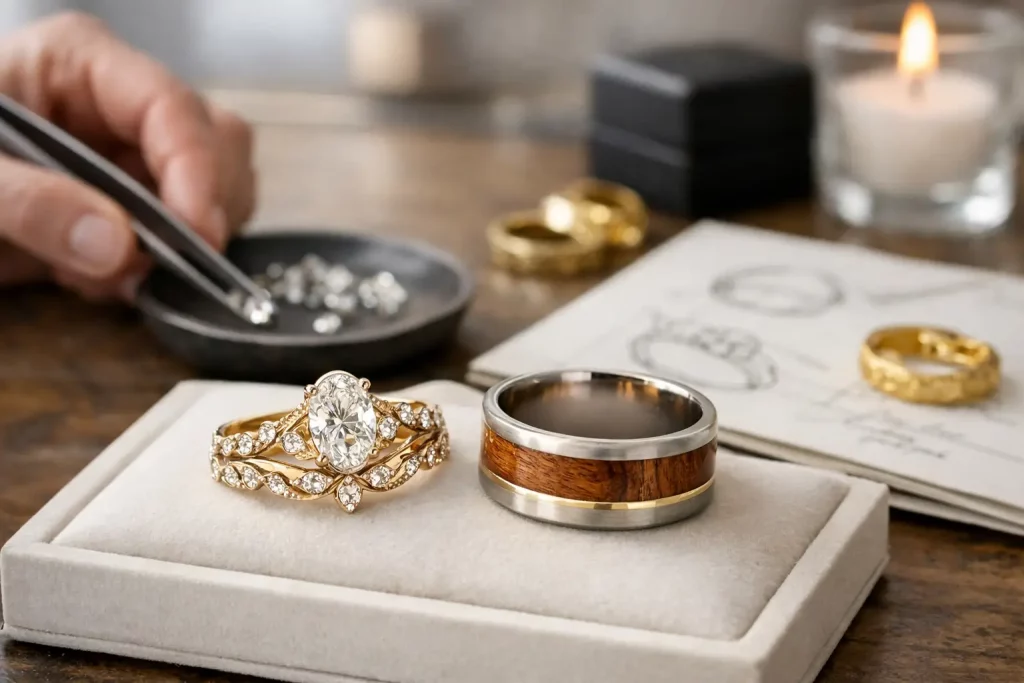
Your wedding ring will be there for the quiet moments as much as the photographs: making tea, holding hands, carrying bags, and marking every ordinary day after the celebration. That is why the question, what are bespoke wedding rings, is about far more than choosing a style. It is about creating a ring that feels comfortable, meaningful and completely yours.
A bespoke wedding ring is designed around you rather than selected from a standard range. You may begin with a sketch, a saved image, a much-loved family piece, or an engagement ring that needs a perfectly fitted partner. With expert guidance, those ideas become a ring made to suit your hand, lifestyle and story.
What are bespoke wedding rings?
Bespoke wedding rings are made to individual specifications, rather than chosen off the shelf in a fixed design, width and size. The process is collaborative. You decide what matters most, and a jeweller helps turn those preferences into a considered design.
That could mean a classic yellow gold band in an exact width, a wedding ring curved around an unusual engagement-ring setting, or a design with diamonds placed in a particular pattern. It might be a slim, low-profile band for someone who works with their hands, or a weightier ring with a soft court profile for a substantial, traditional feel.
The word bespoke can mean different things between jewellers, so it is worth asking what is genuinely custom. A fully bespoke ring is usually designed and made for you, with choices over metal, profile, proportions, finish, stones and personal details. Some jewellers also offer made-to-order versions of existing styles. Both can be lovely options, but they offer different degrees of freedom.
Why couples choose a custom-made ring
The strongest reason is often fit. Engagement rings with prominent settings, oval or pear-shaped stones, vintage clusters, or intricate galleries do not always sit neatly beside a straight wedding band. A bespoke shaped-to-fit ring is carefully contoured around the engagement ring, allowing the two to sit together with minimal gap and without forcing either ring out of position.
That does not mean every wedding ring needs to touch the engagement ring. Some people prefer a deliberate gap, especially if they like the contrast between two distinct designs. The right choice is the one that looks balanced to you and feels easy to wear. Seeing the rings together during the design process removes much of the guesswork.
Personal meaning is another reason to go bespoke. A date, handwriting sample, private phrase or initials can be engraved inside the band. An heirloom diamond may be reset into a new design, allowing a family story to continue in a ring you will actually wear. You can also choose details that are meaningful without being immediately visible: a hidden stone, a particular number of diamonds, or a finish that recalls another piece of jewellery.
There is also the simple pleasure of having a ring that is not a compromise. Standard wedding bands are useful for inspiration, but they cannot anticipate every preference. With a bespoke design, the width can be adjusted by a fraction, the edges softened, the curve refined, and the overall look matched to your engagement ring and personal style.
The details that make the design yours
A wedding ring may look simple, yet its comfort and character depend on a number of small choices. Your jeweller should talk you through them in plain language rather than expecting you to know the terminology.
Metal and colour
Yellow gold, white gold, rose gold and platinum all offer a different appearance and wearing experience. Platinum is naturally white, dense and durable, while gold allows for a warmer colour and a range of carats. Mixing metals can create a beautiful contrast, particularly where the wedding ring is designed to complement an engagement ring in another colour.
The best metal is not always the one that matches exactly. A white metal engagement ring alongside a warm yellow gold wedding band can look intentional and modern. Equally, matching metals may give a more traditional, joined-up appearance. Think about the jewellery you already wear, not just the ring in its box.
Profile, width and comfort
Profile describes the shape of the ring across its surface. A traditional court band is rounded inside and out, while a flat band has a cleaner, more contemporary line. There are also softly rounded, bevelled and knife-edge options. The inner profile matters just as much as the outside, especially if you plan to wear your ring all day.
A few millimetres can change the whole feel of a wedding band. A narrow ring may look delicate beside a fine engagement ring, whereas a wider band can create a confident, architectural contrast. Trying proportions alongside your engagement ring is often more useful than choosing based on a photograph alone.
Stones, texture and finishing
Diamonds can be set all the way around the band, across the top, or in subtle sections. A full eternity style is striking, but it can be harder to resize later. A part-set design may offer more flexibility while still giving you the sparkle you love.
Finishes are equally personal. High polish catches the light, while a brushed, satin or hammered finish has a softer texture and can disguise small everyday marks. None is automatically better. Consider how you want the ring to look after months and years of wear, not only on collection day.
How the bespoke process works
A good bespoke experience should feel exciting, not intimidating. It normally begins with a conversation about your engagement ring, preferences, budget and timescale. Bring your engagement ring where possible, or share clear photographs from several angles if you are starting remotely. Reference images are helpful too, even when you are unsure what you like about them.
From there, the design is developed around the details that matter. For a shaped wedding ring, the engagement ring can be measured so the curve follows its setting accurately. For an heirloom redesign, the stones and metal can be assessed before deciding what can be reused and what may need to be added.
You should have an opportunity to understand the proposed shape, dimensions and cost before the ring is made. Ask questions about the fit, whether future resizing is likely to be possible, and how the design will sit against your engagement ring. A thoughtful jeweller will welcome those questions and explain any trade-offs honestly.
At BWR London, this one-to-one approach is central to the experience: you can begin from scratch, share inspiration, or create a shaped band around the ring you already have. The aim is not to rush you towards a stock answer, but to make the decision feel clear and personal.
Are bespoke wedding rings more expensive?
They can be, but bespoke does not automatically mean extravagant. Cost depends primarily on the metal, ring weight, width, stone choice, setting style and complexity of the design. A simple custom gold band may be close in price to a premium ready-made ring, while a diamond-set, intricately shaped design will require more time and materials.
Being open about your budget early is one of the most useful things you can do. It lets the design focus on what you value most. Perhaps the perfect fit around your engagement ring matters more than adding extra diamonds. Perhaps you would rather choose a wider plain platinum band than a thinner diamond-set option. Good design is about prioritising, not being persuaded into features you do not want.
It is also sensible to consider future practicality. Full eternity rings, very delicate bands and highly detailed settings can involve limitations around resizing or repair. That does not make them poor choices, but it is better to know the implications before you commit.
Questions worth asking before you begin
Before commissioning a bespoke ring, ask how the wedding band will be fitted against your engagement ring, whether you will see a design proposal or sample, and what aftercare is available. If diamonds or other gemstones are involved, ask about their sourcing and quality. If you are remodelling family jewellery, ask which elements can be retained and whether there are any risks in working with older stones.
You may also want to ask about lead times. Bespoke rings need time for design, making and final checks, particularly during busy wedding periods. Starting early gives you more room to consider options calmly and avoids turning a meaningful purchase into a last-minute task.
A bespoke wedding ring is not valuable simply because it is custom-made. Its value comes from the thought behind it: the way it fits your engagement ring, your hand and the life you are building together. Start with the details that matter to you, then let an experienced maker help you shape them into something you will be glad to wear every day.