

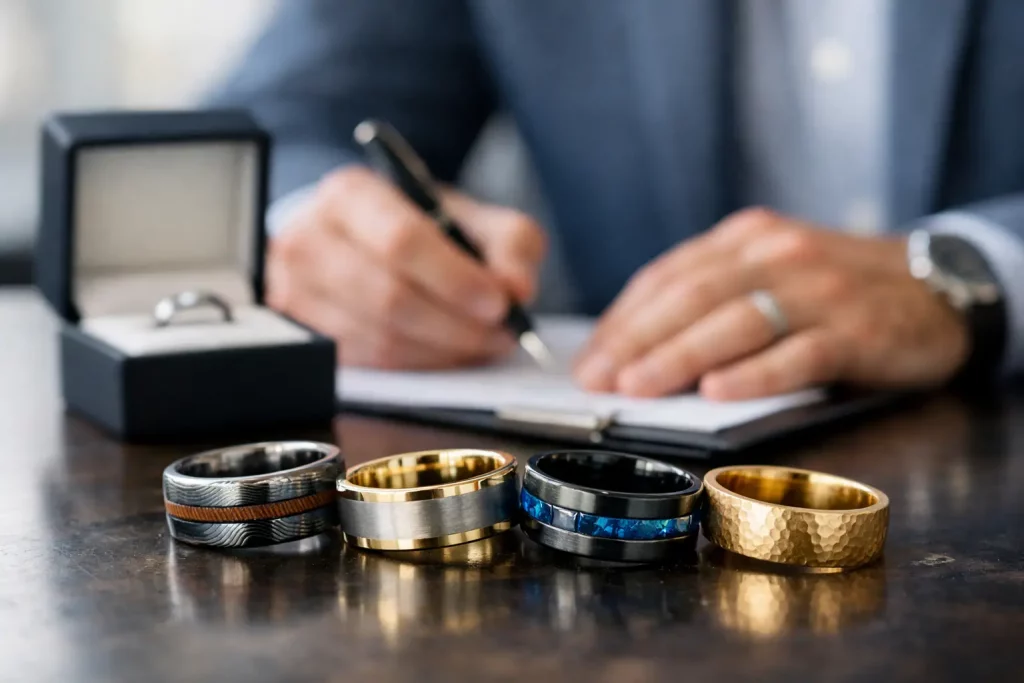
A wedding ring can look simple from across a room, yet the one on your hand needs to feel right every single day. The best custom men’s wedding rings are not chosen from a display case because they are labelled “for him”. They are designed around the person wearing them: their hands, their work, their style, their story and the kind of comfort they expect from a ring they may never take off.
For some, that means a quiet, beautifully weighted gold band with a private engraving. For others, it means an unusual profile, a combination of metals, a subtle diamond, or a design that incorporates a meaningful element from family jewellery. Custom gives you room to make those decisions properly, with guidance rather than pressure.
What makes a custom men’s wedding ring the right choice?
A bespoke wedding ring should be more than an alternative to a standard band. It should solve the details that ready-made rings cannot always account for. Perhaps you have broad knuckles but narrower fingers, want a low-profile ring for an active job, or have a particular finish in mind that you have not seen in person. These are all useful starting points for a custom design.
The most meaningful designs often begin with something personal rather than a fixed idea of what a men’s ring ought to look like. A favourite watch, a family signet, the texture of a place you both love, or a small section of inherited gold can inspire a ring without making it feel overly elaborate. The result can still be understated. Personal does not have to mean conspicuous.
Custom work is also particularly valuable when you are choosing rings as a couple. Your bands do not need to match exactly, but shared details can create a connection: the same metal, a matching edge profile, a hidden engraving or two different interpretations of one design idea.
Start with daily life, not a metal sample
The best ring on paper can be the wrong ring for the life you lead. Before looking at finishes or stones, think honestly about how your hands are used. Someone working with tools, lifting weights, playing an instrument or regularly removing gloves may need a different width, profile and surface finish from someone whose ring will have a gentler daily routine.
A low, rounded profile tends to be practical and comfortable, especially if you are new to wearing rings. A more substantial flat band can feel striking and contemporary, but its edges and weight should be considered carefully. Comfort-fit interiors, which are gently rounded on the inside, are popular for good reason: they make a wider or heavier ring easier to wear and remove.
Width changes the character of a ring dramatically. A 3 mm band can feel refined and discreet, while 6 mm or 7 mm makes a stronger statement. Hand size matters, but there is no universal rule. Trying on a range of widths is far more useful than assuming that a wider finger always needs a wider ring.
Choose metal for wear as well as colour
Metal is one of the first decisions couples ask about, but it is best made after discussing lifestyle and preferences. Yellow gold has warmth and a classic quality that works beautifully in polished, brushed and textured finishes. White gold offers a clean, cooler appearance and may need occasional rhodium plating to retain its bright white surface. Rose gold feels softer and distinctive, although its copper content can make it a less obvious choice for anyone with metal sensitivities.
Platinum is naturally white, dense and reassuringly substantial. Over time it develops a soft patina rather than losing material through wear, though it can still collect surface marks. Its weight is part of its appeal for many people, but not everyone enjoys a heavier feel.
There are trade-offs in every choice. A polished finish will show fine scratches sooner than a brushed one, while a brushed surface may need refreshing if you want to maintain a crisp, even texture. The aim is not to avoid signs of life altogether. It is to select a ring whose ageing process you will be happy to see.
Details that make the best custom men’s wedding rings personal
The most successful bespoke details are often the ones the wearer notices first. An engraving inside the band can hold a date, initials, a short phrase, coordinates, handwriting or a line that only makes sense to the two of you. It turns an outwardly simple ring into something intensely private.
Texture can be equally personal. A fine hammered finish catches the light differently every time the hand moves. A satin finish has a calm, modern look. Milgrain edging can add a gentle vintage reference, while a hand-engraved pattern can echo an heirloom piece without copying it exactly.
Stones can be included with restraint. A single flush-set diamond, sapphire or birthstone brings a small point of colour without affecting the practicality of the band. For a ring worn daily, the setting needs to be considered as carefully as the stone itself. Flush settings sit level with the surface, making them a sensible option when a smooth finish matters.
If you have inherited jewellery, a bespoke ring may offer a thoughtful way to carry that history forward. In some cases, an existing stone can be reset. In others, the original metal may be unsuitable to reuse directly but can still inspire the new design. A specialist can assess what is realistic before any promises are made, protecting both the material and its sentimental value.
Fit is a design decision, not an afterthought
A ring size is not completely fixed. Fingers change through the day and across the seasons, responding to warmth, exercise, travel and even salt intake. That is why a careful fitting conversation matters. It is also why ordering in haste, especially from a generic size chart, can create unnecessary stress.
The ideal fit should pass over the knuckle with gentle resistance, then sit securely without pinching or spinning constantly. Wider rings often feel tighter than slim ones in the same size, so the final design should be accounted for when sizing. If you are between sizes, a bespoke jeweller can advise on small adjustments rather than forcing a choice that does not feel right.
Resizing should be discussed before the ring is made. Plain precious-metal bands are generally more straightforward to alter than designs with full-set stones, intricate patterns running all the way around, mixed metals or inlaid materials. That does not mean you should avoid those features. It simply means they deserve an informed decision from the beginning.
Bring references, questions and an open mind
You do not need to arrive at a consultation with a finished sketch. A screenshot, photograph, saved image, description of a finish, or even a ring you dislike can help establish direction. The useful part is explaining why you are drawn to it. Is it the colour, the shape, the texture, the proportion or the way it looks beside your partner’s ring?
A good bespoke process should feel clear at each stage. You should understand the proposed metal, dimensions, finish, engraving, timeline and cost before the ring goes into production. Ask to compare samples where possible, particularly for widths, profiles and metal colours. Tiny differences are difficult to judge from images alone, but immediately apparent when tried on.
Budget should be part of the conversation early, not a source of embarrassment. Custom does not mean there is only one price point. Adjusting width, metal weight, stone choice or complexity can often preserve the heart of a design while bringing it into a comfortable range. The priority is to make thoughtful choices, not to add detail simply because it is available.
A ring that feels like it was always yours
At BWR London, the process is built around listening first, whether you are starting from scratch, bringing reference images or hoping to honour an existing piece of family jewellery. One-to-one guidance makes space for the practical questions as well as the sentimental ones, so the finished ring feels considered rather than complicated.
Give yourselves time to handle different samples, talk through the details and imagine the ring on an ordinary Tuesday as clearly as on your wedding day. The right custom band will not need to compete for attention. It will simply feel familiar, comfortable and quietly yours from the moment you put it on.