

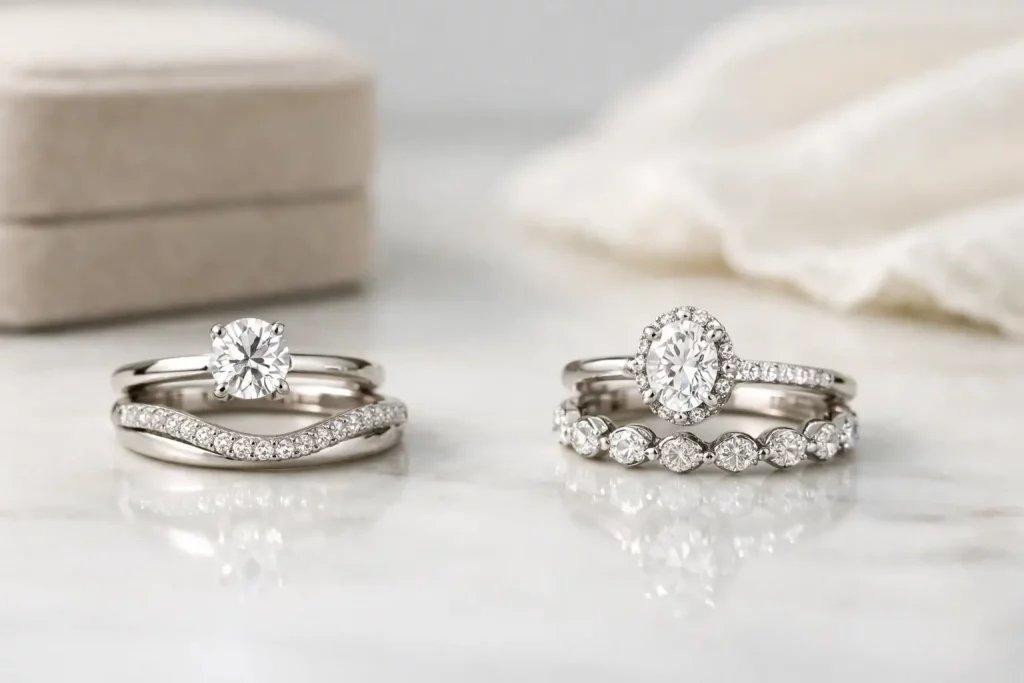
Your wedding band should not feel like an afterthought beside the ring that started it all. The best engagement ring matching band examples show that a beautifully coordinated set is not always about making two rings look identical. It is about proportion, comfort and choosing details that make sense for the way you wear your jewellery every day.
Some engagement rings sit neatly against a straight band. Others need a gentle curve, a deeper contour or a completely bespoke shape to avoid a gap. There is no single right answer, but seeing the possibilities can make choosing your wedding ring feel far less overwhelming.
Engagement ring matching band examples for every setting
A classic solitaire with a straight wedding band
A solitaire engagement ring with a raised setting is often the easiest style to pair. If the centre stone sits high enough above the finger, a plain straight wedding band can rest flush against it, creating a clean and timeless stack. This is a lovely choice for someone who wants the engagement ring to remain the focal point while the wedding band adds quiet significance.
A polished plain band is beautifully understated, while a diamond-set band brings extra light around the centre stone. Matching the width of the wedding band to the engagement ring shank creates a balanced look, but it is not a rule. A slightly finer band can feel delicate and feminine; a wider band can make the set feel more substantial and contemporary.
A low-set solitaire with a shaped band
Not every solitaire is raised high enough for a straight ring to sit flush. If the setting has a low basket or a prominent gallery beneath the stone, a shaped-to-fit wedding band is often the more comfortable and considered option.
A soft wishbone or shallow curve can follow the outline of the setting while keeping the rings close together. The result looks intentional rather than forced, and it avoids the small gap that can collect soap, hand cream and everyday debris. The curve does not need to be dramatic. Often, a subtle contour is all that is needed to make the two rings sit naturally side by side.
A halo engagement ring with a contoured diamond band
Halo rings have plenty of presence, so the matching wedding band needs to support the design without competing with it. A slim pavé band with a gentle contour is a popular choice, especially when it follows the round, oval or cushion-shaped outline of the halo.
For a more seamless look, diamonds can be selected to match the size and setting style of the engagement ring’s shoulder stones. For more contrast, a plain precious-metal contour gives the halo room to shine. Both approaches work well. It depends on whether you love a fully sparkling stack or prefer a little visual breathing space between the diamonds.
An oval engagement ring with a wishbone band
An oval diamond is elegant from every angle, but its elongated shape can make a standard straight band sit awkwardly if the setting is low. A wishbone wedding ring creates a flattering frame around the oval, with a gentle point that nestles beneath the centre stone.
This is one of the most versatile engagement ring matching band examples because the wishbone can be subtle or pronounced. A fine plain V-shaped band feels modern and minimal. A diamond-set wishbone brings a romantic, bridal finish. If you are considering an enhancer-style look, two matching wishbone bands worn above and below the engagement ring can create a striking symmetrical stack, although it is worth thinking about whether you will enjoy wearing three rings every day.
A pear or marquise ring with an asymmetric curve
Pear and marquise diamonds are wonderfully individual, particularly when set north to south with the pointed end facing the fingertip. Their shape can call for a wedding band with a little more personality than a standard curve.
An asymmetric contour can trace one side of the centre setting, while a softly curved band may sit beneath the point. This is where bespoke design is especially valuable: the band can be made around the exact profile of your engagement ring rather than approximated from a photograph. The aim is not to hide the unusual shape, but to celebrate it.
A trilogy ring with a shaped diamond band
Trilogy engagement rings have sentimental appeal, often representing a couple’s past, present and future. Because three-stone settings can be wider across the finger and lower at the sides, a shaped wedding band is often the most natural companion.
A contoured diamond band can mirror the sweep of the side stones, creating an elegant line of sparkle around the setting. If your engagement ring already has detailed claws, milgrain edges or diamond shoulders, consider keeping the wedding band slightly simpler. A matching set should feel connected, not overly busy.
A vintage-inspired ring with a detailed companion band
Engagement rings with ornate galleries, engraving, milgrain or floral details deserve a wedding band with equal thought behind it. A plain fitted band can offer a calm contrast, while a hand-engraved contour can continue the decorative story.
It is also possible to echo a small detail rather than copy the whole design. For example, a wedding band might repeat the milgrain edge of an engagement ring, use a similar leaf motif, or include a tiny hidden engraving that only the wearer knows is there. These personal touches often matter more than a perfect visual match.
Choosing a matching band: flush fit is not the only goal
A flush fit is satisfying, but it is not essential. Some couples genuinely prefer a small, deliberate gap between their rings, especially if the engagement ring has a distinctive setting that deserves to stand alone. A straight band can also be easier to resize in future than a heavily shaped one, although this depends on the design and metal.
Comfort should always have a place in the decision. Try to consider how the rings will feel when you are typing, carrying bags, exercising or putting on gloves. A very deep curve may look perfect from above but can feel less balanced if it twists on the finger. The best design is one you will be happy to wear on an ordinary Tuesday, not just in photographs.
Metal choice matters too. Matching metals gives a cohesive, traditional look, whether that is platinum, yellow gold, rose gold or white gold. Mixing metals can be equally beautiful, especially if you want the wedding ring to bring warmth to a platinum engagement ring or tie in with jewellery you already wear. The key is making the combination look deliberate.
Why a bespoke shaped band makes a difference
Ready-made wedding bands are designed to suit many rings. A bespoke shaped band is made for yours. Your jeweller can work from the engagement ring itself, checking its height, setting, width and every small curve so the finished band feels properly considered.
This is particularly reassuring for rings with unusual settings, inherited stones or sentimental details. Rather than compromising with a band that nearly fits, you can choose the profile, width, diamond coverage, metal and finish around your own priorities. A comfort-fit interior, a meaningful engraving or a discreet gemstone on the inside of the shank can make the ring feel even more personal.
At BWR London, the process can begin with your existing engagement ring, a few reference images or simply an idea of how you want the finished set to feel. One-to-one guidance makes space for practical questions as well as the exciting ones, so you are not expected to know the jewellery terminology before you begin.
Bring your rings together in a way that feels like you
The most successful matching band is not necessarily the one that disappears beside the engagement ring. It is the one that feels comfortable, meaningful and completely at home on your hand. Whether that means a crisp straight band, a diamond-set wishbone or a contour shaped around every detail of your setting, give yourself permission to choose the version that makes you smile each time you look down at it.