

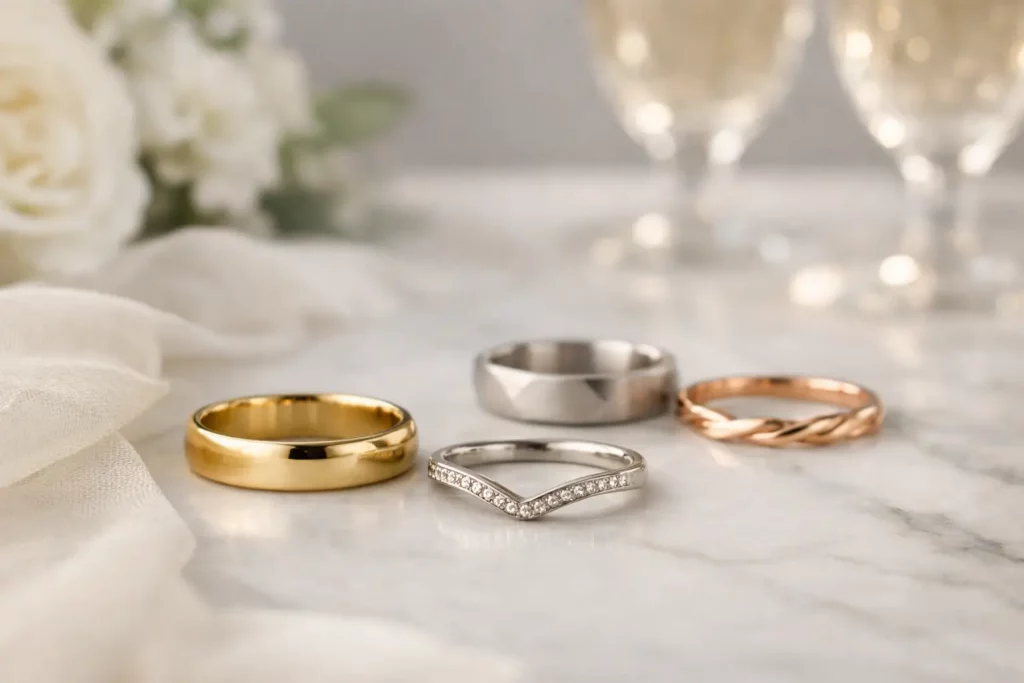
The moment you place a straight wedding ring beside a beautifully detailed engagement ring and see a gap, the choice of band shape becomes much more than a style decision. This guide to wedding band shapes is designed to make that choice feel clear, personal and reassuring – whether you love a perfectly flush fit, a little breathing room between rings, or a design unlike anyone else’s.
Your wedding band will be worn every day, often next to the engagement ring that already means so much to you. The right shape should honour that ring, suit your hand, and feel comfortable enough to forget you are wearing it.
Why wedding band shape matters
A wedding band is not simply a smaller ring that sits beside an engagement ring. Its profile, curve and depth affect how the two rings look and feel together. A band that is technically the right finger size can still rub against the setting, spin uncomfortably, or leave an unexpected gap if its shape has not been considered carefully.
For some couples, that gap is part of the look. A fine straight band paired with a solitaire can feel light, modern and intentional. For others, particularly where an engagement ring has a low setting, prominent centre stone or shaped shoulders, a fitted band creates the satisfying impression of one considered set.
There is no universally correct answer. The best choice depends on the engagement ring, your everyday routine, how you like rings to sit on your hand, and the story you want the pair to tell.
Guide to wedding band shapes: the main options
Straight wedding bands
A straight band follows a classic, even circle. It is wonderfully versatile on its own and works especially well beside engagement rings with a raised setting that leaves enough clearance underneath the centre stone.
Straight bands can be slim and delicate, broad and substantial, plain, diamond-set, engraved or textured. Their simplicity is their strength: they are timeless, easy to wear and can be worn alone if you need to leave your engagement ring safely at home for work, travel or sport.
The trade-off is that a straight band may not sit flush against a low-set engagement ring. Before choosing one, place a sample band beside your ring and look at it from above and from the side. A visible gap is not a fault, but it should be a choice you genuinely enjoy.
Curved wedding bands
A curved band has a gentle sweep at the front, allowing it to nestle around the centre setting of an engagement ring. It is often the answer when a straight ring would press against the setting or sit too far away.
The curve can be subtle, with only a slight dip, or more pronounced for a larger stone or a lower basket. Curved bands feel romantic and balanced, particularly when the curve mirrors the rounded outline of an oval, pear or round centre stone.
A gentle curve may also suit someone who wants the appearance of a close fit without making the wedding ring look overtly shaped when worn on its own. The key is proportion. Too shallow a curve may still leave the rings touching in the wrong place, while too deep a curve can look disconnected from the engagement ring.
Wishbone and chevron bands
Wishbone bands form a soft V at the front, while chevron bands usually have a sharper, more defined point. Both create space for the centre of an engagement ring and bring a little more character than a simple curved design.
These shapes are especially lovely with pear, marquise and oval stones, or with engagement rings that have a pointed or tapered detail. A diamond-set wishbone can draw the eye towards the centre stone, while a plain polished version offers a crisp, contemporary contrast.
The point needs careful placement. It should sit comfortably beneath or around the engagement-ring setting rather than pushing into it. This is where trying a ring against the real engagement ring, rather than judging from a photograph, makes all the difference.
Contoured and shaped-to-fit bands
A contoured band follows the actual outline of an engagement ring. It may curve around a halo, dip beneath a setting, flow around side stones or accommodate an unusually shaped centre stone. These are often called fitted wedding bands, shaped wedding rings or shaped-to-fit bands.
This option is ideal when your engagement ring has an intricate setting, sits low on the finger, or has a distinctive silhouette you do not want to compromise. It can create a close, polished fit that makes the two rings feel designed together from the beginning.
Because the shape is made for a particular ring, it is worth thinking about the future too. If you expect to wear the band alone regularly, discuss how it will look independently. A well-designed fitted ring should still feel like a beautiful piece in its own right, not an incomplete half of a set.
Open and notched bands
An open band has a deliberate gap at the front, while a notched band includes a small cut-out to make room for the engagement-ring setting. Both can be practical solutions for rings with a very low or wide centre setting.
These designs have a contemporary, airy feel and can make an engagement ring appear more prominent. They are also useful where creating a full contour would require an extreme curve. However, the open area can catch on clothing depending on the design, and the exposed ends need to be finished with comfort in mind.
Wrap and enhancer styles
Wrap bands curve around either side of the engagement ring, sometimes with diamonds or decorative details that frame the centre stone. They offer a more statement-making look and can add width, sparkle and visual symmetry to a simple solitaire.
These are best approached as a complete design rather than an afterthought. The proportions must work with the engagement ring, especially if it has delicate claws or side stones. A wrap that is too close can cause unwanted contact, while one that sits too wide can overpower the original ring.
How to choose a shape for your engagement ring
Start with the setting, not just the stone. Two oval engagement rings may need entirely different wedding band shapes if one has a high cathedral setting and the other has a low basket. Look at where the ring touches your finger, how far the centre setting extends across the band, and whether there are side stones, a halo or decorative shoulders to work around.
Then consider how you want the rings to behave day to day. If you prefer them to sit completely together, a bespoke contour may be the most comfortable choice. If you enjoy mixing rings, a straight band or a gentle wishbone gives more flexibility. If you work with your hands, comfort-fit interiors and a lower-profile design may matter as much as the view from above.
Width is just as important as shape. A very fine curved ring can disappear beside a substantial engagement ring, while a wide fitted band may make a delicate centre stone appear smaller. Trying different widths in proportion to your existing ring helps you find a balance that looks intentional rather than crowded.
Why a bespoke fit can be worth it
Ready-made shaped bands are useful for inspiration, but they are made to suit a general outline. An individual engagement ring has its own measurements, setting height and details. Even a small difference can affect whether the rings sit neatly together.
A bespoke process allows the shape to be created around your ring, while leaving room for the choices that make it yours: metal colour, diamond coverage, engraving, a hidden stone, a meaningful texture or an heirloom diamond worked into the design. At BWR London, that conversation begins with listening to how you wear your jewellery and what you want the finished pair to feel like, not simply selecting the nearest available shape.
If you cannot bring your engagement ring to an appointment, clear photographs from above and side-on can help start the discussion. For the closest possible fit, though, working from the ring itself gives the maker the information needed to account for every curve and clearance point.
A few practical details before you decide
Ask whether the two rings will rub together. Metal-on-metal contact can gradually wear away polished surfaces, and diamonds set very close to another band can create friction. A tiny planned gap or a carefully adjusted contour may protect both rings better than forcing a flush fit.
Think about resizing as well. Straight bands are generally the simplest to alter, while heavily diamond-set, deeply contoured or open designs may have more limitations. This does not mean you should avoid a shaped ring you love, only that it is wise to understand the construction before committing.
Finally, give yourself permission to choose the look that feels right rather than the one you think you ought to want. Some people want an exact, puzzle-piece fit. Others fall in love with the softness of a small gap, the drama of a chevron, or the individuality of an open band. The most meaningful wedding ring is the one that feels naturally at home beside your engagement ring and on your hand.