

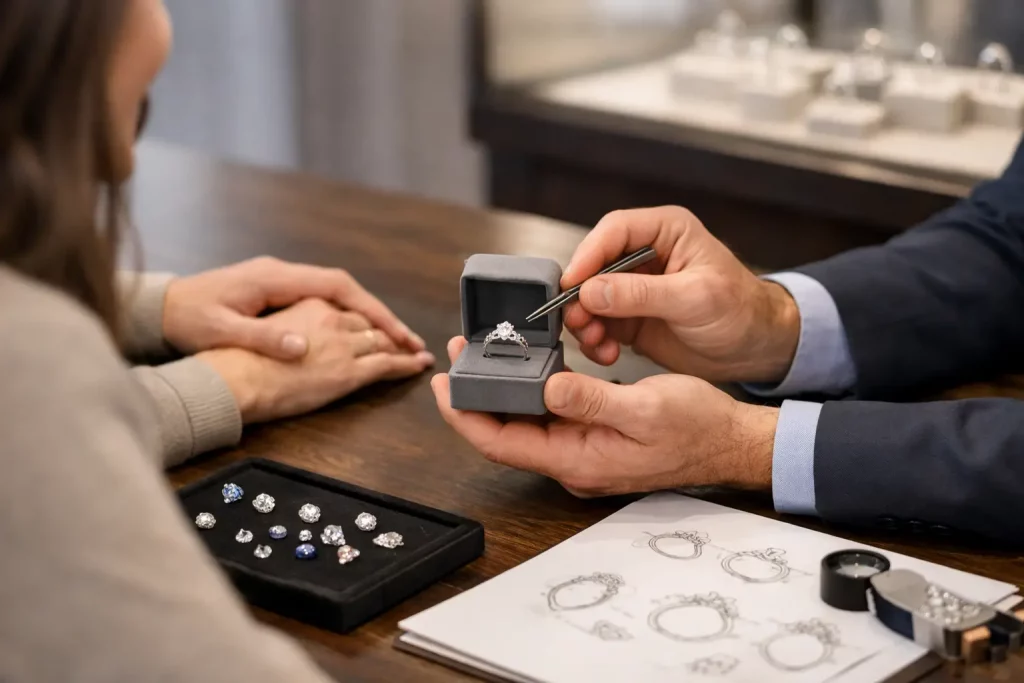
Your engagement ring may sit high, have an unusual setting, or feature a stone shape that leaves no room for a straight band. That is exactly where a thoughtful conversation makes all the difference. This guide to custom ring consultations explains how a one-to-one appointment turns an idea, a much-loved ring, or even a saved photograph into a wedding band that feels made for you.
A bespoke consultation is not a test of how much you know about jewellery. It is a chance to be heard. Whether you know the exact profile, metal and engraving you want, or only know that standard wedding rings do not look right beside your engagement ring, an experienced jeweller should guide the process with patience and clarity.
What a custom ring consultation is really for
The best custom rings solve a personal problem rather than following a fixed template. Perhaps your engagement ring has a low, wide setting and needs a shaped-to-fit wedding band. Perhaps you would like to honour a family member with an heirloom stone, add a private inscription, or create a pair of bands that share one small design detail.
A consultation gives those ideas proper attention. Your jeweller will look at proportion, comfort, durability and the way the rings will sit together, then translate your preferences into a design that works in real life. It is about more than choosing something beautiful in a display case. It is about creating something you will be happy to wear every day.
For many couples, it is also reassuring to have honest advice before committing. A delicate design may be perfect for occasional wear but less practical for an active job. A very fitted band can create a lovely joined-up look with an engagement ring, while a small gap may offer more flexibility if either ring needs resizing in the future. There is rarely one correct answer, only the option that best suits your ring and your life.
How to prepare for your consultation
You do not need a finished design before you arrive. Bringing a few starting points helps, though. If you have an engagement ring already, bring it along so its setting, height, profile and proportions can be assessed properly. A photograph is useful for an initial enquiry, but seeing the ring in person is the most reliable way to plan a close fit.
Reference images are equally welcome. Save details rather than trying to find one image that captures everything: the soft curve of one band, the texture of another, a particular engraving style or the way diamonds are set. It can be helpful to say what you do not like too. A jeweller can often learn as much from your wish to avoid a chunky look or highly polished finish as from your favourite image.
Give some thought to everyday wear. Consider whether you work with your hands, exercise regularly, remove your rings often, or prefer jewellery that feels almost weightless. If you are choosing rings as a couple, it is worth discussing whether you want them to match exactly, share a metal or finish, or simply feel connected in a quieter way.
Finally, be open about your budget. This is not an awkward part of the conversation. It helps narrow the choices intelligently, from metal and ring width to diamond setting and engraving. A good bespoke service will explain where your budget has the greatest visual and practical impact, rather than steering you towards details that do not matter to you.
Your guide to custom ring consultations: what happens in the appointment
A consultation should feel calm, collaborative and unhurried. At BWR London, the focus is on understanding the story behind the ring as well as the specifications. The conversation usually begins with your existing jewellery, your ideas and how you want the finished piece to feel.
Looking at the engagement ring first
When a wedding band needs to sit alongside an engagement ring, the engagement ring leads the design. Your jeweller will examine its setting from every angle, noting where it sits against the finger and where a straight band may touch the setting or leave a gap.
A shaped band can follow the outline of the engagement ring with a gentle curve, a deeper contour or an entirely individual silhouette. The aim is not always to make the rings lock together with no space at all. Sometimes a tiny intentional gap protects delicate claws, makes cleaning easier and gives each ring room to sit naturally. Your jeweller should explain this trade-off clearly before anything is made.
Choosing width, profile and comfort
Small differences in width can change the entire balance of a ring stack. A narrow band may let an intricate engagement ring remain the focal point, while a wider band can give a simple solitaire more presence. Trying on sample widths and profiles is valuable because what looks subtle in a photograph can feel very different on your hand.
Profile matters too. A court-shaped interior is softly rounded for comfort, while a flatter band can offer a more contemporary look. Neither is automatically better. The right choice depends on your preferred style, finger shape and how noticeable you want the ring to feel during the day.
Selecting metal, stones and meaningful details
Your consultation is the time to discuss metal colour and durability. You may want a wedding band that matches your engagement ring exactly, or prefer a gentle contrast, such as warm yellow gold beside platinum. Matching is often the most traditional route, but mixed metals can look intentional and personal when the proportions are considered carefully.
Diamonds or coloured stones can be added as a delicate line, a scattering of light, or a hidden detail within the band. Ask how stones will sit against your engagement ring and whether they are suitable for daily wear. Full eternity styles can be striking, but they may be harder to resize than designs with stones across the top half only.
Engraving brings another layer of sentiment. A date, initials, a short phrase, a fingerprint motif or a line in your own handwriting can make a ring feel unmistakably yours. If you are adapting family jewellery, the consultation can also explore what is possible with inherited stones or gold. Sometimes the most meaningful option is to preserve the original material; in other cases, a new design that carries the memory forward will wear better for years to come.
Agreeing the design, budget and timing
Before the design is finalised, you should understand exactly what is being made. This includes the ring shape, width, metal, finish, stones, engraving and how it will relate to your engagement ring. If there is a design drawing, wax model or other visual reference, use it to ask questions. It is much easier to adjust a detail before production than after the ring is complete.
Timing deserves the same care. Bespoke rings are made to order, so allow enough time before the wedding for design approval, craftsmanship and any final checks. If your date is close, say so at the start. A specialist can advise honestly on what is achievable, rather than leaving you to worry later.
Questions worth asking your jeweller
Ask how the band will sit beside your engagement ring, whether it can be resized in future, and what care the chosen finish or stone setting will need. If you are considering an unusual shape, ask whether the rings should be stored together and whether repeated rubbing could affect either piece over time.
It is also sensible to ask what happens if the fit needs a small adjustment after collection. Fingers can change with temperature, travel and pregnancy, and a comfortable fit is central to enjoying your ring. Clear aftercare guidance is part of a considered bespoke experience, not an afterthought.
Do not be afraid to ask for an opinion. You may be torn between two widths, unsure whether an engraving is too personal to show, or worried that a shaped band will look too different when worn alone. A trusted jeweller will give a professional view while keeping the decision yours.
After the consultation: let the design settle
You may leave your appointment feeling certain, or you may need a day or two to reflect. Both are completely normal. Custom jewellery is personal, and taking a little time can help you notice what you keep coming back to: the comfort of one profile, the romance of an engraving, or the way a curved band completed your engagement ring.
When you are ready, choose the design that feels like it belongs to your hand and your story – not simply the one you think you are meant to choose. The right wedding ring should bring a small moment of recognition every time you look down at it.