

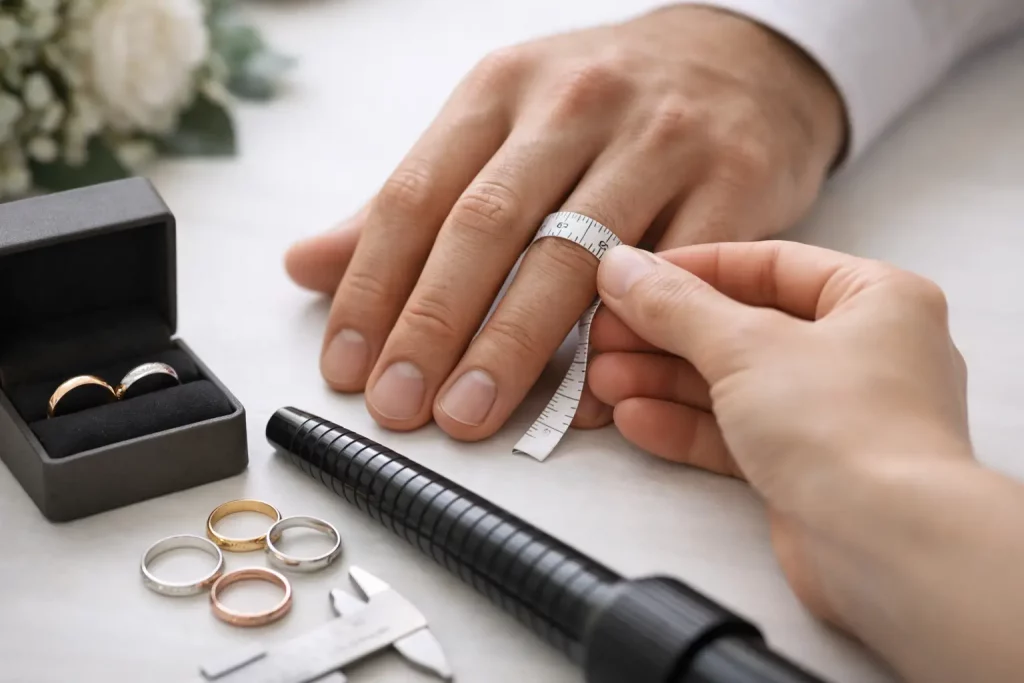
A wedding ring should feel so natural that you forget it is there – until you catch sight of it and remember what it represents. That is why taking the time to measure ring size properly matters. A ring that is too loose can turn round, catch on clothing or feel unsettlingly close to slipping off. One that is too tight can be uncomfortable, particularly on warm days or after a long flight.
For a plain, straight band, finding the right size is usually straightforward. For a shaped wedding ring designed around an engagement ring, there is a little more to consider. The aim is not only a number on a sizing chart. It is a comfortable fit, a beautiful join between both rings, and a result you will be happy to wear every day.
How to measure ring size accurately
The most reliable way to find your ring size is to visit a jeweller and be measured with professional ring sizers. They allow you to try a range of sizes and widths, so you can feel the difference rather than relying on a guess. This is particularly valuable when you are choosing a wedding band to sit beside an engagement ring.
Your finger size can change during the day. Hands are often slightly larger when you are warm, after exercise, after a salty meal, or during pregnancy. They may be smaller first thing in the morning or when you are cold. If possible, have your finger measured in the middle or later part of the day, when your hands are at a comfortable, normal temperature.
A good-fitting ring should slide over the knuckle with gentle resistance. Once it is in place, it should sit securely without pressing into the skin or feeling restrictive when you make a fist. If your knuckle is noticeably larger than the base of your finger, the right fit needs careful judgement. The ring must pass over the knuckle but not spin freely once worn.
Using a ring you already wear
If you already own a ring that fits the intended finger well, it can provide a useful starting point. Take it to a jeweller, who can measure its internal diameter and match it to an appropriate UK ring size. Be sure it is a ring worn on the same hand and finger. Many people have a small but meaningful difference between their left and right ring fingers.
This method is helpful, but it is not perfect for every wedding ring. A delicate 1.5 mm band and a substantial 5 mm band do not always feel the same in the same size. Wider rings cover more of the finger and can feel tighter, even when their internal measurement is identical. In that case, you may prefer a slightly larger size for comfort.
Can you measure at home?
At-home methods can be useful when you are beginning your search or arranging a surprise, but they should be treated as an estimate rather than the final word. Printed ring sizers and measuring strips are only as accurate as the printer settings, paper scale and the way they are used. A piece of string wrapped around the finger can also give a misleading result if it is pulled too tight or held too loosely.
If you do use an at-home guide, measure more than once at different times of day. Compare the result with a ring that already fits, where possible. If you land between two sizes, do not automatically choose the larger or smaller option. The width, profile and design of the finished wedding band all affect what will feel right.
For a bespoke piece, a conversation is often more useful than a number alone. Share what you are planning to wear, whether you prefer a close or relaxed fit, and whether your hands tend to swell. Those small details help a jeweller advise you with much greater confidence.
Measure ring size with your engagement ring in mind
A wedding ring is often chosen as part of a pair, not in isolation. If your engagement ring has a prominent setting, a low basket, an oval centre stone, a trilogy design or an unusual silhouette, a standard straight band may leave a gap. Some couples love that space. Others want both rings to sit neatly together, and a shaped-to-fit band is the answer.
The fitting process for a shaped band considers the engagement ring itself as well as your finger size. The curve, contour or notch in the wedding ring needs to follow the profile of the engagement ring without placing pressure on its setting. It also needs enough metal in the right places to remain strong and comfortable over years of wear.
This is why photographs can be helpful at the early design stage, but having the engagement ring available is best whenever possible. A jeweller can assess its exact dimensions, how high it sits from the finger, and where a fitted wedding band can rest. Even rings that appear similar in photographs can have quite different proportions in person.
If you cannot part with your engagement ring for long, there are still practical options. Detailed images from above and from the side, along with measurements, can help begin the conversation. The final fit should then be checked carefully before the wedding band is finished.
Ring width, profile and comfort make a difference
Two wedding rings in the same size can feel completely different. Width is one reason. A narrow band tends to feel light and unobtrusive, while a broader band has more contact with the finger. Many people find they need a little extra room in a wider style.
The inside profile matters too. A traditional flat interior gives a classic look, while a comfort-fit interior is gently rounded on the inside edge. This can make a wider wedding ring easier to put on and take off, especially if your knuckles are prominent. Neither is universally better – the right choice depends on the style you love and how you want the ring to feel.
Details such as engraving, milgrain edges, diamonds and a shaped contour should also be planned early. They are part of the design, not afterthoughts. An engraving can carry a private message, a meaningful date or a few words known only to the two of you. It deserves enough space and a suitable ring profile to be clear and enduring.
When should you be sized?
Ideally, arrange sizing once you have a good idea of the wedding ring style you want. If you are deciding between a slim diamond band and a wider shaped design, trying both is worthwhile before committing to a size. Your preferred fit may change as the design becomes clearer.
Allow enough time before the wedding. Bespoke rings are made with care, and any final fitting adjustments should not be left until the last week of planning. This is especially true when a band is being created to fit an engagement ring precisely, or when it includes stones, engraving or an intricate shape.
If you are ordering for someone else, discretion is possible, but accuracy takes more thought. Borrowing a ring they wear often can help, provided it is worn on the correct finger. Asking a close friend or family member to casually discover their size may be another option. Keep in mind that resizing is not equally simple for every design. Eternity-style diamond bands, patterned rings and complex fitted shapes can be more difficult to alter after they are made.
A bespoke fitting should feel reassuring
Choosing your wedding rings is personal. There is no need to know every measurement, metal or design term before you begin. A thoughtful jeweller should listen first: to how your engagement ring sits, what you want the pair to look like, your budget, and the details that matter to you both.
At BWR London, the process is built around that one-to-one guidance. Whether you arrive with a clear sketch, a few saved images, a family ring you hope to adapt, or simply a wish for your wedding band to fit beautifully alongside your engagement ring, the design can be shaped around your story.
The right size is not just the one that fits on the day you try it. It is the one that supports comfortable, confident wear through ordinary mornings, celebrations, hand-holding and every small moment that follows.