

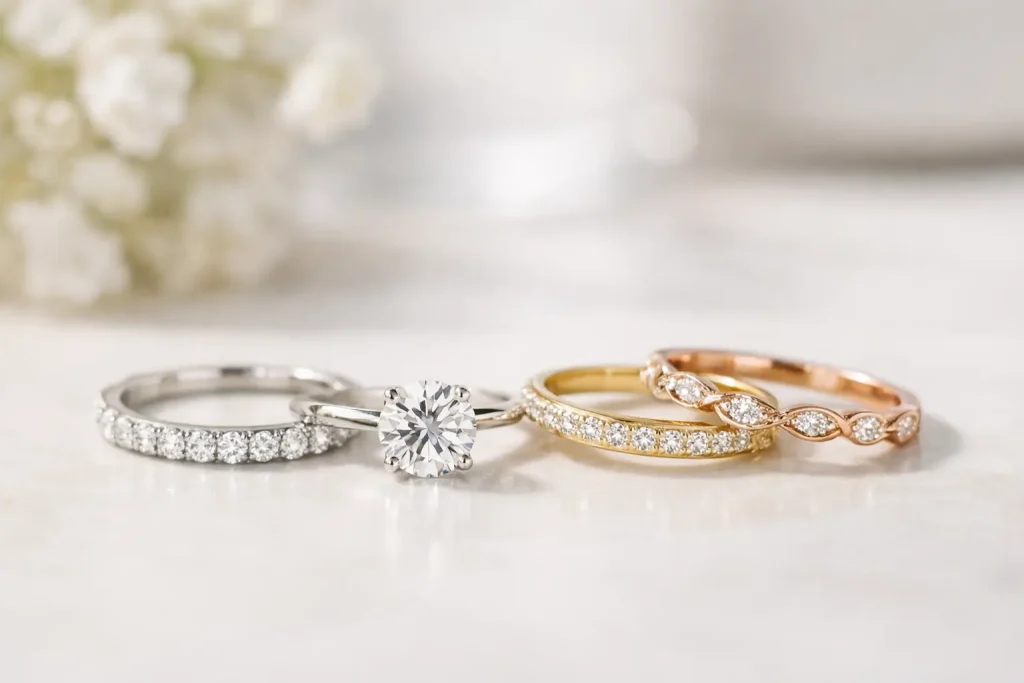
A solitaire engagement ring has a wonderful clarity to it: one central stone, chosen to hold the attention. Finding the best wedding bands for solitaire rings is therefore less about competing with that diamond and more about creating a pairing that feels intentional, comfortable and entirely yours. The right band can make a classic solitaire look even more refined, add a little sparkle, or solve the practical challenge of a setting that sits low on the finger.
There is no single best answer for every ring. The height of the setting, the shape and size of the centre stone, the metal colour, and how you want to wear your rings day to day all matter. A band that looks perfect beside one solitaire may leave an awkward gap beside another. That is why trying proportions carefully, or having a band made around your engagement ring, can make such a meaningful difference.
Best wedding bands for solitaire rings: start with the setting
Before falling in love with a band style, look at your engagement ring from the side. Is the centre stone raised on claws, held in a cathedral setting, or set low against the finger? A higher setting often gives a straight wedding band enough clearance to sit neatly beneath the diamond. A lower setting may mean a straight band presses against the setting, forcing the rings apart or causing unnecessary rubbing over time.
A small gap is not always a problem. Some couples prefer it because it lets each ring stand on its own, particularly with a delicate solitaire. But if you want the two rings to sit flush, a shaped-to-fit wedding band is often the most elegant solution. It can be gently curved, notched or contoured to follow the profile of your engagement ring without overwhelming it.
Bring the engagement ring into the decision from the beginning. Photographs are useful, but the exact position of the setting, the depth of the basket and even the shape of the shoulders affect the fit. A bespoke jeweller can measure around these details and create a band that looks considered from every angle.
The classic plain band
For many solitaire rings, a plain polished wedding band is the timeless choice. It allows the engagement diamond to remain the focal point while adding a clean, confident line beneath it. This pairing works especially well with round, oval, pear and emerald-cut solitaires, where the simplicity of the design is part of the appeal.
The key decision is width. A very fine band can look beautifully understated, but it may appear too slight next to a larger centre stone. A wider band offers more presence and can feel substantial for everyday wear, though it may change the delicate balance of a slender engagement ring. Often, choosing a band close to the width of the engagement ring shank creates a harmonious stack, but matching exactly is not a rule.
Metal choice matters too. Matching the metals gives a traditional, unified look. Choosing a contrasting metal, such as a yellow gold band beside a platinum solitaire, can make the set feel more personal and slightly more modern. If you love mixed metals, make that decision because it feels like you, rather than because you feel obliged to match.
A court profile for everyday comfort
The inside profile of a plain band deserves as much attention as its visible design. A court-shaped band is softly rounded on the inside and outside, while a comfort-fit profile is shaped to feel smooth against the finger. For a ring you will wear every day, this small detail can be more valuable than an extra millimetre of decoration.
A flat or flat-court band can offer a more contemporary outline and a larger surface for engraving. It is a lovely option for someone who wants a minimal set with a little more character.
Diamond bands that add light without taking over
A diamond-set wedding band brings extra sparkle to a solitaire, especially if your engagement ring has plain shoulders. A fine pavé or micro-set band creates a bright frame around the centre stone and can make a simple solitaire feel more celebratory without changing its character.
For most solitaire rings, a delicate diamond band works best when its stones are noticeably smaller than the centre diamond. The eye should still travel naturally to the solitaire first. If the wedding band has very large stones or a high setting of its own, the two rings can compete for attention and may rub together.
A half-eternity band is often a practical choice. Diamonds across the top of the ring give you the sparkle you see when wearing it, while plain metal underneath makes future resizing easier. A full-eternity band has diamonds all the way around and carries a beautiful sense of continuity, but it is usually harder to alter if your finger size changes.
Consider the setting style as well as the diamonds themselves. Pavé settings create a fine, continuous shimmer. Channel-set diamonds are protected within metal edges and suit clients who want a smoother surface. Bezel-set stones offer a modern, secure look and can be especially appealing if you lead an active life or work with your hands.
Shaped bands for low-set solitaire rings
If your solitaire sits low, a shaped wedding ring can remove the frustration of trying to make a straight band work. The shape may be a subtle dip beneath the centre stone, a graceful curve around it, or a more defined notch that hugs the setting closely. When made well, it looks like part of the original design rather than an afterthought.
A gentle curve is ideal when you want a soft, romantic look and only need a little clearance. A deeper fitted shape can be better for an engagement ring with prominent claws, a wide basket or a low gallery. The more closely the band follows the engagement ring, the more important it is to have it made to precise measurements.
There is a trade-off. A highly shaped band may look less conventional when worn alone, whereas a straight band can be worn independently with ease. Some people love the distinctive silhouette of a fitted ring and see it as part of the story of their set. Others prefer a softly curved shape that still feels versatile. Neither approach is more correct – it simply depends on how you want your jewellery to feel on ordinary days as well as your wedding day.
Consider proportion, not just style
A solitaire ring can look very different once a wedding band is added. The combined width of both rings may feel broader than expected, particularly on smaller hands or if the engagement ring already has a substantial shank. Trying on sample widths can help, but a visual assessment alongside your own ring is always more reliable.
Think about the overall silhouette. A round solitaire is naturally soft and often pairs beautifully with rounded bands. An emerald-cut solitaire has crisp geometry and can look striking beside a clean flat band or channel-set diamonds. A pear or marquise diamond may suit a curved band that echoes its graceful shape, although a simple straight band can create an attractive contrast.
You can also use texture to add personality without adding more diamonds. A matte finish, fine milgrain edge, subtle engraving or a softly hammered surface brings detail to a plain band while keeping the solitaire centre stage. These quieter choices are particularly lovely for couples who want their rings to feel individual but not overly ornate.
Make room for meaning
The wedding band is more than a supporting piece of jewellery. It can carry details that belong only to the two of you: a date, initials, a line from a reading, a fingerprint or metal from a family heirloom that can be thoughtfully reworked. A plain inner surface is often the best canvas for an engraving, while a wider band can accommodate a longer message.
If you are choosing ethical materials, discuss the origin and options for your metal and diamonds early in the design process. Recycled precious metals, responsibly sourced diamonds and heirloom stones can all become part of the ring’s story. The important thing is that the finished piece reflects your priorities as well as your style.
At BWR London, the process can begin with your engagement ring, a few reference images or simply an idea of how you want the set to feel. A one-to-one conversation makes it easier to work through fit, budget, metal, profile and the personal details that turn a beautiful band into your wedding ring.
Give the final choice a real-life test
When you try rings together, look beyond the front view. Check whether they sit comfortably, whether one pushes the other out of place, and whether the edges catch when you make a fist. Notice how the pair looks in daylight as well as under shop lighting. A wedding band should feel as good while making breakfast or travelling to work as it does in your ceremony photographs.
The best pairing is the one that respects the solitaire you already love while giving you something new to cherish. Take your time, ask for honest guidance, and choose a band made for your ring and your life – not simply the closest option on a display tray.