

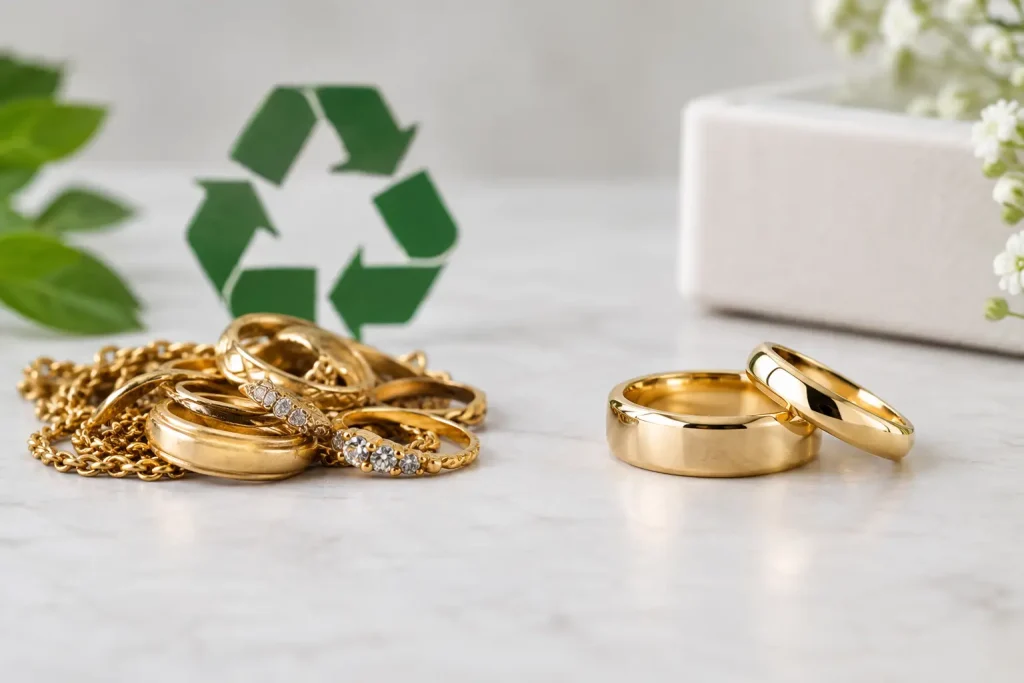
Your wedding ring will be worn through ordinary Tuesdays, big anniversaries, holidays, hand-holding and everything in between. So when choosing the metal, it is natural to ask whether recycled gold versus new gold will affect its beauty, strength, value or meaning.
The reassuring answer is that recycled gold can be every bit as beautiful and suitable for a bespoke wedding ring as newly mined gold. The more useful question is not simply which is “better”, but what you want to know about your ring’s origin, how it will be made, and what matters most to you as a couple.
What recycled gold actually means
Recycled gold is gold that has already been used in jewellery, electronics, coins or other products, then refined and returned to the supply chain. During refining, the metal is melted and purified so it can be made into fresh alloys for new jewellery.
Gold is unusual in that it can be recycled repeatedly without losing its inherent qualities. Once properly refined, recycled 18ct yellow gold has the same gold content and can have the same appearance, workability and durability as 18ct gold made from newly mined material. It is not weaker because it has had a previous life.
That distinction matters for wedding rings. A carefully made recycled-gold band can be shaped around an engagement ring, engraved with a date or message, and finished to a high polish, soft satin or textured surface just as any other gold band can.
Recycled gold versus new gold: the real differences
The finished ring itself is rarely where the difference lies. Gold is measured by purity, with alloys added to create the colour and practical characteristics needed for jewellery. In the UK, an 18ct gold ring contains 750 parts per thousand gold, whether that gold began as recycled material or newly mined material.
The difference is primarily in provenance. Newly mined gold enters the market from recent extraction, while recycled gold reuses material already above ground. For couples who would prefer to reduce reliance on newly extracted metal, recycled gold can be a meaningful choice.
However, “new” does not automatically mean irresponsible, and “recycled” does not automatically explain the whole ethical picture. Responsible sourcing involves more than one label. It can include how the metal is refined, the transparency of the supplier, labour standards, environmental practices and the wider supply chain. A good jeweller should be open about the materials they use and honest about what can, and cannot, be traced.
Quality and durability
For a wedding ring, quality comes down to the alloy, design, manufacture and aftercare rather than whether the gold was recycled. A slim band with a delicate setting needs thoughtful engineering; a shaped band needs enough structure to sit comfortably against the engagement ring; and a highly polished surface will show fine marks sooner than a textured finish. These are design decisions, not recycled-gold limitations.
It is also worth remembering that no gold wedding ring is completely scratch-proof. Gold is precious partly because it is workable. Daily wear develops a gentle patina over time, which many people love as part of the ring’s story. A well-made band can be cleaned, polished and cared for throughout its lifetime.
Colour and matching
Yellow, white and rose gold are created with different alloy metals, so their shade can vary slightly between suppliers and existing pieces. This is especially relevant if you are commissioning a fitted wedding band to sit beside an engagement ring.
If your engagement ring has a warm, rich yellow tone, a new band should be selected to complement it. If it is white gold, the rhodium plating, original alloy and age of the ring can all influence how closely a new band matches on the day. Recycled gold does not prevent a good match, but the jeweller should assess your engagement ring in person or from clear images before finalising the alloy and finish.
Is recycled gold always the greener choice?
Recycling existing gold avoids the need for that particular metal to be newly extracted, which is a compelling consideration for many couples. It makes use of a material that is already in circulation and can help support a more circular approach to jewellery.
Yet sustainability is rarely a simple tick-box decision. Refining gold uses energy, and recycled content claims depend on reliable systems for collecting, segregating and processing material. There is also a difference between using certified recycled gold from a documented supplier and simply melting down unknown old jewellery in a workshop.
For some couples, the most sustainable option has a deeply personal form: remodelling inherited jewellery. A grandmother’s ring, an unworn chain or a collection of old gold pieces may be transformed into something made for your life together. This can be wonderfully sentimental, but it needs careful assessment. Old jewellery may contain solder, hollow sections or mixed alloys, and its exact composition may not be suitable for every design without further refining or additional metal.
What about price and value?
Recycled gold is not necessarily cheaper than new gold. Gold is traded as a commodity, and the price of a bespoke ring reflects several elements: the current gold price, purity, weight, design complexity, stones if included, fitting work, labour and finishing.
A shaped-to-fit wedding ring, for example, is made around the profile of an engagement ring rather than taken from a standard tray. The skill involved in achieving a close, comfortable fit may have more effect on cost than the recycled or newly mined origin of the metal.
Nor should recycled gold be seen as a compromise in value. Hallmarking confirms the fineness of the precious metal, not whether it was recycled. When comparing quotes, focus on the carat, weight, craftsmanship, design details and service included. A ring that fits beautifully, feels secure and has been made with care is the one you are most likely to wear with confidence for decades.
Choosing the right gold for your relationship and ring design
There is no universal answer because every ring has a different job to do. If environmental considerations are central to your decision, recycled gold from a trusted supply chain may feel like the clearest fit. If you are remodelling family jewellery, the emotional connection may outweigh every other factor. If matching an existing engagement ring is your priority, the focus should be on selecting the correct alloy, colour and profile for a harmonious set.
The best starting point is a conversation about your engagement ring and how you live. Do you want a band that sits flush against it, follows an unusual setting, or makes a deliberate contrast? Would you prefer a low, practical profile for everyday life, or a diamond-set contour with more sparkle? Are you drawn to a hidden engraving, a fingerprint detail or gold with family history behind it?
These choices are connected. A bespoke ring gives you the chance to consider the metal alongside the shape, width, finish and sentiment, rather than treating it as an afterthought.
Questions worth asking your jeweller
When discussing recycled gold, ask what the term means within their supply chain and whether the metal is refined and certified. Ask which carat and alloy they recommend for your design, particularly if the band needs to match another ring. If you are providing heirloom gold, ask whether it can be used directly, whether it needs refining, and how any unused material will be handled.
It is also sensible to ask how the finished ring will be hallmarked, what care it will need, and whether the design can be adjusted if the engagement ring requires a particularly precise fit. Clear answers make the process calmer and help you choose with confidence.
At BWR London, the starting point is always the ring you want to wear and the story you want it to carry. Whether you choose recycled gold, newly sourced gold or a family piece with history, the most meaningful result is a wedding band made thoughtfully around you – comfortable on your hand, beautiful beside your engagement ring, and personal enough to feel like it could only be yours.