

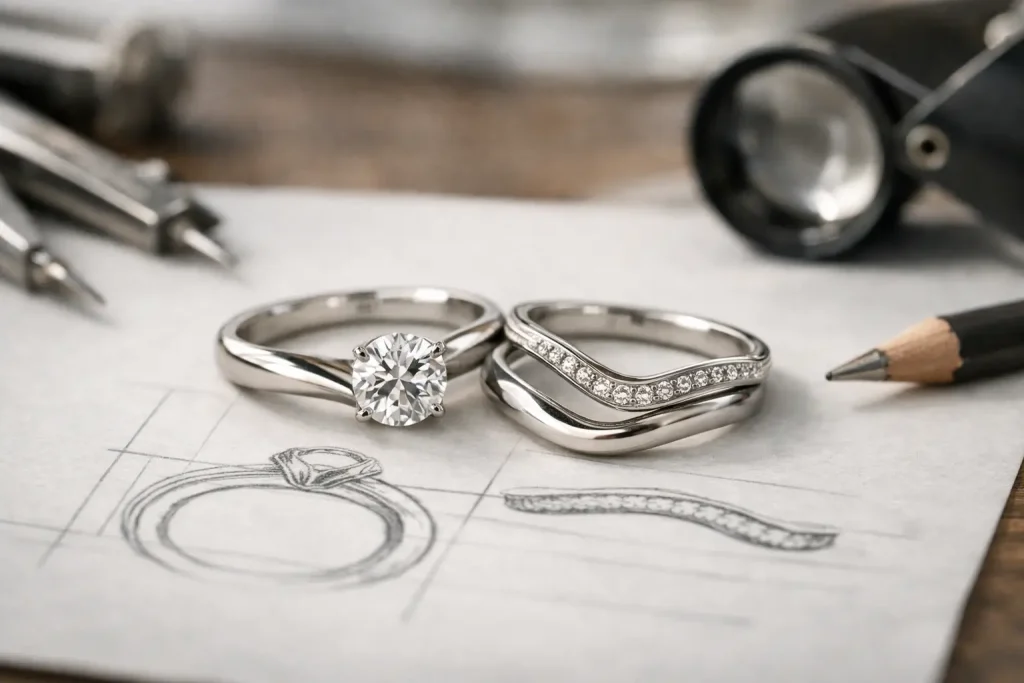
A wedding band should never feel like an afterthought beside the ring you already love. When an engagement ring has a low setting, a prominent centre stone, an oval, pear or marquise shape, finding the right fit can feel surprisingly difficult. Choosing to design curved wedding bands gives you a ring that follows the lines of your engagement ring beautifully, while still feeling comfortable, considered and personal in its own right.
A curved band is not simply a standard ring with a bend in it. The best designs are shaped around the proportions, setting height and character of the engagement ring, so the two pieces sit together with intention. Whether you want a fine, understated contour or a diamond band that makes a statement, the details matter.
Why a straight wedding band is not always the answer
Many engagement rings sit neatly alongside a traditional straight wedding band. Others leave a frustrating gap, push the rings apart or make them sit at different angles. This is particularly common with centre stones that extend beyond the band, settings with low baskets, and rings with unusual silhouettes.
Some people like the space between their rings. It can make each piece feel distinct and create a light, modern look. But if you would prefer your wedding and engagement rings to sit flush, a curved or shaped band is often the most natural solution.
The aim is not always perfect symmetry. Sometimes the most flattering fit is a gentle curve that leaves a small, deliberate space around the setting. What matters is that the finished pairing looks balanced from above and feels easy to wear every day.
How to design curved wedding bands around your ring
The starting point is always the engagement ring itself. Its shape tells us far more than a photograph can show: where the setting begins, how high it sits, whether the band tapers, and how much room is available beneath the centre stone. For a truly close fit, a jeweller will usually work from the ring in person. If that is not possible at first, clear images from above and the side, alongside the ring measurements, provide a useful basis for an initial conversation.
Begin with the curve, not the decoration
It is tempting to choose diamonds, engraving or metal colour first. Yet the curve is the foundation of the design. A soft U-shaped contour works well around many round and oval stones. A deeper V can complement a pear, marquise or pointed setting, while a more irregular sweep may be needed for an asymmetric or vintage engagement ring.
The curve should mirror the engagement ring without appearing copied from it. If it is too shallow, the band may still press against the setting. If it is too deep, it can look disconnected when worn alone. This is where custom design is especially valuable: the profile can be adjusted until it feels right both as a pair and on its own.
Decide how close you want the rings to sit
“Flush fit” can mean different things. For some couples, it means no visible gap whatsoever. For others, it means the rings are comfortably close without touching or rubbing. A small amount of breathing room can protect delicate details, especially if the engagement ring has a fine pavé setting or an intricate gallery beneath the stone.
It is also worth thinking about movement. Your fingers naturally change size through the day and across the seasons. Two rings that fit tightly together when tried on may feel less comfortable when your hands are warm. A considered design allows for everyday wear, not only the moment it is first placed beside the engagement ring.
Match the proportion before matching every detail
A curved wedding band does not need to be identical to the engagement ring to look beautifully coordinated. A plain polished band can provide a calm contrast to a diamond engagement ring, while a fine diamond contour can bring light to a simple solitaire. The most convincing pairings tend to share proportion, metal tone or a repeating detail rather than matching every element exactly.
For example, a slim engagement band may suit a similarly delicate curved ring, whereas a substantial solitaire often needs a band with enough width to hold its own. If the engagement ring has a knife-edge profile, milgrain border or hand engraving, echoing one of those features can make the rings feel connected without making them overly formal.
Choosing diamonds, metal and finish
Once the silhouette is settled, the decorative choices become much easier. A plain curved band is timeless and places full focus on the engagement ring. It is also often the most practical choice for those with an active lifestyle, as there are fewer stones to consider when it comes to long-term maintenance.
Diamonds can be set across the curve, along one side, or in a more selective arrangement that follows the shape of the engagement ring. A full eternity style creates maximum sparkle but cannot usually be resized easily. A half-set or three-quarter-set band offers a similar look from the top of the hand with greater flexibility later on.
Metal choice deserves practical thought too. Matching the engagement ring in platinum, yellow gold, rose gold or white gold is a classic route, but mixing metals can be striking when done deliberately. Yellow gold against platinum, for instance, can give a ring stack warmth and definition. The finish also changes the mood: high polish feels crisp and traditional, while a brushed or softly matte finish feels quieter and more contemporary.
Comfort is part of the design
A shaped band may look delicate from above, but it still needs to feel secure and smooth around the finger. The inside profile matters, particularly if you are not used to wearing rings every day. A comfort-fit interior has gently rounded edges and can make a noticeable difference over long hours.
Consider the width at the back of the band as well as the visible curve at the front. Very narrow rings can be elegant, but they may feel insubstantial beside a larger engagement ring and can wear more quickly over many years. A slightly wider band may offer better durability without losing its refined appearance.
If you plan to wear additional rings later, perhaps an anniversary band or another meaningful piece, mention this early in the design process. The curve can be planned so your future stack still feels balanced rather than crowded.
Make the band personal beyond its shape
The contour is already a response to your engagement ring, which makes it personal by nature. But there are quieter ways to make it unmistakably yours. An engraving of a date, initials, a private phrase or even a small symbol can turn the inside of the ring into a detail only the two of you know about.
Heirloom diamonds or gold can also be incorporated into a new curved wedding band. This can be a lovely way to carry family history into a design that suits your life now. It does require careful assessment, as older stones and jewellery may need sympathetic handling, but the result can hold layers of meaning no ready-made ring can offer.
Reference images are useful for discussing mood, shape and setting style, but they should be a starting point rather than a strict template. The final ring should be designed for your hand and your engagement ring, not for a photograph of someone else’s.
Give yourself time to get the fit right
A bespoke curved band is made through considered measurements, design decisions and skilled making, so it is wise to begin well ahead of the wedding. This gives you room to review the proposed shape, ask questions about proportions and make choices without pressure. It also means the design can evolve if you discover that a gentler curve, a different width or fewer diamonds better suits your ring.
At BWR London, the process is centred on listening closely to how you want your rings to look and feel together. Whether you bring your engagement ring to a consultation, share images for an initial discussion or have a clear idea already, the goal is the same: a wedding band that feels as though it was always meant to sit beside it.
The right curved wedding band will not compete with your engagement ring or disappear beside it. It will make the pair feel complete, carry the details that matter to you, and become a piece you are genuinely pleased to put on every morning.