

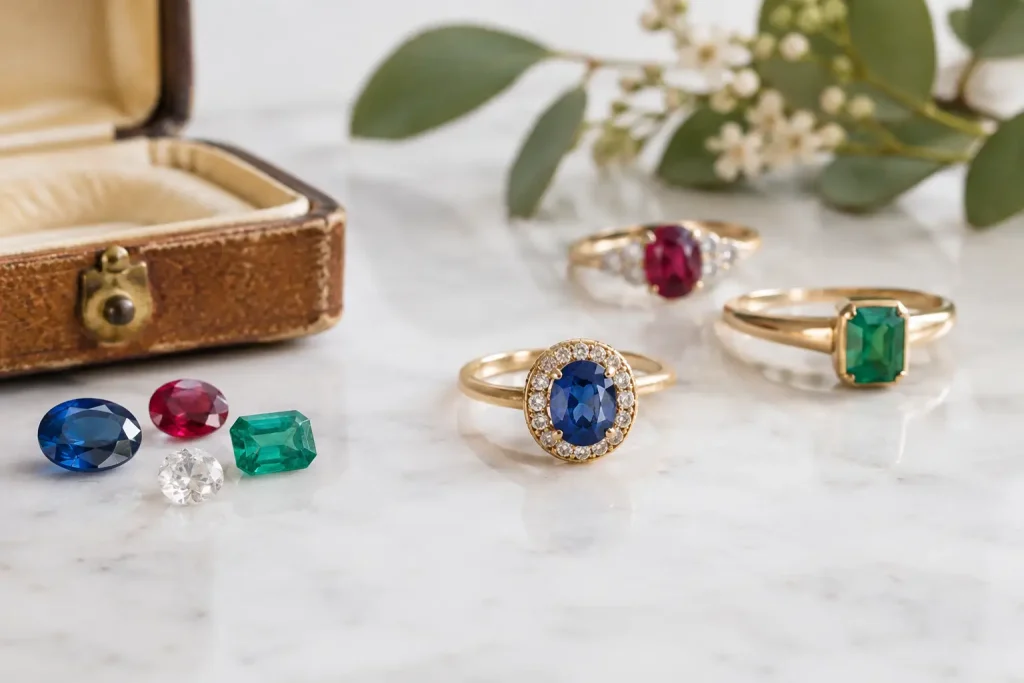
A small diamond from your grandmother’s ring can hold more feeling than a newly bought stone ever could. Choosing to reuse heirloom gemstones lets you carry that story into your marriage, while creating a ring that suits your style, your daily life and the way your engagement ring sits today.
The most successful heirloom redesigns do not try to copy the past exactly. They respect the original piece, then make thoughtful choices about what will be comfortable, secure and beautiful for the next chapter. Whether you have one treasured sapphire, a cluster of tiny diamonds or several family rings to consider, a bespoke design can turn them into something you will genuinely want to wear every day.
Why reuse heirloom gemstones?
Family jewellery often arrives with a complicated mix of emotions. You may love the sentiment but feel that the ring itself is too ornate, too fragile or simply not your taste. Redesigning the gemstones is not a rejection of its history. It is a way of keeping the most meaningful part close, rather than leaving it unworn in a jewellery box.
There is also a practical appeal. An existing gemstone may reduce the cost of sourcing a comparable new stone, particularly if it is a good-quality diamond, sapphire, ruby or emerald. That said, it is not always the cheaper route. Careful stone removal, condition checks and bespoke setting work all require skilled labour. The value is in making an informed decision, not assuming an heirloom redesign will automatically cost less.
For wedding jewellery, inherited stones can create a subtle connection between generations. A diamond from a parent’s ring might become a hidden stone inside a wedding band, while a set of smaller stones could trace the curve of a shaped-to-fit band. The finished ring can feel entirely yours while still holding a private family detail.
Start with the stone, not the sketch
It is tempting to arrive with a finished idea from social media, but the gemstone should lead the design. Its shape, measurements, condition and proportions determine what is realistic.
A jeweller will first examine the stone closely. They will assess any chips, abrasions, fractures and signs of previous repairs, as well as checking whether it has been treated. Older gemstones can show wear around the edges, especially diamonds with fine chips at their girdles and softer coloured stones with worn facets. This does not necessarily mean they cannot be used, but it may affect the setting style or make a protective design the better choice.
Stone shape matters just as much. A round diamond is wonderfully flexible, while an old-cut diamond often has a softer, more individual character that deserves a setting designed around it. An oval, pear or marquise stone may need a shaped band or a carefully planned gap so that both rings sit comfortably together. Tiny stones can be beautiful in a grain-set row, a constellation pattern or as discreet details around a central stone, but may not be suitable for resetting one by one if they are heavily worn.
If the original ring has an engraving, hallmark or setting you want to preserve, say so from the beginning. Sometimes the best answer is to redesign only the gemstones. In other cases, a section of the original metal can be incorporated, or the heirloom ring can remain intact while its influence appears in the new design.
Should the original metal be reused too?
Gold from an old ring can sometimes be melted and incorporated into a new piece, but it is not always advisable. Vintage alloys can be unpredictable, and solder, impurities or unknown metal content may affect the finish and strength of a newly made ring. A jeweller may recommend creating the new ring in freshly sourced, ethically sourced metal instead, then returning the original mount to you as a keepsake.
This can feel disappointing at first, but it is a sensible conversation to have. The gemstone is usually the element with the greatest sentimental and design value, while fresh metal gives a more reliable foundation for a ring intended for lifelong wear.
How to reuse heirloom gemstones in a new ring
The clearest first step is to decide how you want to wear the finished piece. Will it be an engagement ring, a wedding band, an eternity-style ring, or a separate dress ring for special occasions? There is no rule that says inherited stones must become an engagement ring. A wedding band with a hidden heirloom diamond can be just as meaningful and often makes more sense if your engagement ring already feels complete.
If you are designing a wedding band around an existing engagement ring, bring it to the consultation. Its setting height, profile and stone shape will affect how closely a new band can sit. A straight band may be perfect for a raised solitaire, whereas a low-set oval or pear design may need a gentle curve, a notch or a more sculptural shaped-to-fit silhouette.
This is where a bespoke process is especially valuable. Instead of choosing a band from a tray and hoping it works, you can consider the proportions of both rings together. The aim is not only a neat visual fit. Your rings should feel comfortable on the hand, avoid unnecessary rubbing and still look balanced when worn separately.
A few design directions are particularly lovely for heirloom gemstones. A single central stone can be reset into a clean solitaire with a modern band. Small inherited diamonds can become a curved pavé detail that follows the contour of your engagement ring. Coloured gemstones may sit in a protective bezel setting, which gives a sleek look while shielding vulnerable edges. You could also place a small family stone on the inside of the shank, known only to you and the person who gave it meaning.
Make room for sentiment and real life
The best bespoke ring is not merely photogenic. It needs to suit your work, routines and preference for maintenance. A high claw setting can make a stone look wonderfully prominent, but it may catch more easily on knitwear. A low bezel setting offers excellent protection, though it can change how much light reaches some stones. Neither is universally better – it depends on the gemstone and how you live in your jewellery.
Coloured stones need particular care. Sapphires and rubies are generally durable choices for everyday rings, although they should still be checked periodically. Emeralds are more vulnerable to knocks and may contain natural inclusions, so a design with more protection can be wise. Pearls, opals and turquoise are usually better reserved for occasional wear or incorporated in a piece that will not face daily impact.
Sentimental details do not need to be obvious. Consider an engraving in a loved one’s handwriting, a meaningful date inside the band, or a tiny stone set where only you will see it. These details are especially effective when an heirloom piece has several stories attached to it and you want the new ring to honour your own relationship too.
Ask the right questions before resetting
Before work begins, you should understand exactly what is being proposed. Ask how the gemstone will be assessed, whether it needs an independent valuation, and what happens if a hidden issue is found once it is removed from its old setting. A careful jeweller will explain that removing an old stone carries a small degree of risk, particularly if the setting is worn or the stone has existing damage.
It is also worth discussing the design through realistic visuals or samples. The scale of an heirloom gemstone can look very different on the hand than it does in a ring box. If the ring will sit beside your engagement ring, checking the fit in person or from accurate measurements helps prevent avoidable surprises.
At BWR London, the conversation begins with your jewellery and your story, not a fixed template. You can share reference images, bring your engagement ring and heirloom stones, and explore a design that feels personal without making the process feel overwhelming.
Finally, think beyond the proposal or wedding day. Choose a design you will be happy to put on during an ordinary Tuesday morning, years from now. When an heirloom gemstone is reset with care, it does more than preserve a memory – it gives that memory a place in the life you are building together.