

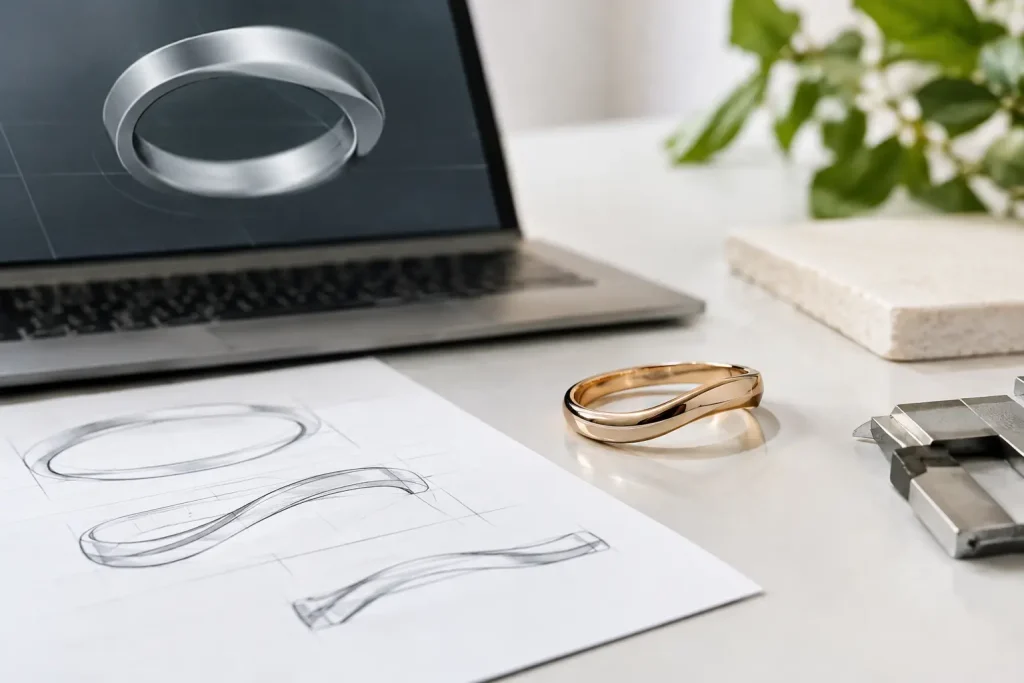
A wedding band should not feel like the ring that had to compromise. In this curved band design case study, we follow a typical bespoke commission for a bride whose engagement ring had a low-set centre stone and a setting that made a straight wedding ring sit awkwardly apart.
She loved the engagement ring exactly as it was. The question was not whether to change it, but how to create a wedding band that felt intentional beside it: close enough to look like a pair, comfortable enough for daily wear, and distinctive enough to hold its own.
This is an illustrative example based on the kinds of shaped-to-fit commissions we create. Every ring is different, which is precisely why a personal design conversation matters.
The curved band design case study
The engagement ring featured an oval diamond with a gently tapered yellow-gold band. Its setting sat low against the finger, while the diamond and supporting gallery extended beyond the line of the shank. A conventional straight band could be worn with it, but it would leave a visible gap. For some people, that space is part of the look. For this bride, it felt unfinished.
Her first priority was a close fit. Her second was balance. She did not want a deeply scooped band that disappeared behind the engagement ring, nor did she want a curve so dramatic that the wedding ring looked unfamiliar when worn on its own.
That distinction shaped every decision that followed. A curved band is not simply a straight ring with a notch cut into it. The curve needs to respond to the exact dimensions of the engagement ring, including the width of the setting, the height of the gallery, the position of the diamond and the way the ring sits on the hand.
Starting with the engagement ring, not a stock shape
The design process began with clear photographs of the engagement ring from above, from the side and while worn. Measurements were then taken to understand the space the band needed to travel around. Where possible, having the engagement ring available in person gives the clearest picture, but a carefully guided remote process can also provide an excellent starting point.
The initial temptation was a pronounced V-shaped contour. On paper, it appeared to solve the fitting issue neatly. In practice, it would have created a sharp point beneath the oval stone and made the set feel more geometric than the bride wanted.
Instead, the chosen design used a soft, asymmetrical sweep. The curve rose gradually towards the setting, leaving sufficient clearance for the engagement ring while keeping the outer edge calm and elegant. When viewed from a distance, the two rings read as a considered set rather than two separate pieces trying to occupy the same space.
This is where bespoke design earns its place. A ready-made curved band may look close in a product photograph, but even a small difference in setting height or stone placement can leave it rocking, rubbing or sitting farther away than expected.
Choosing details that made the set feel personal
The bride wanted the wedding band to add a little light without competing with the centre diamond. A fully pavé-set curve was considered, but the engagement ring already had enough presence to carry the pair. The final choice was a delicate run of round diamonds along the visible top section of the band, stopping before the curve reached the underside of the finger.
That decision offered a practical benefit as well as a visual one. Stones around the full circumference can be beautiful, but they may be less straightforward to resize in future and are more exposed to everyday knocks. Keeping the diamonds on the upper portion concentrated the sparkle where it would be seen, while allowing a plain section at the base for comfort and flexibility.
The metal was matched in 18ct yellow gold. Matching metal colour does not always mean choosing an identical finish, though. The engagement ring had developed a soft, lived-in sheen, so a highly polished wedding band would have looked noticeably newer beside it. A lightly polished finish gave the new ring a gentle glow while allowing it to settle naturally into the set over time.
Inside the band, the couple chose a short engraving: their wedding date and two initials. It was a small detail, unseen by anyone else, but it made the ring feel unmistakably theirs. Bespoke jewellery often holds its meaning in these quieter choices.
Comfort was designed in, not checked at the end
A close-fitting wedding band should not press against the engagement ring. There needs to be enough room for both pieces to sit securely, without metal-on-metal friction that could cause unnecessary wear over years of use.
For this commission, the inner edge of the curved section was softened slightly. The band was also made with a gentle court profile on the inside, meaning the surface against the finger had a subtle rounded feel rather than a hard, flat edge. These adjustments are easy to miss in a drawing, but they make a real difference when a ring is worn every day.
Width was another important consideration. A very narrow curve can appear delicate but may look lost beside a larger engagement ring. A wider band can give a pleasing contrast, yet it needs sufficient depth and careful proportions to remain comfortable. The chosen band was narrow enough to preserve the airy feel of the oval diamond, but substantial enough to keep its shape and sparkle visible.
Why a perfect fit is not always the goal
There is a common belief that a shaped wedding band must sit completely flush against an engagement ring. Often, that is the right choice. It creates a neat, connected look and can make the two rings feel designed as one.
But it depends on the engagement ring and the wearer. Some settings need a small amount of breathing room to avoid contact. Others look more balanced with a deliberate, even gap. And some people want to wear their wedding ring alone regularly, in which case an extremely dramatic contour may not feel as versatile.
For this bride, the best result was a near-flush fit rather than forced contact. The rings sat beautifully together, with enough clearance to protect the setting and preserve a comfortable feel. From above, the curve followed the engagement ring naturally. From the side, neither band appeared pushed out of place.
That is the difference between copying a shape and designing for a real piece of jewellery.
From approval to the finished ring
Once the proportions, diamond placement and engraving had been agreed, the design was translated into a made-to-measure ring. The engagement ring was checked again against the finished curve before completion, because the practical fit matters as much as the approved design.
The final pairing had a softness that surprised the bride. She had expected the curved band to be a functional answer to a fitting problem. Instead, it gave her engagement ring a new presence. The sweep of gold framed the oval diamond, the small diamonds added movement, and the engraving made the band feel connected to the day it represented.
For BWR London, this is the heart of a bespoke wedding band: listening closely enough to solve the practical issue without losing the emotion of the piece. The process can begin with an idea, a sketch or a few photographs. It can also begin with the simple feeling that an off-the-shelf ring is almost right, but not quite.
If your engagement ring has an unusual setting, an heirloom shape or a stone that sits low on the finger, do not assume your only option is a gap. A thoughtfully curved band can be made around its character, your comfort and the way you want to wear it for the years ahead.