

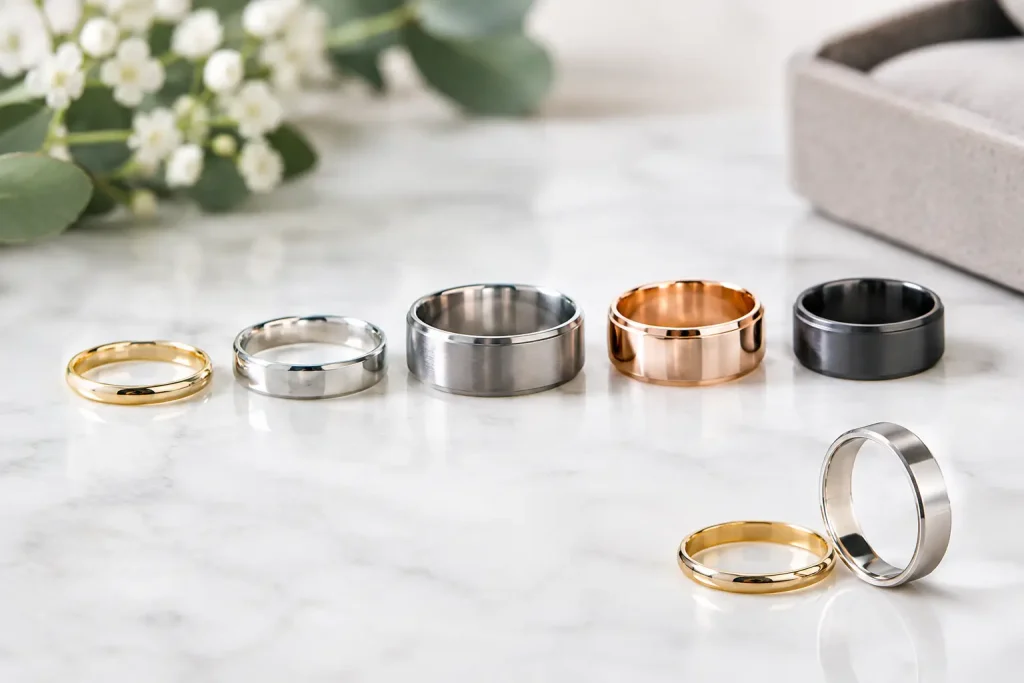
The millimetres you choose will change how your wedding ring feels every time you reach for a hand, hold a glass or catch sight of it beside your engagement ring. This guide to ring width and depth is here to make those small measurements feel less technical and much more personal. There is no single ‘right’ proportion, only the one that suits your hand, lifestyle, engagement ring and the story you want your bands to tell together.
What ring width and depth really mean
Width is the measurement across the top of the ring, from one edge to the other. It is the dimension people notice first when looking at your hand. A 2mm band appears fine and delicate; a 5mm or 6mm band has a stronger, more substantial presence.
Depth, sometimes called thickness, is the measurement from the inside of the band to its outer surface. It affects the ring’s profile, its weight and how it feels between the fingers. A ring can be wide but relatively shallow, or narrow with a deeper, more rounded profile.
Both measurements matter because a wedding ring is not simply an object you admire in a box. It is something you will wear through busy mornings, celebrations, work, weekends and all the ordinary moments that become a shared life.
Ring width: finding a look that feels like you
For many wedding bands, widths between 2mm and 4mm offer a comfortable starting point. That does not make them a rule. Slimmer styles can look beautifully understated, while wider bands may suit someone who wants a more confident, traditional or contemporary look.
A narrow band, often around 1.5mm to 2mm, can be especially effective beside a detailed engagement ring. It leaves room for the centre stone and setting to take the lead, while adding a fine line of precious metal or diamonds alongside it. Narrow rings can also appeal if you are not used to wearing jewellery and want your wedding band to feel unobtrusive.
At around 2.5mm to 3mm, a band often feels balanced and versatile. This width gives enough presence for plain gold, engraving or subtle stones to be appreciated, without overwhelming most engagement-ring designs. It is a popular territory for couples who want a timeless look but still want their ring to be noticed.
Wider bands, from roughly 4mm upwards, make more of a statement. They offer a generous canvas for a brushed finish, a distinctive profile, meaningful engraving or a row of diamonds. They can look particularly striking worn alone, which matters if you may not wear your engagement ring every day. The trade-off is that a wider band covers more of the finger, so fit and comfort become even more important.
Your finger shape plays a part, but not the whole part
Longer fingers can often carry a wider ring with ease, while a slim band may help shorter fingers appear more elongated. Yet proportions are never the only consideration. A wider band on petite hands can look intentional and wonderfully modern. A fine band on broad hands can feel elegant and quietly personal.
The best way to judge width is to try it on, ideally next to your engagement ring. Looking at a measurement on a screen cannot show you how a ring sits with your hand movements or how its scale feels to you. During a bespoke consultation, we would usually compare a few widths so you can see the difference rather than trying to imagine it.
Ring depth: the detail that shapes everyday comfort
Depth is easy to overlook, but it has a real effect on wearability. A deeper ring generally feels more solid and has a more pronounced profile. It may be a good choice for someone drawn to a traditional court shape or a reassuringly weighty wedding band.
A shallower ring can feel lighter and sit closer to the finger. This can be helpful where you prefer a subtle look, work with your hands or want the band to sit neatly beneath a setting. However, a very thin depth may not be appropriate for every design, particularly if it includes stones, intricate engraving or a shape designed to curve around an engagement ring.
There is also a practical balance to consider. Precious metal naturally wears over time, particularly on the edges and underside of a ring. Choosing sufficient depth gives a bespoke band the strength needed for daily life. That does not mean making it unnecessarily thick. It means designing it thoughtfully around the metal, width, profile and details you have chosen.
Profile changes how depth feels
Two rings with the same depth can feel very different depending on their profile. A traditional court profile is rounded inside and out, creating a soft, classic feel on the hand. A flat profile has a cleaner, more contemporary appearance and can make a band look broader. A flat court combines a flatter exterior with a rounded interior, giving you crisp lines with added comfort.
For a shaped-to-fit band, the profile becomes even more significant. The curve or contour needs to sit harmoniously against the engagement ring without pinching, spinning awkwardly or creating a distracting gap. This is why a custom fit is often worth considering where the engagement ring has an unusual setting, a low basket, side stones or a distinctive silhouette.
How to match width and depth to an engagement ring
Matching does not always mean identical. A wedding band can echo the metal, finish, setting style or curve of your engagement ring without copying every detail. In fact, a little contrast can make the pairing feel more considered.
If your engagement ring has a fine band, you may choose a wedding ring of similar width for a light, fluid stack. Alternatively, a slightly wider band can create a pleasing frame and give the wedding ring its own identity. With a wide engagement-ring shank, a very narrow wedding band may look delicate by comparison, while a more substantial band can create a balanced pair.
Depth deserves the same attention. A deep, high-profile wedding ring next to a very slim, low-profile engagement ring can look deliberately bold, but it may not sit as closely as you would like. A carefully measured bespoke design lets both rings sit comfortably together while protecting any delicate settings.
Diamond-set bands need particular care. The placement of stones, the height of the setting and the depth of the metal all affect whether the rings rub together. Sometimes the most beautiful choice is a small shaped gap that prevents contact. Sometimes a precisely contoured band can sit flush. The answer depends on the engagement ring itself, not on a one-size-fits-all chart.
Think about your life, not just the photographs
A wider or deeper ring may feel wonderfully luxurious, but consider what you do with your hands. If you work in healthcare, hospitality, fitness, childcare or a practical trade, you may prefer a lower, smoother profile with no raised edges. If you rarely remove jewellery and want a ring that can take on daily life gracefully, comfort and sensible proportions should lead the design.
Your budget may also influence the balance. Wider and deeper rings use more metal, so their cost can increase accordingly. Choosing a slightly narrower width, a lighter profile or a thoughtful mix of finishes can preserve the look you love while keeping the design within your comfort zone. Bespoke does not have to mean extravagant – it means choosing what matters most to you.
A personal way to choose your proportions
Bring your engagement ring, a few reference images and an honest sense of how you want to feel wearing your band. You may know that you want something almost invisible beside your solitaire, or you may want a bold ring that stands confidently on its own. Both are equally valid starting points.
At BWR London, we can assess your existing ring and talk through width, depth, profile and shape in person, so the final design is made around your hand rather than chosen from a standard tray. If you are redesigning heirloom jewellery, those proportions can also help carry a family stone or engraving into a ring that feels right for your everyday life.
Let the ring feel personal before it feels perfect on paper. When its width, depth and shape are chosen with care, your wedding band will not just match your engagement ring – it will feel like it has always belonged beside it.