

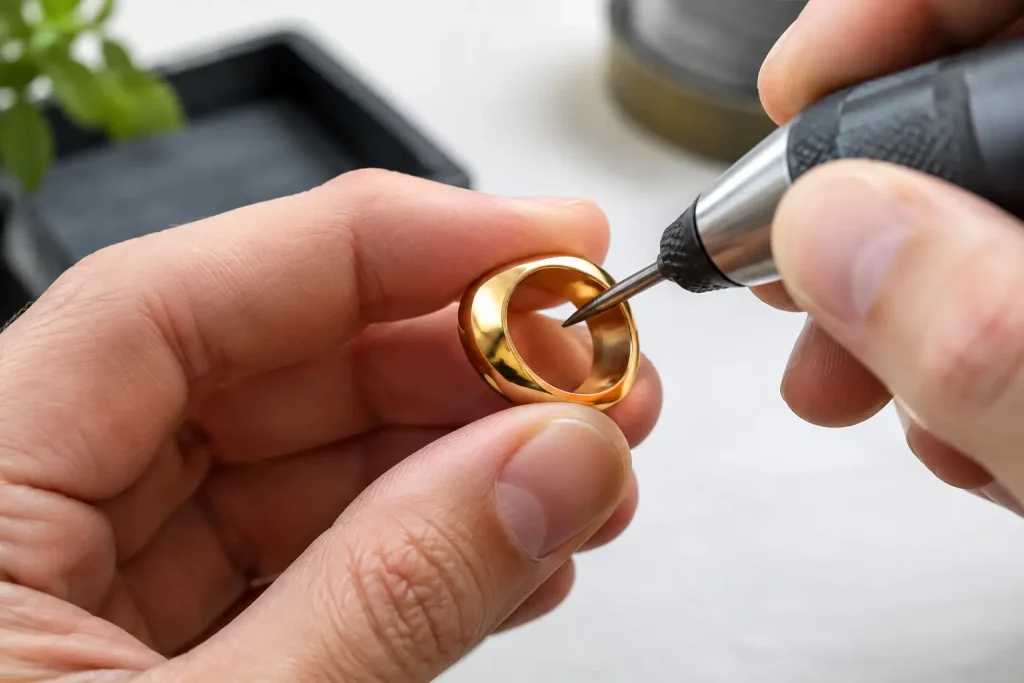
A ring can look beautifully simple from the outside while holding a whole story within. If you are asking, “can you engrave inside a ring?”, the answer is usually yes – and it is one of the loveliest ways to make a wedding ring, engagement ring or eternity ring feel entirely your own. A date only the two of you recognise, a private nickname, a line from a letter, or even the coordinates of where you met can turn a piece of jewellery into something deeply personal.
The best engraving is not necessarily the longest or most elaborate. It is the one that still feels true when you read it decades from now.
Can You Engrave Inside a Ring? Usually, Yes
Most wedding bands can be engraved on the inside, provided there is enough flat, accessible metal for the lettering. Plain bands are generally the most straightforward choice, but shaped wedding rings, curved bands and rings designed to sit around an engagement ring can often be engraved too.
The practical answer depends on the design. A wide, flat-profile band offers more room than a narrow or heavily contoured ring. Similarly, a ring with diamonds all the way around may have limited space, while a plain inner surface gives the engraver a clearer area to work with.
Engraving can be completed by hand or with a precision machine. Both can create a refined result, but the right method will depend on the style of lettering, the ring’s metal and the level of detail you would like. A bespoke jeweller will assess the finished shape of your ring rather than making assumptions based on a standard size or style.
What Determines Whether Your Ring Can Be Engraved?
Ring width and inner profile
As a rule, wider bands allow for more characters and a more easily readable inscription. That does not mean a slim ring cannot be engraved. It may simply suit a shorter message, smaller lettering or discreet initials and a date.
The interior profile matters too. A court-shaped band has a softly rounded inside, which is particularly comfortable for everyday wear but can provide less level space than a flat inner profile. This is not a problem in itself. It just means the engraving needs to be planned carefully to remain neat and comfortable.
The metal you choose
Yellow gold, white gold, rose gold and platinum are all popular choices for engraved wedding rings. Each can take an inscription well when the ring has suitable space. Platinum is dense and durable, while gold offers a traditional finish and can show crisp engraving beautifully.
Softer metals can mark more easily over a lifetime of wear, and every inscription will naturally develop a little character as the ring ages. For many couples, that lived-in quality is part of the charm. If keeping the lettering especially defined is your priority, ask your jeweller about the best letter depth and finish for your chosen metal.
Stones, settings and shaped designs
A ring set with diamonds or gemstones may still be engraveable, particularly if it has a plain section inside the band. However, an eternity ring with stones around its full circumference can leave very little room. Deeply shaped wedding bands also need extra consideration, especially where the curve narrows to fit around an engagement ring.
This is where a made-to-measure approach helps. Instead of choosing an engraving before the design is finalised, the ring can be created with both the fit and the inscription in mind.
Choosing Words That Belong to You Both
There is no rule saying an engraving must be romantic in the traditional sense. Some couples choose their wedding date or initials. Others prefer a phrase that would mean nothing to anyone else: an in-joke, a favourite saying, the name of a place, or a few words exchanged during a proposal.
Short inscriptions often have the strongest impact. A simple “Always”, “My home”, or “14.06.26” can feel more intimate than a longer sentence. If you do have a quote in mind, consider using just the part that captures its meaning. This is particularly useful for narrow bands, where trying to fit too much text can make the letters hard to read.
You may also want the two rings to speak to each other. One band could read “To the moon” and the other “And back”. Or each ring might carry the same date in different formats. Couples who are matching a wedding band to an existing engagement ring sometimes choose an engraving that connects the old and new pieces, such as the date they became engaged inside one ring and their wedding date inside the other.
Before deciding, say the words aloud. Ask whether they will still feel like you in ten, twenty or fifty years. The answer does not have to be serious. It just needs to be sincere.
When Should You Arrange the Engraving?
Ideally, discuss engraving while the ring is being designed. It gives your jeweller the chance to confirm that the chosen wording will work with the width, shape and setting of the band. This is especially worthwhile for shaped-to-fit wedding rings, where every millimetre of the design has a purpose.
Engraving is often completed once the ring has been made and sized, because resizing can affect the inscription. If there is any chance that the size may need adjusting, it is usually better to wait until the fit is confirmed. This helps avoid a situation where a message has to be altered, removed or re-engraved after the fact.
That said, a ring you already own can often be engraved later. A family ring, an heirloom wedding band or a ring you have worn for years may be suitable, provided it is in good condition and has enough space. A jeweller should inspect it first, particularly if it is thin, worn, stone-set or has been resized previously.
Making Engraving Work With a Bespoke Ring
The beauty of having a ring made for you is that the personal details do not have to be an afterthought. The ring can be shaped around an engagement ring, tailored to your preferred profile and finished with an inscription that fits naturally within the design.
At BWR London, conversations about engraving often begin with the meaning behind it rather than the character limit. That is useful because there may be several ways to express the same sentiment: initials instead of full names, a meaningful date rather than a phrase, or a symbol that keeps the message private.
A clear reference image can also be helpful if you have seen a particular script, layout or style you love. While not every font will suit every ring, sharing your ideas allows the jeweller to suggest a finish that is legible, lasting and in keeping with the character of the piece.
A Few Common Engraving Questions
Will engraving make my ring less comfortable?
A properly finished engraving should not affect comfort. The inscription is placed into the metal rather than left raised on the surface, and the inside of the band is polished after the work is done. Very deep engraving may be unsuitable for an exceptionally slim ring, but your jeweller can advise on a depth that feels smooth against the skin.
Can a ring be engraved with a symbol?
Often, yes. Hearts, stars, infinity signs and simple motifs can work well if there is enough room. Symbols are a lovely option when you want meaning without a long message. More intricate artwork may not translate clearly at ring scale, so simpler is usually better.
Can engraving be removed or changed?
It can sometimes be polished out and replaced, though this depends on the depth of the original inscription and the amount of metal available. Removing engraving also means removing a small amount of metal, so it is best treated as a careful alteration rather than something to do repeatedly.
How many characters can fit inside a ring?
There is no fixed number. It depends on the ring size, width, profile, font and whether spaces or symbols are included. A date and initials may suit a narrow band perfectly, while a wider ring can accommodate a longer phrase. Your jeweller can provide a realistic recommendation once the design is known.
The most meaningful engraving is often the one no one else needs to understand. Choose words, numbers or symbols that bring you straight back to a person, a promise or a moment – then let your ring carry that memory quietly, every day.