

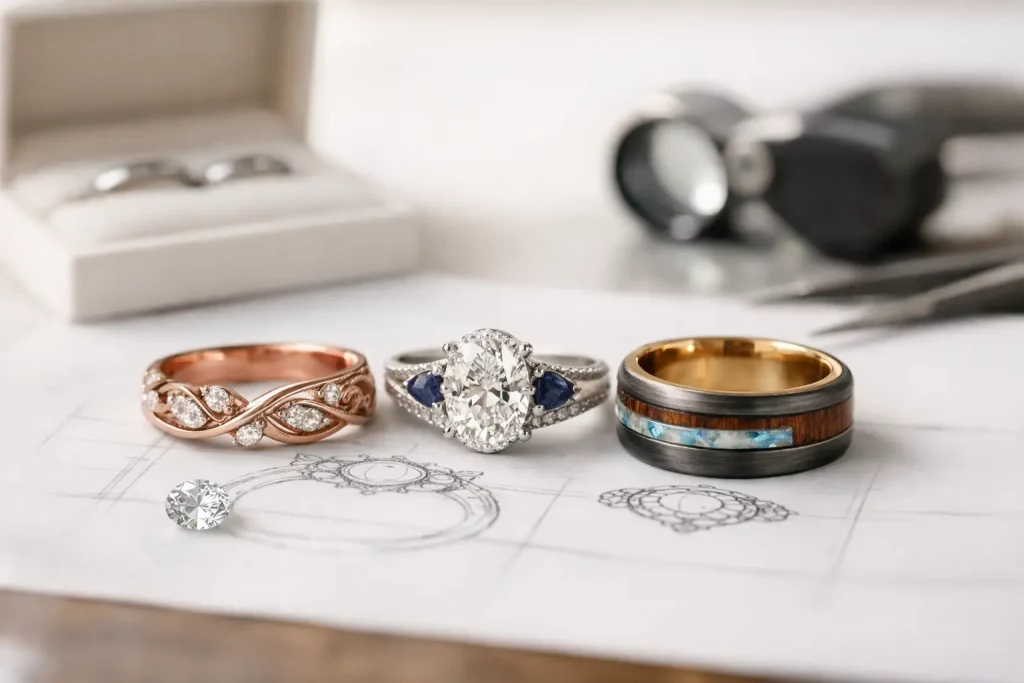
A wedding ring can be the simplest piece of jewellery you own, yet it is often the one that carries the most meaning. It sits beside an engagement ring, follows you through ordinary Tuesdays and extraordinary milestones, and becomes part of the way your hands look and feel. These custom wedding ring design examples show how a band can be made to reflect your relationship, your style and the practical reality of wearing it every day.
The best starting point is not a trend. It is the question: what do you want this ring to say, and how do you need it to work? For some couples, that means a wedding band shaped precisely around an engagement ring. For others, it is a quiet engraving only the two of you understand, a stone from a family piece, or a texture that makes a classic gold band feel unmistakably yours.
Custom wedding ring design examples for every story
A shaped-to-fit band around an engagement ring
A shaped wedding band is one of the most personal custom designs because it begins with a ring you already love. If your engagement ring has a low setting, prominent centre stone, unusual shoulders or an oval, pear or marquise shape, a straight band may leave a gap or push the rings apart. A gentle curve, deeper contour or soft wishbone shape can allow the two rings to sit beautifully together.
The shape does not need to be dramatic. Sometimes a discreet dip at the front is all that is required, giving the rings a close, considered fit while keeping the wedding band elegant when worn alone. This is particularly helpful if you want a clean, traditional-looking stack without compromising on comfort.
It is worth knowing that a perfectly flush fit depends on the structure of the engagement ring. A jeweller will assess the setting, stone position and available space before recommending the best curve. If a fully flush fit is not possible, a deliberate small gap can still look refined and can protect delicate details in the engagement ring.
A curved diamond band that follows the centre stone
For those who love a little more light, a curved diamond-set band can frame an engagement ring rather than compete with it. The diamonds might run across the visible front of the band, follow a gentle contour, or taper away towards the sides. The result can be delicate and romantic, especially beside a solitaire or a ring with a coloured centre stone.
The detail lies in proportion. Tiny diamonds can give a fine, understated sparkle; larger stones create a more defined statement. A shared-claw setting often maximises light, while a channel or bead setting can offer a smoother profile for everyday wear. The right choice depends on your lifestyle as much as your taste. If you work with your hands, have young children or prefer a lower-maintenance ring, a protected setting may feel more reassuring.
You can also choose to use diamonds from an existing piece of jewellery. Resetting stones from a family ring into a new wedding band can keep a meaningful connection close, while creating something designed for your own life.
An engraved plain band with a private message
Not every bespoke ring needs stones or an unusual silhouette. A beautifully made plain band with a meaningful engraving can be just as distinctive. A wedding date is timeless, but couples also choose initials, a line from a letter, the coordinates of a significant place, a shared phrase, or even a small symbol meaningful only to them.
Engraving gives a classic yellow gold, white gold, platinum or rose gold band an intimate layer that is not immediately visible to anyone else. It is a lovely option if you are drawn to simplicity but still want the ring to hold a very personal detail.
There are practical considerations. Very narrow bands leave less room for text, and longer messages may need a slightly wider profile or a carefully chosen typeface. Hand engraving can bring a softer, artisanal character, while machine engraving can suit clean lettering and fine detail. During a consultation, you can discuss what will remain clear and comfortable over decades of wear.
A mixed-metal wedding ring that ties two styles together
Mixed metals are an excellent answer when your engagement ring, existing jewellery and personal preferences do not all point in the same direction. Perhaps your engagement ring is platinum, but you have always worn yellow gold. Or perhaps one of you wants a contemporary white metal edge with the warmth of yellow gold at the centre.
A two-tone design can be subtle, such as a yellow gold inner band with a platinum outer edge, or more graphic, with contrasting stripes and finishes. It can also make a stack feel more intentional when the engagement ring and wedding band are different colours.
This approach needs thoughtful design rather than simply adding two metals for effect. Different metals wear and polish in their own ways, so the proportions, joins and finish should be planned carefully. A skilled jeweller can guide you towards a design that looks balanced now and continues to wear well.
A wedding band remade from heirloom jewellery
A family ring does not have to be worn exactly as it was inherited to be treasured. Remodelling heirloom gold or resetting inherited diamonds can turn an unworn piece into a wedding band you will genuinely reach for every morning. It may be a grandmother’s ring, a piece with sentimental but outdated styling, or jewellery shared between family members.
The most successful heirloom adaptations respect the original story without forcing you into a design that is not your own. You might preserve an engraving, reuse a recognisable stone, or melt eligible gold into a newly made band. A small diamond from an old ring could be set discreetly inside the wedding band, creating a private link between generations.
Not every item can be remade in the same way. The condition and alloy of old metal, the security of stones, and the sentimental value of the original setting all matter. In some cases, using the heirloom as inspiration and keeping it intact is the better choice. The value is in making that decision with care, not treating a family piece as just another source of materials.
A textured band with character you can feel
Texture is often overlooked until you try it on. A brushed finish has a soft, modern appearance; a hammered surface catches the light with an organic, handmade feel; fine milgrain adds a vintage-inspired edge; and a subtle bark or satin texture can make a simple band feel far from ordinary.
This is a strong choice for someone who does not want diamonds but does want detail. It also works beautifully for matching wedding rings, where both bands share a finish rather than being identical in width or shape. One partner may prefer a broad, flat profile while the other chooses a narrower, rounded band, united by the same handcrafted texture.
Bear in mind that finishes change through daily wear. Polished surfaces develop small marks, and textured finishes may soften over time. Many people love this lived-in quality, but it is useful to choose a finish knowing that a wedding ring is meant to be worn, not kept perfect in a box.
How to choose the right design for your hand and lifestyle
Beautiful reference images are helpful, but they are a starting point rather than a specification. A ring that looks lovely in a photograph may need adjusting to suit the height of your engagement ring, the width of your finger, your preferred metal or the way you use your hands. The most satisfying custom designs are often the result of small decisions made well.
Start with the fit. If the ring will sit beside an engagement ring, having that ring assessed is invaluable. If you want to wear the wedding band alone sometimes, consider whether the curve still feels attractive and balanced on its own. Comfort also matters more than many people expect. A court-shaped inner profile can feel smooth and easy for daily wear, while a flatter profile may create a sharper, more contemporary look.
Then consider proportion. A fine engagement ring can be overwhelmed by a wide diamond band, while a substantial solitaire may need a more confident wedding ring to look intentional. There is no rule that the rings must match exactly. They simply need to look like they belong together and feel right to you.
Finally, be honest about your budget and priorities. A bespoke ring can be tailored in thoughtful ways: changing the diamond coverage, choosing a different setting style, adjusting the width, or placing a sentimental stone inside the band rather than across the top. Custom does not mean adding every possible feature. It means choosing the details that matter most.
Bring your ideas to a personal consultation
You do not need a finished drawing to begin designing. A photograph of your engagement ring, a few saved images, an heirloom piece, or even a clear sense that you want something different is enough to start a conversation. At BWR London, the process is built around listening first, then helping you understand what is possible for your ring, your budget and the way you want to wear it.
A good bespoke experience should feel calm, not complicated. Ask questions, try on different profiles, talk through metal and stone options, and take time over the details you will notice every day. The right wedding ring is not simply the one that looks beautiful under showroom lights. It is the one that feels completely at home on your hand.