

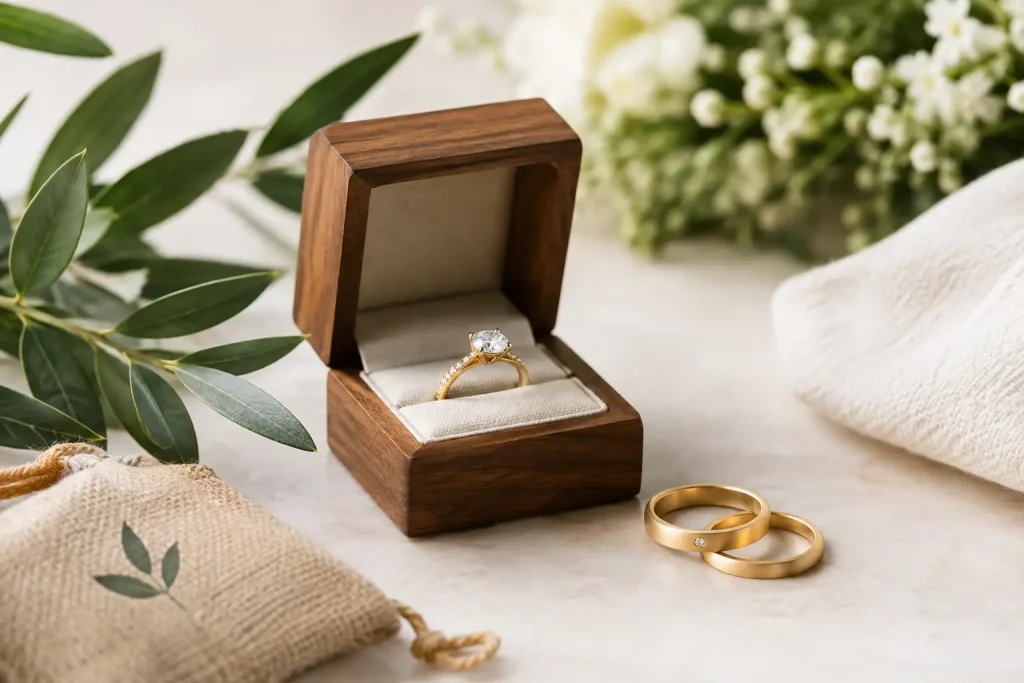
Your wedding ring may be one of the few things from your wedding day that never gets packed away. It is worn through ordinary Tuesdays, big celebrations and every chapter in between. That is why a guide to ethical wedding jewellery should be about more than choosing a label – it should help you create a ring whose materials, making and meaning all feel right to you.
Ethical choices do not have to make a ring look worthy rather than beautiful, or force you into a design that does not suit your engagement ring. With the right questions and a little expert guidance, you can choose a wedding band that fits comfortably, complements your existing ring and reflects what matters most to you both.
What does ethical wedding jewellery really mean?
There is no single definition of ethical wedding jewellery. For one couple, it may mean recycled precious metal. For another, it is a traceable diamond, a laboratory-grown stone, or the chance to reset a cherished family piece. Often, it is a combination of considered sourcing, skilled local craftsmanship and making something that will be treasured rather than replaced.
A genuinely thoughtful jeweller should be comfortable explaining where their materials come from, how their pieces are made and what options are available at different budgets. Beware of vague claims that sound reassuring but offer no detail. Terms such as “eco-friendly” or “conflict-free” can be a starting point, but they do not tell the whole story on their own.
Ethics are also personal. A newly mined, independently certified metal may matter more to you than recycled gold. You may prefer a lab-grown diamond for its known origin, while another couple may choose an antique diamond because reusing an existing stone feels most meaningful. The best choice is an informed one, not a prescribed one.
Start with the metal you will wear every day
For wedding rings, metal is usually the biggest material decision. Recycled gold and platinum are popular choices because they reuse precious metal already in circulation, reducing the need for new extraction. Once refined, recycled gold has the same quality and durability as newly mined gold. It can be alloyed into yellow, white or rose gold and worked into a simple band, an intricate shaped ring or a design with sentimental engraving.
Newly mined precious metals can also be a considered option when they come with clear sourcing standards and responsible mining credentials. The important question is not simply whether a metal is recycled or mined, but whether the jeweller can clearly account for its supply chain.
Your lifestyle should remain part of the decision. Platinum is naturally white, dense and hard-wearing, making it a lovely choice for a ring that will see constant wear. Gold offers warmth and versatility, with 18ct gold being a classic choice for bridal jewellery and 9ct often offering a more budget-conscious alternative. White gold may need occasional rhodium plating to retain its bright white finish, whereas platinum develops a soft patina over time. Neither is better in every situation – comfort, colour preference, maintenance and budget all matter.
Consider stones with care, not pressure
If your wedding band includes diamonds or coloured stones, ask about origin and documentation. A responsible jeweller should be able to explain the choices available without making you feel that one route is morally perfect.
Natural diamonds can be selected through suppliers with strong traceability practices and recognised industry standards. Laboratory-grown diamonds are physically diamonds too, with the same sparkle and durability, but are created in a controlled setting rather than mined. They can offer a larger stone for a given budget, although resale values and long-term market behaviour can differ from natural diamonds.
For a more individual look, sapphires, rubies and other coloured gemstones can be wonderful in wedding bands, particularly when matched to a coloured-stone engagement ring. Their ethical picture varies greatly by mine, country and cutting route, so provenance is especially worth discussing. An old-cut diamond or gemstone from inherited jewellery may also be a beautiful answer, giving an existing stone a new life while keeping family history close.
Reusing heirloom jewellery
Heirloom remodelling is one of the most personal forms of ethical jewellery, but it needs careful planning. Some older stones can be removed and reset safely, while others may have wear, chips or settings that need attention. The metal itself may not always be suitable for direct reuse in a new ring, particularly if its composition is uncertain or it has become brittle over time.
A specialist can assess what is possible and help preserve the character of the original piece. Sometimes the most meaningful solution is not to melt down every element, but to reuse a diamond, replicate a distinctive engraving or take design cues from an older ring.
Why bespoke design can be the more thoughtful choice
An ethical ring is also one made to be worn and loved for decades. Bespoke design gives you the opportunity to consider proportion, fit and durability before the ring is made, rather than settling for a band that sits awkwardly beside your engagement ring.
This is particularly valuable if your engagement ring has a low setting, an unusual profile, a prominent centre stone or side stones along the band. A shaped-to-fit wedding ring can curve gently around it, leaving the right amount of space without forcing the rings to rub. It should look intentional from every angle, not like a compromise made at the last minute.
Working directly with a jeweller also reduces the risk of unnecessary buying and remaking. You can share photographs of your engagement ring, reference images and the details that matter to you, then refine the design before it is crafted. A fine band with a subtle curve may be exactly right for one person; another may need a wider, sturdier profile that balances a substantial engagement ring. Ethical choices should support lasting wear, not just a momentary trend.
Questions worth asking before you commission a ring
A good consultation should leave you feeling clearer, not overwhelmed. Ask where the metal is sourced and whether recycled or responsibly mined options are available. If you are choosing stones, ask what information is provided about their origin, whether they are natural, laboratory-grown or reclaimed, and how this affects price and future care.
It is also sensible to ask who will make the ring, where it will be made and what aftercare is offered. In the UK, precious-metal jewellery over specified weights must be hallmarked by an approved Assay Office. A hallmark is not a complete ethical certificate, but it is an important assurance of the metal’s fineness and a useful sign that you are buying from a responsible jeweller.
Finally, discuss the practical details. Will the band sit flush against your engagement ring? Can it be resized in future? Are stones securely set? Is engraving possible? The answers help you choose a design that remains part of your life, rather than a precious object you are afraid to wear.
Let your budget reflect your priorities
Ethical wedding jewellery is not only for unlimited budgets. A simple recycled 9ct gold band can be every bit as meaningful as an elaborate platinum ring with diamonds. If your budget is finite, it may be wiser to prioritise a comfortable bespoke fit and well-made metalwork, then keep decorative details understated.
There are thoughtful ways to adjust a design without losing its character. You could choose a narrower band, use a small number of carefully placed stones, select lab-grown diamonds, or incorporate one heirloom stone rather than purchasing several new ones. Clear conversations about budget allow the design to be shaped around what matters, rather than making you feel pushed towards something beyond your means.
A ring with a story you can stand behind
The most meaningful wedding jewellery is rarely the piece with the longest list of claims. It is the ring that feels considered in your hand: made from materials you understand, designed around the person wearing it and crafted to become part of your shared story.
At BWR London, that can begin with something as simple as a photograph of your engagement ring, a family jewel box or an idea you have been saving for years. Give yourself permission to ask questions, take your time and make a choice that feels as good on your hand as it does in your heart.