

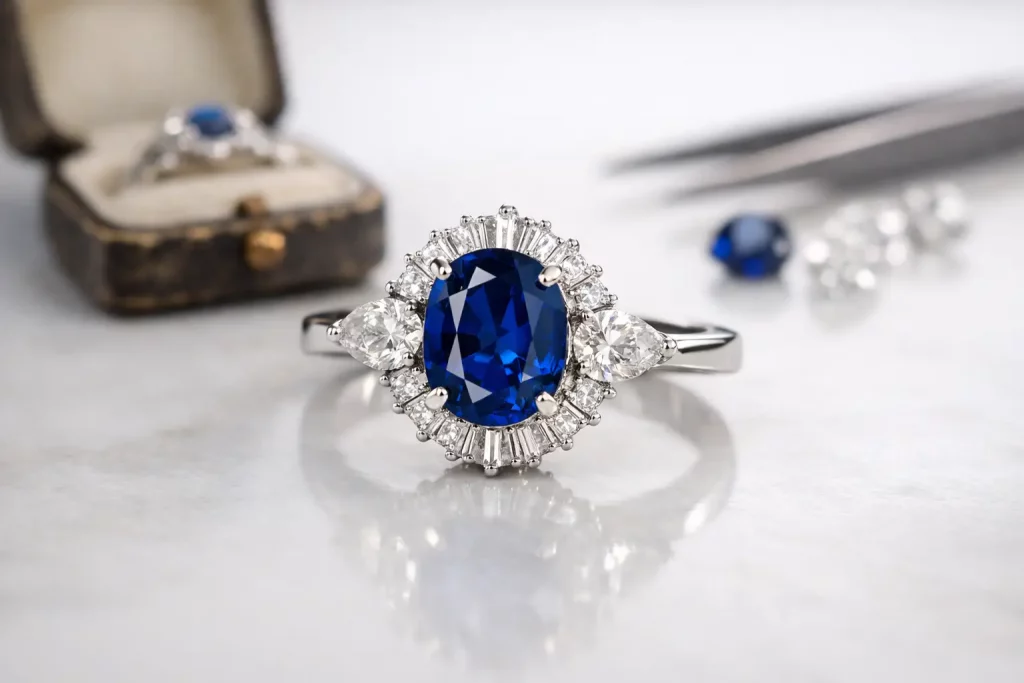
A sapphire passed down through a family can carry far more than its monetary value. It may remind you of a grandmother’s hands, a parent’s wedding day, or a piece of jewellery that has sat carefully tucked away for years. This heirloom sapphire redesign example shows how an older ring can become a piece you genuinely enjoy wearing, without losing the story that made it precious in the first place.
The aim is not to erase the past. It is to give a meaningful stone a new role in your life, whether that means a future engagement ring, a right-hand ring, or a wedding band designed to sit beautifully beside it.
The starting point: a sapphire with a story
Imagine a client brings in a late grandmother’s ring: a deep cornflower-blue oval sapphire held in a traditional yellow-gold setting. The stone is beautiful but the ring itself is not quite right for its new owner. The shoulders feel high, the setting catches on knitwear, and the yellow gold does not suit the jewellery she wears every day.
There is also an emotional consideration. She does not want a copy of the old ring, nor does she want to feel that she has dismantled something important. She wants a design that feels considered, wearable and distinctly hers.
That is a very common place to begin. A redesign works best when it starts with an honest conversation about what you love, what you would change, and which details deserve to be remembered.
Heirloom sapphire redesign example: from old ring to everyday piece
Before sketching a new design, the sapphire should be assessed carefully. A jeweller will look at its condition, including any surface wear, chips around the girdle, or existing fractures. Sapphires are durable stones for everyday wear, but they are not indestructible. An older stone may have lived through decades of knocks, and its new setting should respect that.
In this example, the sapphire is in good condition but has a slightly shallow cut. Rather than forcing it into a very high claw setting to make it appear larger, the design is built around its natural proportions. The client chooses platinum for its cool tone and strength, with a low-profile setting that makes the ring feel secure and easy to wear.
The oval sapphire is set north to south in a refined bezel with an open gallery beneath it. A bezel is a rim of precious metal that follows the edge of the stone. It offers excellent protection and gives a softer, more contemporary outline than prominent claws. The open gallery allows light to reach the sapphire from the side, while keeping the overall ring lower on the finger.
To retain a connection to the original piece, a small detail from the old ring is carried forward. The former setting had delicate leaf-shaped engraving along the shoulders. Instead of recreating it heavily, the new ring features a fine engraved motif on the inside of the band, visible only to its wearer. It is a quiet reminder rather than a literal reproduction.
This is often where bespoke design becomes especially meaningful. A family ring can be honoured through its stone, its engraving, its metal, or simply the feeling it carries. You do not need to preserve every visual detail for the redesign to remain faithful to its history.
Choosing a setting that suits real life
A sapphire redesign should look lovely in photographs, but it must also work on an ordinary Tuesday. Comfort, durability and ease of wear matter just as much as the first impression.
For someone who works with their hands, has young children, or simply dislikes catching a ring on clothing, a low bezel or low claw setting is often sensible. For someone who loves a more classic engagement-ring look, a claw-set sapphire with a protective gallery may be the better fit. Neither is automatically right. It depends on your lifestyle, the shape and condition of the stone, and how you want the ring to feel.
Band width also changes the character of the finished piece. In our example, the client selects a gently rounded 2mm platinum band. It is substantial enough to balance the oval sapphire, yet slim enough to remain elegant and comfortable. A wider band might have created a bolder, more architectural look; a narrower one may have made the centre stone feel more prominent. Seeing proportions through sketches or design imagery can make this decision much easier.
If the ring may eventually sit alongside a wedding band, that should be considered from the beginning. A low-set sapphire ring can leave little room for a straight band to sit flush. There are several lovely solutions: creating a shaped wedding ring later, setting the sapphire high enough to accommodate a straight band, or designing both rings as a pair. Planning ahead avoids a frustrating compromise when the time comes to choose wedding jewellery.
What happens to the original gold?
Clients often ask whether the original ring’s metal can be used again. In some cases, it can be recycled into a new piece, particularly when the metal type and design allow for it. However, it is not always the best technical option. A jeweller may recommend using new, traceable metal for the main structure of a ring, especially where strength and consistency are essential.
That does not mean the old gold has to disappear. It could become a small companion piece, such as a pendant, a charm or an engraved disc. It may also be retained as a keepsake. Some families prefer to preserve the original setting intact, even after the central sapphire has been reset. Others feel happiest when the material itself is part of the next chapter.
The right answer is personal, and a good redesign process leaves room for that decision rather than rushing it.
Adding sentimental details without overloading the design
An heirloom sapphire already carries significance, so the most successful redesigns usually avoid adding every possible feature. One or two intentional details often say more than a crowded design.
In this example, the client adds an inscription inside the platinum band: her grandmother’s initials and the year the original ring was given. The engraving is private, enduring and easy to live with. If desired, a tiny accent diamond could be set inside the band, or a birthstone could be incorporated discreetly beneath the sapphire.
These choices should complement the stone rather than compete with it. A saturated blue sapphire has real presence. Pairing it with too many diamonds, ornate shoulders or multiple colours can sometimes distract from the very thing you wished to preserve. On the other hand, a halo of diamonds or a trilogy design can be perfect when the stone needs more visual scale or when you want a more traditional bridal feel.
Questions worth asking before a redesign
A considered consultation should give you confidence, not pressure. Bring photographs of the original ring from different angles, any family information you have, and images of styles you are drawn to. You do not need to know the correct jewellery terms. Knowing that you want something delicate, comfortable, vintage-inspired or clean-lined is a useful starting point.
It is also worth discussing how often you will wear the ring, whether it needs to stack with other jewellery, your preferred metal colour, and your budget. The cost can vary depending on the condition of the sapphire, the complexity of the setting, the metal chosen, and whether additional stones or engraving are included. A clear design process helps you understand where the budget is going and where choices can be adjusted without losing the heart of the piece.
At BWR London, this kind of project begins with listening. You can share reference images, talk through the original ring, and explore a design that works around both your sapphire and your life.
A family sapphire deserves more than a setting that is merely safe. Given thoughtful attention, it can become the ring you reach for every morning: familiar in its meaning, fresh in its design, and ready to gather stories of its own.