

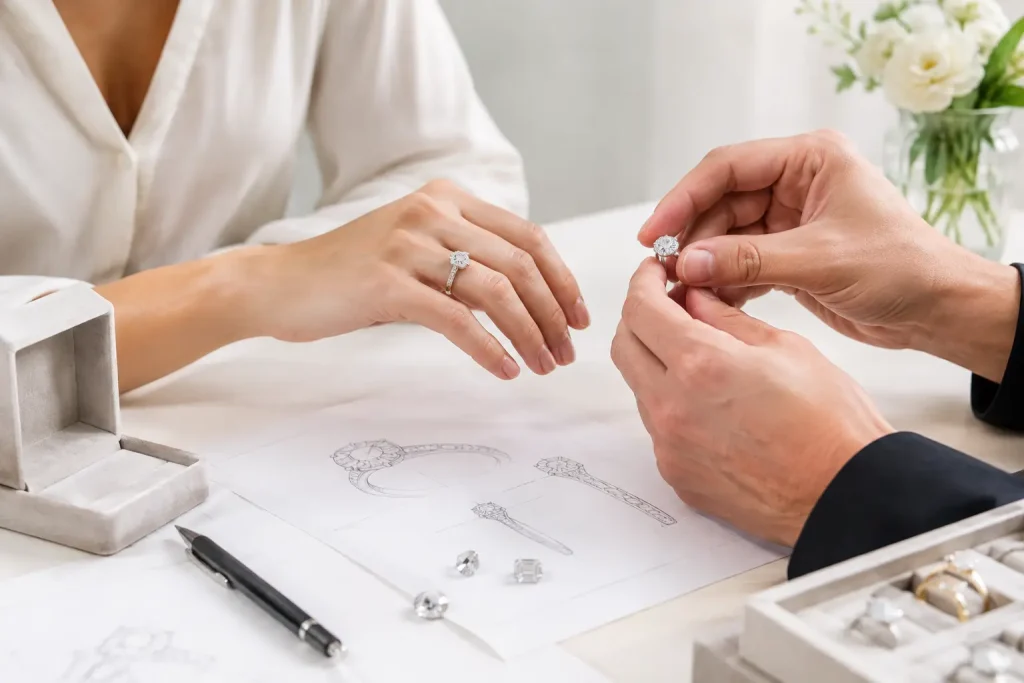
Your wedding ring should not feel like an item you happened to pick from a tray. It is the piece you will reach for every morning, alongside an engagement ring that may already hold years of meaning. Knowing how to commission wedding jewellery gives you the freedom to make those two pieces belong together, whether that means a precisely shaped band, a secret engraving or a design inspired by family jewellery.
A bespoke commission is not about making the process more complicated. With the right jeweller, it is a thoughtful conversation that turns your ideas, practical needs and budget into a ring that feels unmistakably yours.
Start with the ring you already wear
For many couples, the engagement ring is the natural starting point. Its setting, stone shape and profile will influence whether a straight wedding band will sit comfortably beside it. If the centre stone sits low, a standard band may leave an awkward gap, push against the setting or simply feel wrong when worn as a pair.
This is where commissioning is particularly valuable. Your jeweller can assess the engagement ring in person, or begin from clear photographs and measurements, then create a wedding band shaped to follow its contours. A gentle curve, a deeper notch or an asymmetrical sweep can allow the rings to sit neatly together without compromising the look of either piece.
Do not assume a shaped band has to be dramatic. Some of the most successful designs are almost invisible from a distance: a small contour where it is needed, with a clean, classic profile everywhere else. Equally, if you love the idea of two rings that make a statement together, the shape can become part of the design rather than a problem to hide.
How to commission wedding jewellery with a clear brief
You do not need a technical sketch or perfect jewellery vocabulary before speaking to a bespoke jeweller. A good commission begins with the details you already know: what you wear every day, what you love about your engagement ring and what is not working for you in ready-made options.
Reference images are genuinely useful, especially when they show individual elements you are drawn to. You may like the softness of one band, the texture of another and the setting style of a third. Share them all, but also explain why each image appeals. That gives your jeweller a clearer sense of your taste than asking them to copy a single ring exactly.
It also helps to be honest about practical preferences. Think about whether you work with your hands, exercise frequently, prefer jewellery you barely notice or want a band with visible sparkle. A highly detailed design can be beautiful, but it may need more care than a smooth, low-profile ring. There is no universally right choice – only one that suits your life.
At BWR London, the most useful starting point is often a one-to-one conversation built around the engagement ring, your ideas and how you want the finished set to feel. That personal guidance matters because a bespoke ring should be designed for the wearer, not just for a photograph.
Bring the practical details too
Alongside inspiration, your jeweller will need to understand the ring size, preferred metal, approximate width and any non-negotiables. If your engagement ring is platinum, you may want a platinum wedding band for a consistent look and similar wear over time. But matching metals is not a rule. Yellow gold beside platinum can create a deliberate contrast, while rose gold can bring warmth to a vintage-inspired setting.
Ring width changes more than appearance. A narrow band may feel delicate and leave more attention on the engagement ring; a wider band can feel bolder and offer space for engraving, texture or stones. The depth of the ring matters too. A comfort-fit interior, gently rounded on the inside, can make a meaningful difference when you wear it every day.
Choose materials and details that mean something
The material is the foundation of your commission. Platinum is naturally white, strong and valued for its reassuring weight, while gold offers a range of colours and carats. Higher-carat gold contains more pure gold, but can be softer, so the best option depends on the design and your day-to-day routine.
Ethical sourcing should be part of the conversation, not an afterthought. Ask where metals and stones come from, and whether recycled precious metal or traceable stones are available. The answers can help you choose materials that feel as considered as the design itself.
Personal touches do not need to be visible to everyone else to be powerful. An engraved date, initials, a short phrase or a line in your own handwriting can turn a beautiful ring into a private reminder. Some couples incorporate a small hidden stone, use an inherited gemstone, or rework gold from a family piece. These choices carry real sentiment, though they may affect the design process. Older jewellery can sometimes be reused, but its condition and metal composition need to be checked before it is melted down or reset.
If you are adding diamonds or gemstones, consider how they will be set. Pavé stones can bring a fine line of light, while channel or flush settings offer a smoother surface for people who lead active lives. Stones around the full circumference look striking but cannot usually be resized easily. A half-set design may be the more practical choice if your ring size changes in future.
Agree the budget before the design is finalised
A bespoke ring does not have to mean an open-ended budget. In fact, a clear budget often leads to better design decisions early on. Tell your jeweller what feels comfortable, including whether that figure needs to cover engraving, stones, resizing or adjustments to an engagement ring.
Cost is shaped by the metal, ring weight, complexity of the shape, stone quality and quantity, hand finishing and any remodelling work. A complex fitted ring may require more design and bench time than a straight band, but there are ways to protect the feeling of the design if the first idea is beyond budget. Reducing the width slightly, choosing a half-set stone design or simplifying a detail that will not be visible when worn can all make a difference.
The aim is not to remove everything special. It is to spend where it matters most to you. For one person, that may be a perfect fit beside the engagement ring; for another, it may be an heirloom diamond or a deeply personal engraving.
Allow enough time for a considered commission
Wedding planning can make even simple decisions feel urgent, so leave room for the jewellery process. Bespoke work involves consultation, design development, production and fitting. If the ring has an unusual shape, gemstones or a remodelled heirloom element, it may need extra time.
Try to begin the conversation several months before the wedding where possible. This gives you breathing room to consider options rather than settling for the quickest available solution. It also allows time for any final adjustments after you have tried the ring on with your engagement ring.
If your date is close, still ask. Some designs are more straightforward to produce than others, and an experienced jeweller can explain what is realistic without promising the impossible. Clear communication is far more reassuring than rushing a decision you will wear for decades.
Make the fitting part of the experience
The first time you try on a commissioned wedding ring, wear it with your engagement ring and move your hand naturally. Clench your fist, hold a bag and notice whether the rings rub, spin or catch. Comfort is not a finishing touch. It is a core part of good design.
Look at the rings in ordinary light as well as bright showroom lighting. Ask whether the finish will develop a soft patina, how to care for the setting and what resizing options are available later. A polished surface may show fine marks sooner than a textured or brushed finish, but each can be restored and enjoyed in its own way.
The best commission leaves you feeling heard, not overwhelmed. Bring the ring you love, the images that have stayed with you and the story you want to carry forward. From there, the right questions and careful craftsmanship can create a wedding ring that feels at home from the very first day.