

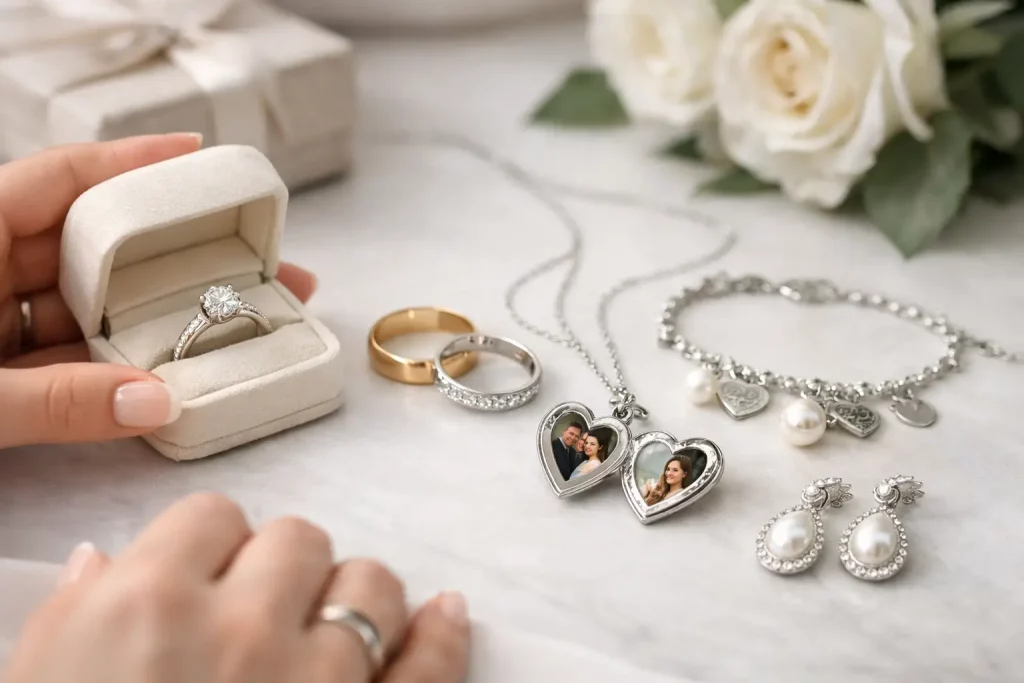
Your wedding ring will sit beside your engagement ring every day, often for decades. That is why choosing to personalise wedding jewellery is about far more than adding a date inside a band. It is an opportunity to create something that fits your hand, your relationship and the way you actually live.
The most meaningful rings rarely begin with a trend. They begin with a conversation: what do you want to remember, what needs to feel comfortable, and how should the wedding band work with the ring you already love? With the right guidance, even the most specific ideas can become a beautifully wearable piece.
Start with the story you want the ring to hold
Personalisation works best when it has a reason behind it. That reason can be quietly private or immediately visible. Some couples choose an engraving taken from a handwritten note, while others incorporate a family stone or redesign gold from an inherited piece of jewellery. A wedding band can echo the profile of an engagement ring, include a hidden birthstone, or carry a motif that only makes sense to the two people wearing it.
You do not need to arrive with a fully formed design. In fact, a reference image, a photograph of an heirloom, or a few thoughts about your shared style are often enough to begin. A good bespoke process is about listening carefully and translating those details into proportions, materials and finishing that feel considered rather than overly decorative.
It can help to decide whether you want the personal element to be visible. A distinctive shaped band, a coloured gemstone or an engraved outer edge makes a clear statement. An interior engraving, a tiny stone set beneath the setting, or a detail on the side of the band is more discreet. Neither approach is more meaningful. It simply depends on what feels natural to you.
Personalise wedding jewellery around the engagement ring
For many brides, the practical challenge is finding a wedding band that sits properly alongside an engagement ring. A straight band may leave an awkward gap, push against the setting or hide details you want to see. This is where a shaped-to-fit wedding ring can make all the difference.
Rather than forcing your engagement ring to work with an off-the-shelf band, a bespoke jeweller can assess its shape and create a curve, notch, contour or open design that follows it closely. The goal is not only a neat fit. It is to make the two rings look as though they were always intended to be together.
There are trade-offs worth discussing early. A band designed to sit flush against one particular engagement ring may not look quite the same if worn alone. A deeper curve can be striking, but it may reduce the amount of metal in certain areas. Likewise, a delicate diamond-set band can complement a detailed engagement ring beautifully, though it may need more careful consideration if you have a hands-on job or prefer low-maintenance jewellery.
This is why trying on sample shapes and talking through your day-to-day routine matters. Comfort should never be an afterthought. The best design is one you are excited to wear on your wedding day and still enjoy reaching for years later.
Choose details that feel personal, not prescribed
Engraving remains one of the loveliest ways to make wedding jewellery your own, but it need not be limited to names and a wedding date. Consider the coordinates of where you met, a line from a letter, initials in your own handwriting, or a short phrase that belongs to your relationship. The available space will depend on the width and profile of the band, so a jeweller can help you choose wording that stays clear and balanced.
Metal choice also carries character. Yellow gold has warmth and a timeless feel, while platinum offers a naturally white finish and reassuring durability. Rose gold can bring softness, particularly alongside warmer-toned stones. Mixing metals is another option, especially if your engagement ring and everyday jewellery do not all match. There is no rule requiring a wedding band to be identical to the engagement ring. What matters is that the combination feels intentional.
The finish changes the personality of a ring too. A high polish catches the light and feels classic; a satin or brushed finish has a quieter, contemporary look. Fine milgrain edges, hand engraving, subtle texture and carefully placed stones can add interest without taking attention away from the overall design.
Give heirloom jewellery a new chapter
Family jewellery can hold enormous sentiment, yet a ring or brooch tucked away in a box is not always something you will wear. Remodelling an heirloom can be a thoughtful way to carry that connection forward into your marriage.
The process needs sensitivity. Some pieces are suitable for reusing as they are, while others may be too worn, thin or structurally compromised to remake safely in the same metal. Stones can often be assessed for reuse, but their condition, cut and setting requirements should guide the design. Sometimes the most practical choice is to take inspiration from an heirloom rather than dismantle it.
A meaningful result does not have to replicate the original piece. A grandmother’s diamond might become a small, hidden detail within a new wedding band. An old pattern may be reinterpreted as hand engraving. A jeweller can help you preserve the sentiment while ensuring the finished ring is secure, comfortable and made for regular wear.
Make the bespoke process feel manageable
Custom jewellery can sound intimidating when you are already arranging venues, guest lists and outfits. It should not feel that way. The process is usually most straightforward when decisions are taken in stages: begin with the engagement ring or your inspiration, discuss practical preferences and budget, review a proposed design, then move into making the ring once you are happy.
Bring your engagement ring to an appointment where possible. If that is not practical, clear photographs from several angles and accurate measurements can provide a useful starting point. Include images showing the side profile and underneath the setting, not only the top view. These details affect how a shaped wedding band will sit.
Be open about budget from the beginning. Personalisation does not automatically mean adding every possible feature. Often, one well-chosen detail has more impact than several competing ones. The width of the band, metal weight, stone size and complexity of the shaping all influence cost, so a bespoke design can usually be adjusted to prioritise what matters most.
Allow enough time before the wedding, particularly if your design involves engraving, stones, remodelling or a shaped fit. A considered process leaves room for questions and avoids turning an emotional purchase into a last-minute compromise.
Ask the questions that protect your future ring
Before confirming a design, ask how the ring will wear over time, whether it can be resized, and how it should be cared for. If diamonds or gemstones are involved, ask about setting security and cleaning. If you are pairing it with an engagement ring, check whether the two rings may rub together and how that can be minimised.
Ethical sourcing is another valuable conversation. Knowing where precious metals and stones come from adds a layer of confidence to a piece intended to symbolise a lifelong commitment. At BWR London, this sits alongside one-to-one support, because the choices behind a ring should feel as good as the ring itself.
Most of all, give yourself permission to choose something that does not look like anyone else’s. A personalised wedding ring can be understated, sculptural, traditional or completely unexpected. The right one is not the design with the most details. It is the one that feels immediately yours each time you look down at your hand.