

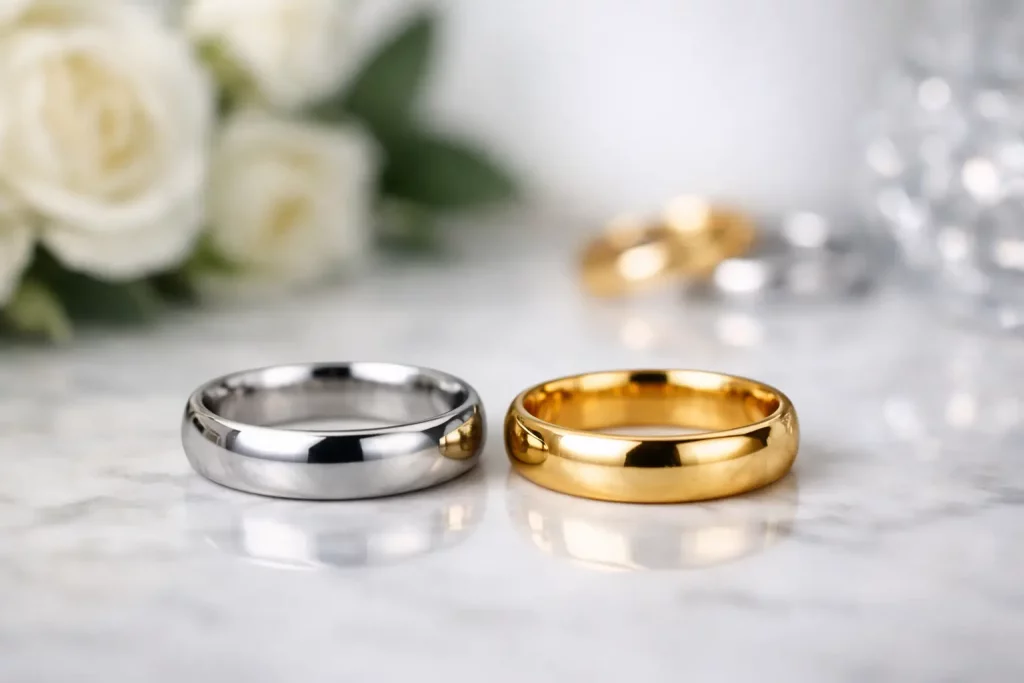
A platinum or gold wedding band can look like a simple choice on paper, yet it shapes the ring you will reach for every morning for decades. The best metal is not necessarily the most expensive, the hardest, or the one somebody else chose. It is the one that suits your engagement ring, your daily life, your personal style and the feeling you want your wedding ring to carry.
For many couples, this decision becomes clearer once they stop thinking in terms of a right answer and start considering the details that are personal to them. The colour of your existing jewellery, the shape of your engagement ring, how hands-on your work is, and whether you want a crisp polished finish or a ring that gathers its own story over time all matter.
Platinum or Gold Wedding Band: The Key Difference
Platinum and gold are both beautiful, precious metals, but they wear differently and create a distinctly different look. Platinum is naturally white, dense and understated. Gold offers more colour choice, from warm yellow gold to soft rose gold and bright white gold.
Platinum is usually 95% pure in wedding jewellery. Its naturally white tone does not depend on plating, so it retains its cool colour throughout its life. It is also wonderfully substantial. Some people love that reassuring weight on the finger, while others prefer a lighter band.
Gold wedding bands are commonly made in 9ct, 14ct or 18ct gold. The higher the carat, the greater the proportion of pure gold and the richer the colour. In the UK, 18ct yellow gold is a popular choice for a wedding ring that feels luxurious and enduring, while 9ct can offer a more accessible price point and a slightly harder alloy.
The decision is not simply about quality. A beautifully made gold band can be every bit as meaningful and suitable as platinum. The question is which material feels most like you.
Choose Platinum if You Love a Cool, Lasting White Finish
Platinum has a quiet elegance that works especially well with white diamonds and white-metal engagement rings. If your engagement ring is platinum, a platinum wedding band often creates the most coordinated result, particularly when the two rings sit closely together.
One characteristic worth understanding is that platinum does not wear away in the same way as gold. Over time, it can develop a gentle satin-like patina as the surface is displaced rather than lost. Many people adore this lived-in finish because it gives the ring character. If you prefer a bright, mirror-polished appearance, platinum can also be professionally polished when needed.
Platinum is a strong choice for someone who wants a naturally white metal without the ongoing maintenance that can come with white gold. It is also generally considered a good option for sensitive skin because of its high purity, although individual allergies should always be discussed before choosing any metal.
Its main trade-off is cost. Platinum is denser and typically more expensive per gram, so a wide or heavy design can command a noticeably higher price. If your heart is set on platinum but budget is a consideration, changing the width, profile or finish of the band can often make a meaningful difference without compromising the design.
Choose Gold for Colour, Contrast and Flexibility
Gold has a warmth that many couples find impossible to replace. Yellow gold has been treasured for centuries, and its rich tone can make even the simplest court-shaped band feel deeply romantic. It is also an especially lovely choice if you wear yellow gold jewellery every day or want a ring with a traditional feel.
A yellow gold wedding band beside a platinum or white gold engagement ring can look intentional rather than mismatched. This mixed-metal pairing brings out the diamond’s brightness while giving the wedding band its own presence. It can be particularly effective with an heirloom-style engagement ring or a design that already combines different tones.
Rose gold has a softer, more distinctive warmth. It suits those who want something less conventional and can be especially flattering against a range of skin tones. As with any choice, try not to select rose gold solely because it is fashionable. Look at it next to the engagement ring and imagine it as part of your everyday wardrobe.
White gold gives a similar appearance to platinum at a lower initial cost. Most white gold rings are rhodium plated to achieve their bright white finish. That plating can gradually wear with regular use, meaning the ring may need replating from time to time to restore its original brightness. This is a straightforward service, but it is worth factoring into a lifetime of wear.
Matching Your Engagement Ring Matters, But So Does Your Taste
There is a practical reason jewellers often recommend matching the metal of an engagement ring and wedding band. Different metals can wear against one another, and a harder ring may gradually affect a softer one where they rub together. A bespoke maker can advise on the best combination for your particular rings and how they will sit side by side.
However, matching does not always mean choosing exactly the same metal. A yellow gold band can sit beautifully with a platinum engagement ring when the design allows enough space between them, or when the contrast is part of the look you love. The important thing is to make the choice deliberately, with an understanding of how the pair will wear.
For an engagement ring with a low-setting centre stone, prominent shoulders or an unusual outline, the shape of the wedding band may matter more than the metal at first. A shaped-to-fit band can curve neatly around the engagement ring, protecting the overall look and avoiding an awkward gap. Once the fit is resolved, you can explore whether platinum, yellow gold, rose gold or white gold best completes the design.
Think About Your Everyday Life
A wedding ring should be designed for real life, not just the photographs on your wedding day. If you work with your hands, go to the gym, garden, care for children or simply prefer not to remove your jewellery often, comfort and profile deserve as much attention as the metal itself.
A rounded court profile is a classic choice because it feels smooth against the finger. A flat band offers a more contemporary look, while a bevelled edge can add definition without becoming uncomfortable. Platinum’s density gives a ring a satisfying presence, but a slim platinum band may feel different from a wider gold one. Trying sample widths and profiles can be more revealing than looking at photographs alone.
Surface finish also changes how a ring lives with you. High polish reflects the light beautifully but can show fine marks sooner. A brushed, satin or hammered finish can make everyday wear feel more forgiving and give the ring a more individual character. These are not flaws to fear. They are part of choosing a ring that will be genuinely worn.
Make Room for the Details That Make It Yours
The most memorable wedding bands are often personal in ways that are not immediately visible. An engraving of a date, initials, a line from a shared song or a private phrase turns the inside of a ring into something only the two of you fully understand.
You might also consider using a small stone, incorporating inherited gold, echoing a detail from the engagement ring, or creating an unusual shaped band that follows its contours. These choices can be made in either platinum or gold, though the design, engraving depth and any heirloom material should be assessed carefully by a specialist.
At BWR London, the process begins with listening. Whether you have a clear sketch, a saved reference image or only a sense of how you want the ring to feel, a one-to-one conversation can turn a difficult metal choice into a considered design that sits beautifully with your engagement ring and your life.
A Simple Way to Decide
If you are torn, place your engagement ring next to samples of platinum, yellow gold, white gold and rose gold in natural light. Notice which combination makes you smile before you start analysing it. Then consider the practical questions: do you want a naturally white metal, are you comfortable with occasional white-gold replating, do you prefer weight or lightness, and what budget feels right for your chosen width and shape?
There is no need to rush this decision or follow a rule that does not reflect your relationship. Your wedding band will become familiar very quickly, but its meaning will continue to grow. Choose the metal that feels right on your hand, works thoughtfully with your engagement ring, and gives you that small, certain feeling of recognition every time you look down.