

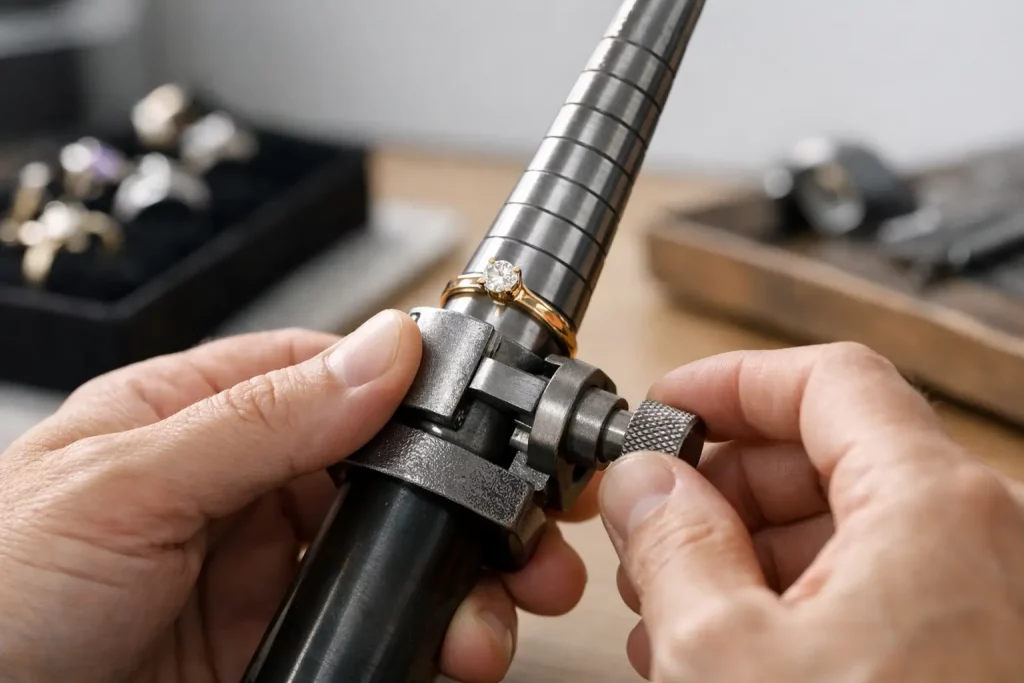
A ring that suddenly feels tight can turn a small daily irritation into a real worry, particularly when it is your engagement ring or wedding band. Stretching a ring to fit may sound like the simplest answer, but it is only suitable for certain designs, metals and size adjustments. The right decision should protect not just the fit, but the strength, setting and story of the ring you love.
Can a ring be stretched to fit?
Sometimes, yes. A skilled jeweller can enlarge a simple ring by gently expanding the shank, the lower part of the band that sits beneath your finger. This is usually done with specialist equipment, applying controlled pressure until the ring reaches a slightly larger size.
It is not a universal resizing method. Stretching works best on a plain, reasonably substantial band in a suitable metal, where only a small adjustment is needed. Think of it as a fine-tuning option rather than a way to make a ring dramatically bigger.
For most rings, the possible increase is modest – often around a quarter to half a ring size, depending on the metal, width and condition of the band. Attempting more can make the shank thinner and weaker, and may leave the ring out of shape. A trusted jeweller will assess the piece in person before suggesting it.
When stretching a ring to fit can work well
A plain yellow gold wedding band with no stones, engraving or patterned edges can often be a good candidate. Gold is relatively malleable, and a classic, solid band has enough continuity in its design for a small expansion to be discreet.
A ring may also be suitable where its fit has changed only slightly. Fingers naturally fluctuate with warmth, exercise, pregnancy, medication, travel and time of day. If a ring is comfortable most of the time but a touch too snug, stretching may offer the gentle adjustment needed without cutting into the band.
That said, comfort matters more than forcing a particular method. A ring should slide over the knuckle with a little resistance, then sit securely without pinching, spinning constantly or leaving a deep mark. If it must be twisted off every evening, it deserves proper attention.
The metal makes a difference
Traditional yellow gold is often the most straightforward metal to resize. Platinum can also be adjusted by an experienced specialist, though it behaves differently under pressure and may require another approach. Silver is softer, but its value and construction do not always make extensive work worthwhile.
Some modern metals are much less accommodating. Tungsten, titanium, zirconium and many stainless-steel rings generally cannot be stretched or conventionally resized. These materials are chosen for durability, but that hardness limits later alteration. In many cases, a replacement ring or a newly made version is the more practical option.
When stretching is not the safest choice
Rings with diamonds or other gemstones around the band should not usually be stretched. Even a small change can disturb the setting, alter the spacing between stones or place pressure on delicate claws. Eternity rings are particularly complex because their design continues all the way around.
Engraving is another consideration. Stretching can soften lettering, distort a pattern or make a sentimental inscription less clear. If a date, initials or a private message are part of why the ring matters, preserving that detail should lead the conversation.
The same caution applies to shaped wedding bands. A fitted band is made to follow the contours of an engagement ring, perhaps around a prominent centre stone or an unusual setting. Stretching can change that carefully planned curve, leaving a gap, an awkward overlap or a less comfortable fit against the engagement ring.
A very thin band, an older ring with wear at the back, or an heirloom with unknown repairs also needs careful inspection. The lower shank often receives the most wear, so it may not have enough strength for expansion. A good jeweller will never treat sentimental jewellery as a quick workshop job.
Stretching versus cutting and resizing
Traditional resizing involves cutting the shank, either adding metal to make the ring larger or removing a small section to make it smaller. The jeweller then reforms, solders and finishes the ring so the work is as discreet as possible.
This can be a better solution when a larger size increase is needed or when the ring needs its thickness and shape preserved. Adding matching metal rather than pulling the existing metal wider helps maintain the ring’s structural integrity. It also gives more control over a shaped design.
There are trade-offs. Cutting and resizing may mean recreating engraving, refinishing an intricate pattern, or carefully checking nearby stones afterwards. It takes more workmanship than simply stretching, but the least invasive option is not always the most durable one.
For a bespoke wedding band, remaking or redesigning can occasionally be the kindest route. This is especially true if your engagement ring has changed, the fit needs to be substantially different, or you would like to retain a small amount of the original metal within a new design. The aim is not to erase the meaning of the ring, but to make it wearable for the life you are building together.
Alternatives if your ring feels loose or tight
If your ring is only loose at certain times, sizing beads may help. These are small, smooth additions placed inside the shank, giving a little extra grip without changing the ring’s overall size. They can be particularly useful where a ring needs to pass over a larger knuckle but sit snugly at the base of the finger.
A hinged shank can be helpful in some circumstances too, especially for fingers with pronounced knuckles. It opens to pass over the knuckle and closes securely once in place. This is a specialist alteration, but it can preserve the appearance of a treasured ring where an ordinary resize would not solve the problem.
For temporary swelling, it may be sensible to avoid wearing the ring during hot weather, exercise or periods when your hands are noticeably puffy. Never use household tools or try to stretch a ring at home. Jewellery pliers and improvised methods can create flat spots, damage settings and turn a manageable adjustment into a costly repair.
How a jeweller decides what is right
The best advice starts with looking closely at the actual ring, not only measuring your finger. A jeweller will assess the metal, band width, hallmarks, stones, setting style, existing wear and whether the ring must sit alongside another piece.
They should also ask how you wear it. Does it feel tight all day or only in the evening? Has it always spun because your knuckle is larger? Is it a wedding band that needs to nest neatly with an engagement ring? These details can change the recommendation completely.
For couples choosing their wedding rings, it is worth discussing future resizing before the ring is made. A custom band can be designed with proportion, comfort and practical adjustment in mind from the outset. At BWR London, that conversation is part of creating a ring that feels beautifully personal, rather than merely choosing one that looks right in a tray.
A note on fitted wedding bands
If you are ordering a shaped band to sit against an engagement ring, accurate fitting is essential. The engagement ring should be assessed directly wherever possible, because photographs cannot always show the height, angle and fine details of a setting.
A bespoke fit gives you the opportunity to decide whether you want the bands to sit flush, leave a deliberate gap, or create a softer curved silhouette. It also means the width and depth of the wedding band can be balanced with your engagement ring, so neither piece overwhelms the other.
Give the ring the care its meaning deserves
A ring should never be painful to wear, and you should not have to choose between comfort and keeping a meaningful design intact. Stretching may be the right answer for a small adjustment to a simple band, but it is not automatically the safest or most lasting one.
Before making any change, have the ring assessed by a jeweller who will explain the options honestly and treat every detail with care. The best fit is the one that lets you wear your ring comfortably, confidently and often – exactly as it was meant to be worn.