

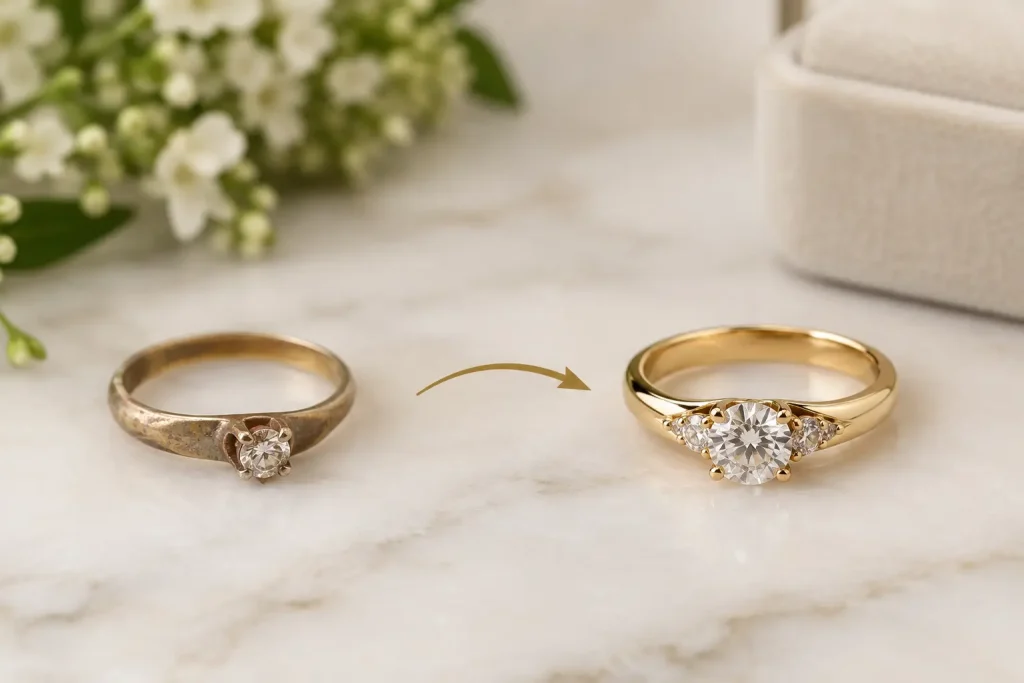
A ring can hold decades of meaning and still no longer suit the hand that wears it. In this wedding ring remake case study, we follow an anonymised, representative project: a bride-to-be wanted to transform inherited gold into a wedding band that sat comfortably beside her engagement ring, while keeping the connection to her family visible in the finished piece.
The request was not simply to melt down old jewellery and make something new. It was to decide what should be preserved, what could be changed, and how a collection of sentimental pieces could become one ring made for everyday life.
The starting point: meaningful gold, practical questions
The client had several yellow-gold items from close family members: an older wedding band, a fine chain and a small signet ring. She loved their warm colour and the idea of carrying that history into her marriage. Yet none of the pieces was practical to wear as it was. The wedding band was too small, the chain was damaged and the signet style did not reflect her own taste.
Her engagement ring added another consideration. It had a low-set central stone with a gently curved setting, so a straight wedding ring would leave an awkward gap. She wanted the two rings to look intentional together, but she did not want an overly ornate design that distracted from the engagement ring.
This is a familiar point in a remake project. Sentiment matters deeply, but comfort, strength and proportion matter too. A ring intended for daily wear needs to work in real life: at a keyboard, on the school run, while travelling, and through the small routines that make up a marriage.
Wedding ring remake case study: agreeing the design brief
Before discussing widths or finishes, the most useful question was simple: what did she want to feel when she looked at the ring?
Her answer shaped the whole brief. She wanted it to feel connected to her family, calm rather than showy, and distinctly hers. From there, the design decisions became clearer: yellow gold to honour the original pieces; a shaped profile to sit close to the engagement ring; and a discreet engraving to add personal detail without changing the clean exterior.
We also discussed whether every item needed to be used. The answer was no. Trying to incorporate every gram of gold can lead to a ring that is heavier, wider or more complicated than the wearer truly wants. In a bespoke remake, the best outcome is not always the one that uses every material available. It is the one that creates a ring you will reach for every morning.
The client chose a softly curved, shaped-to-fit band in 18ct yellow gold, around 2.2mm wide. That width gave enough presence beside her engagement ring without competing with it. A gentle court profile, rounded on the inside, was selected for a comfortable fit.
Can inherited gold always be remade?
It depends on the metal and the condition of the original jewellery. Gold alloys vary, particularly with older pieces, and repaired or mixed-metal jewellery may not behave predictably when melted. Some pieces can also contain solder that affects the final alloy.
For this reason, an experienced jeweller assesses inherited items before promising that they can be directly reused. In some cases, the gold can be refined and worked into the new piece. In others, using an equivalent amount of new, ethically sourced metal is the safer choice, while the original jewellery is retained, returned or incorporated in another thoughtful way.
That distinction can feel disappointing at first, but it protects the finished ring. A wedding band should not only look beautiful when collected. It needs the right durability and consistency for years of wear.
In this project, the inherited pieces were suitable for the remake after assessment. Their gold was carefully prepared and combined with additional metal where needed to achieve the correct alloy and strength. The client understood from the outset that the new ring would carry the material and story forward, rather than preserve the exact appearance of each old item.
Finding the shape that belonged beside the engagement ring
A shaped wedding ring is never chosen from a photograph alone. Even rings that look similar online can have different setting heights, gallery shapes and stone positions. The engagement ring needs to be measured or seen in person so the wedding band can be designed around its individual contours.
For this client, a pronounced wishbone shape would have created too much space and made the set look separate. A very shallow curve, meanwhile, would not have cleared the engagement ring setting. The final design used a subtle central dip, deep enough to nestle neatly against the setting while maintaining the visual simplicity of a classic band.
This stage often involves small adjustments that make a substantial difference. Moving the curve by a millimetre, refining its depth, or slightly tapering the shoulders can change how the rings sit together. It is why a bespoke process is particularly valuable when an engagement ring has an unusual shape or a low profile.
The client was shown the proposed proportions before the ring was made. That gave her space to consider an important trade-off: a perfectly flush fit can sometimes require a more defined curve than a client initially expects. She preferred a close, elegant fit over an invisible gap, so the final contour was refined accordingly.
The details that made the ring personal
The outer surface was finished with a soft polish. High polish catches the light beautifully, but it will show fine marks over time, especially on a ring worn every day. The client liked that gentle signs of wear would become part of the ring’s own history, rather than something to worry about.
Inside, she chose an engraving of two initials and a family date. Rather than using the wedding date, she selected the date her grandparents married. It was a quiet acknowledgement of the jewellery’s origin, known to her and her partner without needing to be explained to anyone else.
This is where a remake can feel especially moving. The sentimental value does not have to be displayed in an obvious way. It can live in the gold itself, a hidden engraving, a familiar detail from an original ring, or simply the knowledge that a cherished piece has been given a new purpose.
What this project teaches about remaking a wedding ring
The finished band looked uncomplicated, which was exactly the point. It sat closely against the engagement ring, felt comfortable from the first fitting and carried family history in a form the client could wear every day.
But the simplicity of the result came from careful choices, not a shortcut. The project worked because the design started with the client’s life and her engagement ring, rather than trying to reproduce the inherited pieces exactly. The metal was assessed honestly, the shape was made around the existing ring, and the engraving added meaning without overloading the design.
If you are considering a wedding ring remake, begin by gathering the pieces and the stories behind them. Take clear photographs of your engagement ring from above and from the side, and think about what you want to preserve: the metal, a stone, a pattern, an inscription, or the feeling of the original jewellery. You do not need a finished design before speaking to a specialist.
At BWR London, a one-to-one conversation can turn those initial thoughts into a clear, considered plan. The most personal wedding rings are rarely the loudest. They are the ones that fit your hand, your life and your story so naturally that wearing them feels like coming home.