

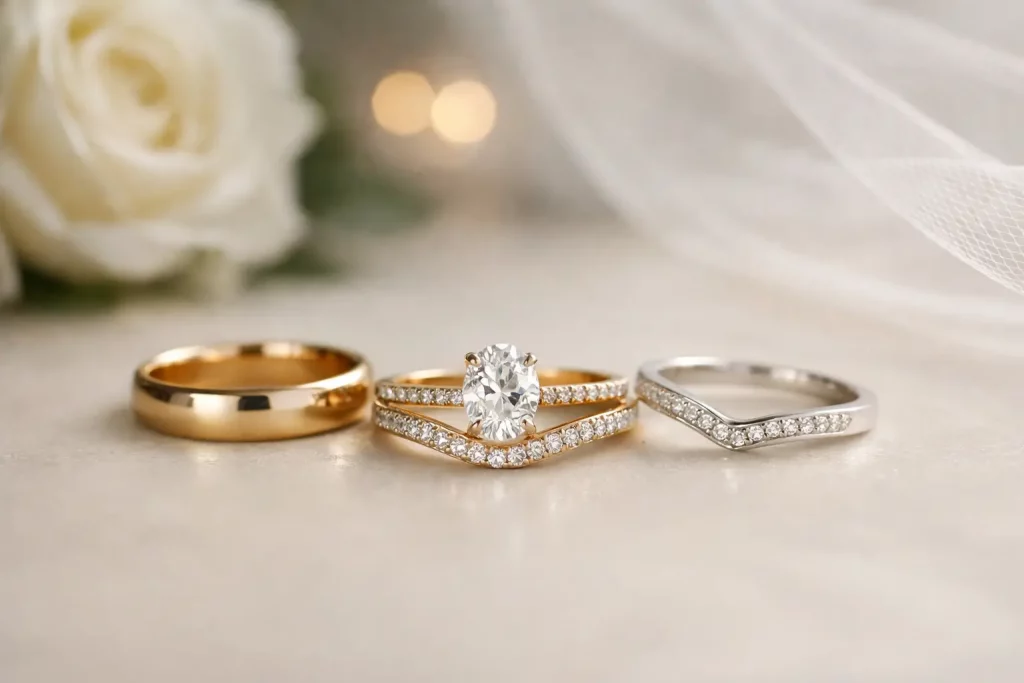
A low-set engagement ring can be wonderfully practical for everyday life. It is less likely to catch on knitwear, feels close to the hand and often has a beautifully considered profile. But when it is time to choose wedding rings for low set engagement rings, that close fit can create one very specific question: how will the two rings sit together?
The answer is rarely a standard straight band picked from a display. Your engagement ring’s setting, basket, gallery and stone shape all affect the fit. With the right design and a little expert guidance, your wedding ring can look intentional beside it, feel comfortable on the hand and honour the ring you already love.
Why low-set engagement rings need a considered fit
A low-set ring places the centre stone close to the finger. This is often achieved with a lower basket or gallery beneath the stone, rather than a setting that lifts it high above the band. While this makes the engagement ring easy to wear, it can leave little or no room for a straight wedding band to sit underneath the setting.
If a straight ring presses against the engagement ring, the two bands may sit apart with a visible gap. More importantly, repeated contact can cause them to rub against one another over time. This does not mean a low-set engagement ring is difficult to match. It simply means the shape of the wedding band should be designed around the engagement ring, rather than the other way round.
A close fit is often the aim, but it is worth defining what that means to you. Some couples want the rings to sit almost flush, with a fine contour following the engagement ring’s setting. Others prefer a deliberate breathing space between the two, particularly if they love the look of contrasting bands. Both can be beautiful when they are chosen rather than accidental.
The best wedding ring shapes for low-set rings
The right wedding band depends on the exact outline of your engagement ring, not only on whether it is low set. A solitaire with a round stone needs a different approach from an oval, pear, marquise or trilogy ring.
Curved and contoured wedding bands
A curved wedding band has a gentle sweep through the front, allowing it to nest around the centre setting. It is a popular choice for a low-set solitaire because it creates a close, elegant pairing without crowding the stone.
The curve can be subtle or more pronounced. A shallow curve is often ideal where the setting has a little clearance, while a deeper contour may be needed for a wider basket or a larger centre stone. The most flattering curve is not always perfectly symmetrical either. A bespoke band can follow the real shape and position of your setting, including a stone that sits slightly off-centre.
Notched or shaped-to-fit bands
Where the setting extends farther down the band, a notched wedding ring can be a more precise solution. Instead of one smooth curve, the ring includes a carefully shaped recess that allows space for the engagement ring’s setting.
This option is especially useful for distinctive settings, such as a ring with side stones, a low halo or an ornate gallery. Done well, the shaped section looks like part of the design rather than a compromise. It can frame the engagement ring beautifully and give the pair a sense of belonging together.
Open wedding rings
An open band has a small gap at the front, with the two ends sitting either side of the engagement ring’s centre setting. It can be minimal and modern, or detailed with diamonds, sculpted ends or meaningful birthstones.
Open styles offer flexibility where a setting is particularly low or unusually shaped. They also allow the engagement ring to remain the focal point. The trade-off is that the opening needs careful proportioning, so it looks balanced and does not catch or feel vulnerable during daily wear.
Chevron and wishbone bands
A wishbone or chevron band forms a neat point at the front. It can sit beneath certain round, oval and pear-shaped stones without touching the setting, while adding a crisp, contemporary line to the stack.
It is not the right answer for every ring. With a very low or wide setting, the point may still meet the gallery before the band reaches the finger comfortably. This is why trying a generic shape beside an engagement ring can be misleading. A made-to-measure version gives you far more control over the depth, angle and placement of the V.
Start with the engagement ring, not a stock size
The most reliable way to create a wedding band for a low-set engagement ring is to work from the ring itself. Its height matters, but so do the width of the setting, the shape underneath the stone, the position of any claws and the curve of the shank.
Photographs are a helpful starting point, particularly clear side and top views. However, a photograph cannot reveal every detail that affects the fit. When possible, having the engagement ring assessed in person allows the wedding band to be shaped with accuracy. If you are planning ahead before your engagement ring is ready, measurements and design drawings can still provide a strong foundation.
It is also wise to think about how you wear your rings. If you want them permanently joined, they can be designed to meet very closely. If you may wear your wedding band alone for work, travel or comfort, it should still feel complete and balanced without the engagement ring beside it.
Choose proportions that feel good every day
A fitted shape solves the practical challenge, but proportion creates the finished look. A very slim band can make a statement engagement ring feel even more prominent, while a wider band brings a more substantial, confident contrast. Neither is inherently better.
Consider the width of your engagement ring band, the size of the centre stone and your own hand. Matching the width can create a calm, classic set. Choosing a finer or broader wedding band adds distinction. For low-set rings, it is also useful to avoid making the shaped area excessively thin, as a design needs enough precious metal to remain durable over years of wear.
Metal choice deserves the same thought. Matching the engagement ring’s metal gives the set a unified appearance, while mixing yellow gold, white gold, rose gold or platinum can make the contour more visible. A contrasting metal can be especially striking with a simple curved band, but it will make the shape a more noticeable design feature.
Diamonds can be added too, whether you prefer a delicate row across the top, stones set around the curve, or a plain band that lets the engagement ring take centre stage. For an eternity-style look, the placement of stones should be planned around the shaped section so the ring stays comfortable and easy to maintain.
A bespoke fit should not feel complicated
Choosing a custom wedding ring is not about arriving with every answer already decided. It is about being listened to. You might have a saved image, an heirloom ring you would like to rework, or simply a clear feeling that a standard band does not quite suit your engagement ring.
At BWR London, the process begins with your ring and your preferences. Together, we can consider the fit you want, the profile that feels comfortable, your preferred metal and any personal details such as engraving or diamond accents. A shaped wedding band can be as understated or expressive as you wish, but it should always feel natural on your hand.
Allow time for this part of wedding planning. A made-to-measure ring benefits from thoughtful design, accurate sizing and careful crafting. You will also have the reassurance of knowing the final piece was created for your engagement ring, rather than asked to work around it.
When a perfectly flush fit is not the best choice
Occasionally, an engagement ring’s setting makes a completely flush fit impractical without changing the ring itself. This can happen with very wide settings, low halos or intricate vintage details. Forcing a band too tightly against these features can place pressure where it does not belong.
In these cases, a slim intentional gap, an open design or a curve that sits close without touching may be the kinder choice for both rings. A thoughtful fit protects the craftsmanship you already own. The goal is not perfection on paper, but a pairing you will enjoy wearing for a lifetime.
Bring your engagement ring, your ideas and any concerns about comfort to the conversation. The right wedding band will not compete with a low-set ring or make you work around it. It will feel like the piece that was always meant to sit beside it.