

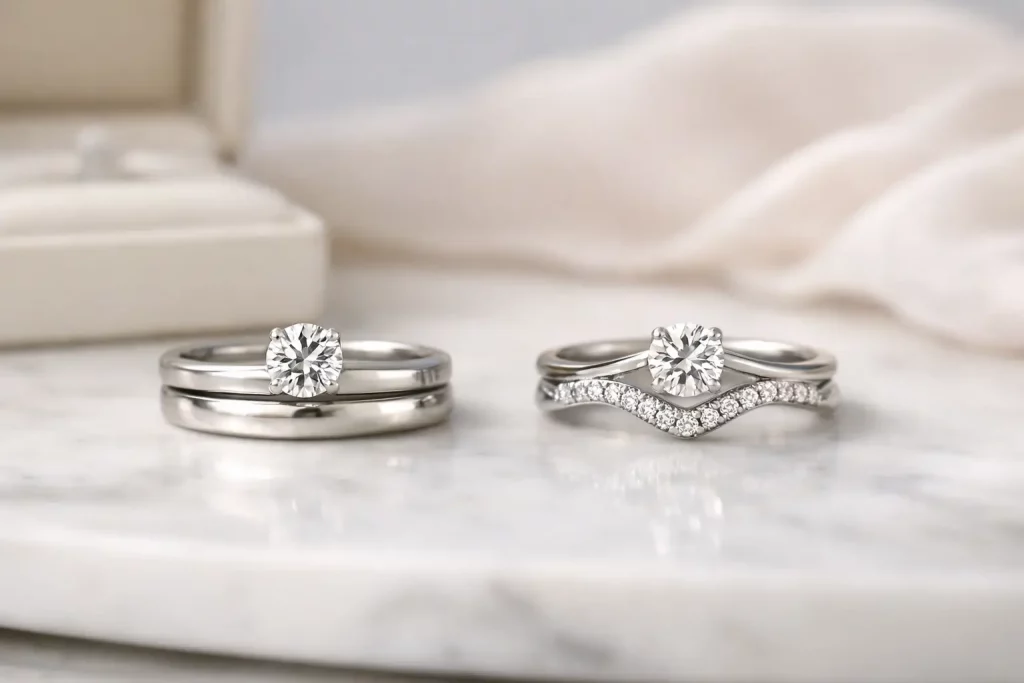
Your engagement ring may be the piece you chose first, but your wedding band is the ring that completes its story. When deciding between a flush fit or shaped band, the question is not simply which one looks best in a photograph. It is about how the rings sit together, how they feel on your hand, and what suits the design you already love.
For some couples, a straight wedding band resting neatly against the engagement ring is exactly right. For others, a carefully curved or contoured band creates the close, considered fit they have been searching for. Both can be beautiful, practical and deeply personal. The right choice depends on your engagement ring, your lifestyle and the look you want to wear every day.
What does flush fit mean?
A flush-fit wedding band sits directly alongside the engagement ring, with little or no visible gap between the two. Usually, this is possible when the engagement ring’s centre setting is raised high enough for a straight band to slide underneath or sit closely beside it.
The result is clean and classic. The rings look like a natural pair, while the wedding band retains a simple, straight profile when worn on its own. This can be particularly appealing if you like the idea of occasionally wearing your wedding ring separately, or if you may want to add an anniversary ring later.
A flush fit is not always an automatic option, however. A low-set centre stone, prominent setting, wide shoulders or an unusually shaped engagement ring can prevent a straight band from sitting close. Forcing two rings together when their shapes are not compatible can lead to rubbing, spinning or a gap that feels more noticeable than expected.
When a shaped band is the better match
A shaped wedding band is designed with a gentle curve, contour, dip or more distinctive silhouette to follow the outline of an engagement ring. You may also hear it called a fitted, curved, contoured or wishbone band. While these terms can overlap, the most useful distinction is simple: the band is made to work around your engagement ring rather than asking your engagement ring to accommodate it.
This is often the best choice for rings with low settings, oval or pear-shaped stones, halos, side stones, elongated centre diamonds, or decorative details that extend across the setting. A shaped band can nestle around these features and create a closer visual connection between the two rings.
There is no single shape that works for every ring. A subtle curve may be enough for a solitaire with a slightly low basket. A deeper contour can suit a larger stone or a ring with an elaborate setting. In some cases, an asymmetric shape gives the most natural fit, especially where an engagement ring has a distinctive design.
A shaped band does not have to look dramatic. It can be delicate and understated, with the curve only becoming obvious when the two rings are placed together. Equally, it can be a design feature in its own right, perhaps with diamonds following the curve or a pointed wishbone shape that frames the centre stone.
Flush fit or shaped band: the questions that matter
The first question is how your engagement ring sits on your finger. Look at the space beneath the centre stone and around its setting. If a straight band can sit comfortably beside it without being pushed away, a flush fit may be possible. If the ring has a low profile or the setting meets the finger close to the band, a shaped design is likely to offer a better fit.
Next, consider whether a tiny gap genuinely bothers you. Some people love a little breathing space between their rings. It can make each piece stand out and give the stack a softer, less formal feel. Others want the rings to sit together as one, without a visible break. Neither preference is more correct, but knowing yours before you begin will make the design process much easier.
Comfort also deserves more attention than it often receives. A wedding band should feel good from the ceremony through busy working days, weekends and every ordinary moment in between. A ring that is beautifully fitted should not pinch, catch or press awkwardly against the engagement ring. The profile, width and curve all affect how it feels.
Finally, think about how you want to wear the band in years to come. A straight ring is often more versatile on its own. A shaped band can be designed to look lovely independently too, but a more pronounced contour may make it feel less traditional when worn without the engagement ring. If you expect to wear them together most of the time, this may not be a concern at all.
Why a made-to-measure fit makes such a difference
Ready-made shaped bands can be useful for inspiration, but they are rarely made for the exact dimensions of your ring. Two engagement rings that look similar can have different stone heights, setting widths, angles and proportions. Even a small difference can affect how closely a wedding band sits.
A bespoke wedding ring begins with your engagement ring rather than a standard template. Measurements, photographs and the way the ring rests on your finger all help determine the appropriate curve. If you can visit in person, the fit can be assessed directly. If you are further away, clear reference images and careful guidance can still help shape the design.
At BWR London, this is treated as a conversation rather than a choice from a tray. You may have a clear sketch in mind, a saved image that captures the feeling you want, or no idea beyond wanting the rings to sit beautifully together. Each is a perfectly good place to start.
A custom design also gives you control over the details that make the ring yours. You might choose yellow gold to complement a platinum engagement ring, echo the width of its band, add a row of diamonds, or select a plain polished finish that lets the centre stone remain the focus. Engraving, meaningful stones and heirloom-inspired details can be included without compromising the fit.
Balance is more valuable than a perfect gap
It is easy to become focused on eliminating every millimetre of space between two rings. Yet the most successful pairing is not always the one with the tightest possible fit. Sometimes a very slight gap protects delicate settings, allows the rings to move naturally, or simply gives the overall design better balance.
A close fit should never come at the cost of your engagement ring’s safety. Claws, galleries and delicate pavé details need room to exist without being constantly knocked by a neighbouring band. An experienced jeweller will look beyond the front view and consider how the rings interact from every angle.
The same applies to width. A wide diamond-set shaped band may overwhelm a fine solitaire, while a very narrow curve can disappear beside a bold engagement ring. Matching does not mean making the two rings identical. It means choosing proportions, metal tones and details that make sense together.
Choosing the design with confidence
If you are unsure whether you need a flush-fit or shaped band, do not feel you need to work it out alone before asking for help. Start with your engagement ring and the way you want to wear it. Take a few clear photographs from above and from the side, then consider what you are drawn to: a crisp straight stack, a softly curved outline, sparkling diamonds, or a quiet plain band with a hidden personal detail.
It is also helpful to be open about your budget from the beginning. The complexity of the shape, metal choice, width, stones and engraving can all be tailored, so a thoughtful design can be created around what matters most to you. Bespoke does not mean being pushed towards unnecessary detail. It means making considered choices with your ring, your priorities and your life in mind.
Your wedding band will sit beside a ring that already holds a great deal of meaning. Give yourself permission to take the time, ask questions and choose the fit that feels right when you look down at your hand. That feeling is the one you will carry with you long after the wedding day.