

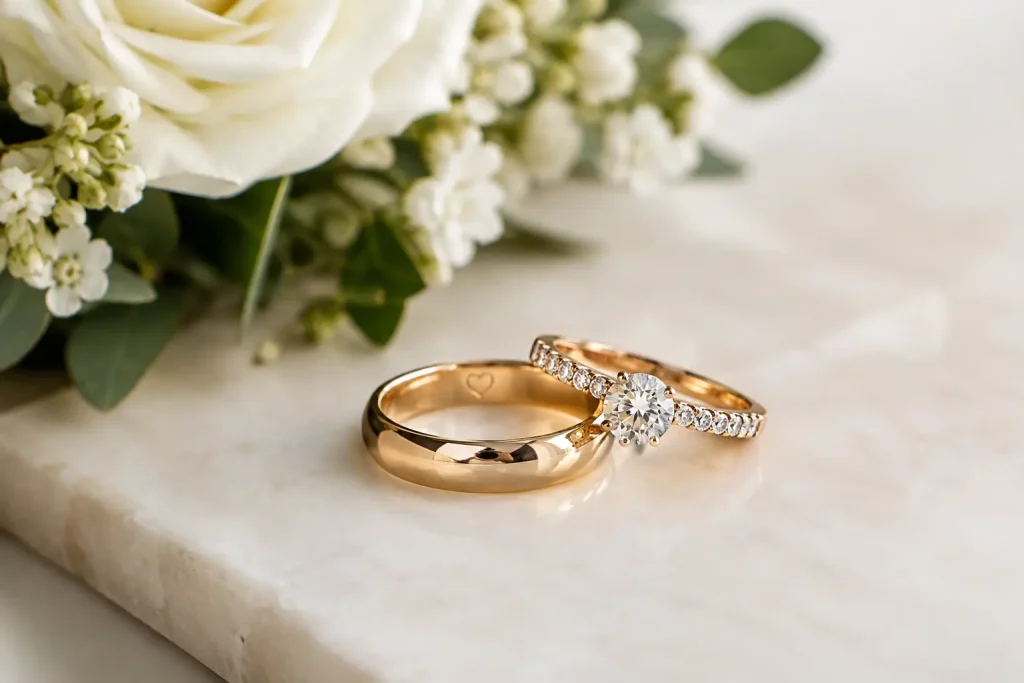
A wedding ring is one of the few things you will wear almost every day for decades. That is why the best sentimental wedding ring details are rarely the loudest ones. They are the thoughtful choices that bring you back to a person, a promise, a place or a moment whenever you look down at your hand.
For some couples, that means a date engraved where only they can see it. For others, it is reshaping a stone from a grandmother’s ring, matching the profile of an engagement ring, or choosing a finish that becomes more beautiful as it gathers the quiet marks of real life. There is no single right answer. The most meaningful ring is the one that feels recognisably yours and comfortable enough to wear without thinking twice.
The best sentimental wedding ring details start with your story
Before choosing an engraving, gemstone or decorative edge, consider what you would like the ring to hold. A sentimental detail works best when it has a genuine connection to you, rather than being added simply because it looks good in a photograph.
Think about the small things that make your relationship yours: the place you met, a phrase you say to each other, a shared piece of music, an inherited piece of jewellery, or even a detail from the proposal. These memories can guide the design without dictating every part of it.
There is also value in restraint. A ring does not need five separate symbols to be meaningful. One carefully chosen detail, beautifully made, often has more impact than a design crowded with references. A bespoke consultation can help you decide which part of the story belongs in the ring and which memories are best kept just between you.
Engravings that feel personal, not predictable
Engraving remains one of the most personal additions you can make to a wedding band. Traditional initials and wedding dates are timeless for a reason, but they are only the beginning.
A short line in your own handwriting can turn the inside of a ring into a private message. This might be a word from a note, a signature, or a tiny version of a phrase that matters to you both. Handwriting needs to be simplified to suit the scale of the band, particularly if the ring is narrow, but an experienced jeweller can preserve its character.
Coordinates are another subtle choice. They can mark the location of a first date, proposal, wedding ceremony or family home without explaining the meaning to anyone else. Roman numerals offer a neater alternative for a significant date, while a short lyric or private nickname can make the ring feel immediately familiar.
Consider the practical side, too. Deep, clear engraving generally lasts better than very fine surface work, and a wider band creates more room for longer wording. If you choose an eternity-style design with stones around the whole ring, the engraving may need careful planning. In some cases, a plain inner section or a small engraved plaque is the better solution.
A message only the two of you understand
The most touching engravings are often the least obvious. A single word that means nothing to anyone else can carry more feeling than a long declaration. If you are worried about getting it perfect, start with the words you actually use with one another. They tend to age far better than a phrase chosen because it sounds traditionally romantic.
A shaped wedding band can be sentimental too
Sentiment is not always a hidden detail. Sometimes it is in the way a wedding ring has been designed around the engagement ring you already love.
If your engagement ring has a prominent setting, pear-shaped centre stone, vintage cluster or unusual silhouette, a straight wedding band may leave a gap or sit awkwardly against it. A shaped-to-fit band follows the contours of the ring, allowing the two pieces to sit together as though they were always meant to be worn as a pair.
This is especially meaningful when the engagement ring has its own history. Perhaps it was chosen together, gifted by a partner, or adapted from an heirloom. Creating a fitted wedding ring respects that original design while adding a new chapter to it.
It is worth deciding whether you want the rings to sit perfectly flush every day. Some people prefer the deliberate space created by a straight band, and there is nothing wrong with that. However, if a close fit matters to you, the engagement ring should be assessed in person or through detailed measurements and images before the wedding band is made. A ring should not only look balanced from above – it should feel comfortable from every angle.
Heirloom details with a future in mind
Family jewellery can bring a powerful sense of continuity to a wedding ring. A diamond from a relative’s ring, a small coloured stone, an old gold band or a recognisable design feature can all be reworked into something wearable for your own life.
This requires sensitivity. Not every older ring is suitable for direct alteration, and sometimes preserving the original piece is more appropriate than dismantling it. In those cases, a new band can be made with an inspired detail instead: the same metal colour, a similar engraved pattern, or a stone set beside a new diamond.
Reusing stones may be meaningful, but it is not automatically the simplest or least expensive route. Old stones need to be inspected for condition, and their shape or size may affect the design. Likewise, melting down inherited gold is possible in some circumstances, but the purity and alloy must be assessed first. A thoughtful jeweller will explain the options clearly rather than promising a result before examining the piece.
The aim is not to make an heirloom unrecognisable. It is to create a ring that honours where it came from and gives it a place in your future.
Hidden stones and personal colour
A small gemstone set inside the band is a beautiful way to add colour without changing the outward look of the ring. Birthstones are popular, whether they represent each partner, children, a wedding month or someone you want to keep close. A tiny sapphire, ruby, emerald or diamond can act as a private marker that only you know is there.
The choice should be guided by wear as well as symbolism. Diamonds and sapphires are particularly durable for daily rings. Softer stones can still be used, but they may be better suited to a protected setting or a ring worn with a little extra care. If the stone has strong sentimental value but is too delicate for a band, it may be wiser to honour its colour through a new stone of the same type.
You can also bring meaning into the ring through metal. Yellow gold may echo a parent’s wedding band, platinum may suit the cool tone of an existing engagement ring, and rose gold can give a vintage feel without copying an older design exactly. The best choice is the one that complements your lifestyle, other jewellery and personal taste, not simply the current bridal trend.
Texture, profiles and details you will feel every day
Some of the most memorable details are tactile. A softly rounded court profile feels smooth against the finger, while a flatter band can look clean and contemporary. Milgrain edges, hand engraving, a brushed finish or a hammered texture each create a different character.
These choices deserve more thought than they often receive because they affect both appearance and maintenance. High-polish bands are classic and can be refreshed easily, but they show fine scratches sooner. Brushed and hammered finishes disguise everyday marks more gracefully, although they may need specialist refinishing if you want to restore their original texture.
A small hidden notch, a scalloped edge that echoes an engagement ring, or an engraved line running around the outside can carry just as much sentiment as a visible gemstone. Try samples where possible. The detail should feel lovely at first touch, but it also needs to make sense after years of handwashing, work, travel and ordinary weekends.
Give yourselves permission to design slowly
Wedding planning often creates pressure to make every choice quickly. Your rings deserve a little breathing room, especially if they need to fit around an engagement ring or incorporate inherited materials.
Bring photographs of jewellery you love, reference images, sketches and even ideas you are unsure about. The best conversations often begin with, “I do not know if this is possible.” At BWR London, the design process is built around listening first, then guiding you towards a ring that works technically as well as emotionally.
Ask to see how the band will sit beside your engagement ring, discuss the width in relation to your hand, and be honest about your budget from the start. Bespoke does not mean every feature must be added. It means the details that matter to you can be prioritised.
Years from now, the sentimental part of your wedding ring may be the message tucked inside, the stone that once belonged to someone you love, or simply the way it fits perfectly beside the ring you said yes to. Choose the detail that makes you pause and smile. That is the one worth carrying with you.