

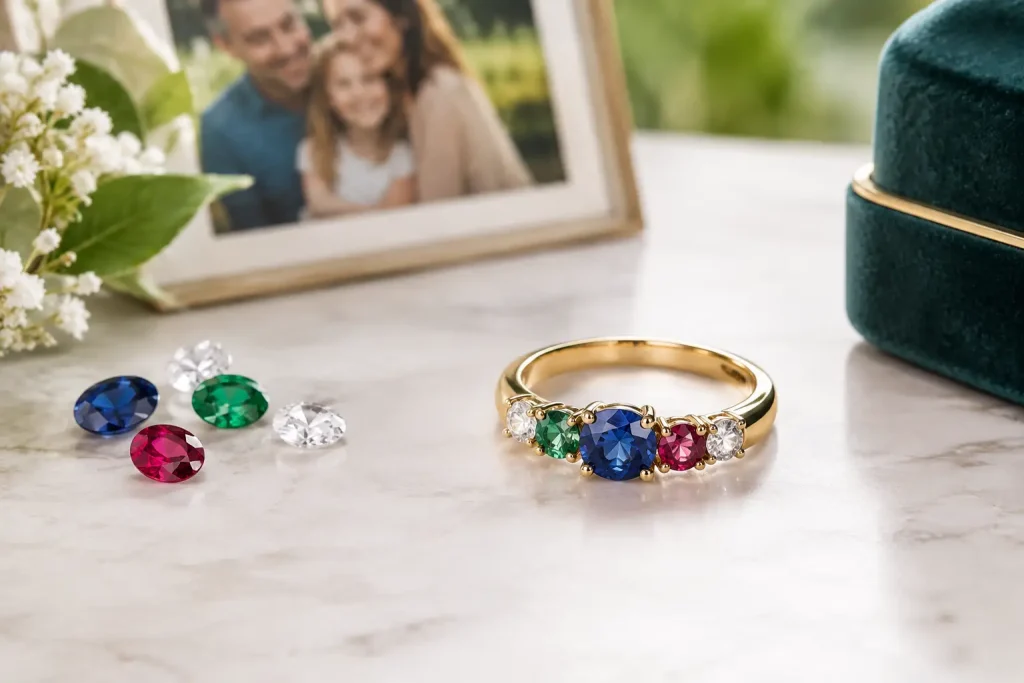
A ring can carry more than one promise. A family gemstone wedding ring project gives you a way to bring a loved one, a shared history or a future family story into the band you will wear every day. Perhaps you have inherited a sapphire from your grandmother, want to include children’s birthstones, or have a small collection of stones from jewellery that is beautiful but never worn. The right design turns those meaningful details into a wedding ring that feels personal, practical and completely yours.
The most successful projects start with the story, rather than a fixed sketch. A gemstone may be precious because of where it came from, not because it is large or perfectly matched. That is exactly where bespoke design can make a difference: it allows the ring to honour the sentiment while still sitting comfortably beside your engagement ring and standing up to daily life.
Start your family gemstone wedding ring project with the stones
Before deciding on a setting, gather what you have. If gemstones are being taken from an heirloom ring, bracelet or pendant, bring the whole piece to a consultation where possible. The setting, metal and condition can reveal useful information, and the stones need to be assessed before a design is promised.
An expert will look at each stone’s size, shape, wear and security. Older gemstones can have chips near their edges, fine surface scratches or historic cuts that make them slightly irregular. None of this makes them less meaningful. It simply affects how they should be set. A well-loved stone may be better protected in a rub-over setting, for example, than in a delicate claw setting.
It is also worth remembering that not every family stone has to be used. Sometimes one central gem carries the story beautifully, while the rest are retained in their original piece or kept for another family member. If several people have a connection to the jewellery, a thoughtful conversation before redesigning it can prevent a sentimental decision from becoming an awkward one later.
Decide what the ring needs to say
There is no single right way to include family gemstones in a wedding band. The design should reflect both the meaning you want to hold close and the way you live.
A line of small birthstones can represent children, siblings or significant dates. Alternating diamonds and coloured gemstones often gives a subtle, classic finish, especially if you want the ring to complement rather than compete with an engagement ring. For a more private detail, gemstones can be set inside the band, facing the wearer alone. This works particularly well for a stone that has emotional value but is too small or delicate for a prominent setting.
You may also choose to make the family connection visible through colour rather than using an inherited stone itself. A deep blue sapphire, a soft green emerald or a warm ruby can echo a loved one’s birth month, favourite colour or a treasured piece of family jewellery. This can be a sensible route where the original gem is unsuitable for resetting but the sentiment remains important.
Think about whether you want the story to be immediately obvious. A ring can be richly personal without explaining itself to everyone who notices it. The most moving designs are often the ones that mean something very specific to the wearer.
Make it work with your engagement ring
For many couples, fit is the point at which a lovely idea becomes a genuinely wearable ring. If your engagement ring has a low setting, a prominent centre stone or an unusual shape, a straight wedding band may leave a gap or press uncomfortably against it. That is not a compromise you have to accept.
A shaped-to-fit band can be carefully contoured around your engagement ring, allowing the two rings to sit together naturally. Depending on the design, gemstones can follow the curve, be placed at either side of the contour or sit along a separate section of the band. The placement matters because stones should enhance the shape rather than make the ring feel busy.
Bring your engagement ring to the design appointment whenever possible. Photographs are helpful as a starting point, particularly if you are beginning the conversation remotely, but seeing the ring in person allows for much more accurate measurements. It also helps you compare metal colours, band heights and how the rings look together from every angle.
There is a practical trade-off here. The closer two detailed rings sit, the more likely they are to rub over time. A skilled jeweller can advise on sensible spacing, setting styles and the best finish for both rings, so the final pair looks considered rather than crowded.
Choose a setting for real life, not just the first photograph
Wedding rings are worn through work, weekends, travel, handwashing, cooking and all the unglamorous moments that make up a life together. A design should feel special, but it also needs to suit your routine.
Rub-over settings surround a stone with a fine rim of metal and offer excellent protection, making them a reassuring choice for heirloom gems or active hands. Channel settings keep smaller stones enclosed within the band for a sleek appearance. Claw settings allow more light around a gemstone and can create a lighter look, but they may need more regular checking, especially on a ring worn every day.
Band width makes a difference too. A very slim band can look elegant, yet it may limit the size and number of stones that can be set securely. A slightly wider ring may give a family gemstone room to breathe and provide more space for an engraving inside. Comfort-fit interiors can be especially welcome if you are not used to wearing rings or want a substantial band that still feels smooth on the finger.
If you work with your hands, play sport or simply prefer low-maintenance jewellery, say so early. A bespoke process should adapt to your life, not ask you to change it.
Keep the design balanced, even when the story is complex
Family jewellery can bring many ideas at once: several birthstones, inherited diamonds, different metal colours, a meaningful engraving and the wish to match an engagement ring. Trying to include every detail in one band can make the design feel less clear.
A good approach is to identify the one element that matters most. It might be your grandmother’s sapphire, three tiny stones for three children, or an engraving in a relative’s handwriting. Let that feature lead, then build the rest of the ring around it. You can often include secondary meaning through subtle choices, such as the number of stones, the arrangement or a hidden detail inside the shank.
Metal choice should support the gemstones as well as your existing jewellery. Platinum offers a naturally white, durable setting for diamonds and cooler-toned gems. Yellow gold can bring warmth to older-cut diamonds and richly coloured stones, while rose gold creates a softer contrast. If your engagement ring is already in a different metal, mixed-metal details may be possible, but the final look needs to feel intentional.
Understand the practical questions before you commit
Resetting family stones is a sensitive process, and clear expectations make it much less stressful. Ask how the stones will be assessed, whether any are too fragile to unset, and what alternatives are available if a gem cannot be used safely. In some cases, recreating a colour with a newly sourced, ethically chosen stone is the best way to protect the original heirloom while preserving its meaning.
Budget will depend on the metal, design complexity, setting work, gemstone condition and whether new stones are required. A simple engraved band with one small inherited gem will be very different from a shaped wedding ring set with multiple stones. Being open about your budget from the beginning helps focus the design on the details that matter most.
Allow time as well. Bespoke rings need room for design discussions, stone checks, making, setting and final fitting. If your wedding date is close, raise it immediately. Some designs can be simplified without losing their heart, while others deserve the breathing space to be made properly.
A personal process makes the difference
The best part of a custom ring is not choosing from a tray. It is having someone listen to why each detail matters, then translate that into a piece you can wear with confidence. At BWR London, that can begin with a conversation, reference images or your engagement ring itself. You do not need a finished design before getting in touch.
Bring the jewellery you are considering, share the story behind it and be honest about what you are unsure of. Whether you want a quiet nod to family or a ring that becomes a future heirloom in its own right, the right questions will lead you towards a design that feels settled, comfortable and deeply yours.
A family gemstone wedding ring should never feel like a box of memories squeezed into one piece of jewellery. Give the most meaningful detail the space it deserves, and it can become the part of your wedding ring you reach for again and again.