

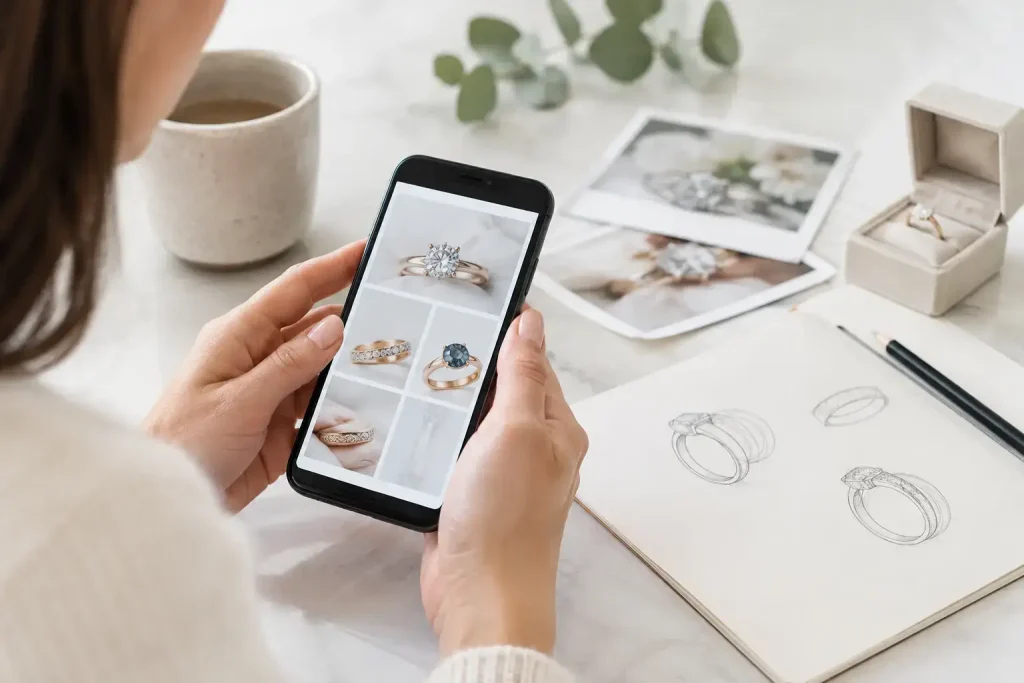
A saved image can say far more than “I like this ring”. It may show the gentle curve you need beside your engagement ring, the kind of texture that reminds you of a favourite place, or a small detail that makes the design feel unmistakably yours. Knowing how to submit ring inspiration means your jeweller can turn those instincts into a wedding band that is beautiful, comfortable and genuinely personal.
You do not need a perfectly curated mood board or jewellery vocabulary to begin. A few screenshots, a photograph of your engagement ring and an honest note about what matters to you can be enough to start a meaningful design conversation.
How to submit ring inspiration with confidence
Start by gathering the images you are naturally drawn to. These might be screenshots from social media, photographs of rings you have tried on, a close-up of a family heirloom, or even details from outside jewellery, such as a scalloped edge on lace or an organic line found in nature. There is no need for every image to match. Differences help reveal what you love most.
When you submit them, tell us what has caught your eye in each one. Perhaps it is the fine beading, the soft brushed finish, a low-profile setting, the way a band wraps around a centre stone, or simply the overall feeling. This is especially helpful if one reference has the shape you want but another has the metal colour or texture you prefer.
Try not to worry about whether your ideas are realistic or whether the images are all from different styles. That is part of the design process. A bespoke jeweller’s role is to listen for the common thread, explain what will work structurally, and suggest thoughtful alternatives where a direct copy would not suit your ring or everyday life.
Photograph your engagement ring clearly
If you are commissioning a wedding band to sit alongside an existing engagement ring, photographs of that ring are among the most useful things you can provide. A shaped-to-fit band is designed around its individual proportions, not around a generic ring shape. Even engagement rings that look similar online can differ in setting height, stone placement, band width and the amount of space beneath the centre stone.
Take images in natural daylight where possible, with the ring clean and placed on a plain background. A photograph from directly above shows the outline of the setting. Side-on pictures help show how high the setting sits from the finger. Include views from both sides if there are stones, claws or details that affect the fit.
A short video can also be useful. Slowly turn the ring to show the profile, the gallery beneath the stone and the route a wedding band would need to take beside it. If you can, place a plain ring or a strip of paper next to the engagement ring to give a sense of scale. It will not replace accurate measurements, but it gives the designer a more complete starting point.
For the closest possible fit, you may be asked to bring or send your engagement ring for assessment. This allows the curve to be designed precisely around it, rather than estimated from photographs alone. If posting a ring does not feel right for you, ask about alternatives. A careful consultation can establish the best and safest way to proceed.
Add the details images cannot show
The most successful inspiration submissions pair visuals with practical information. Your ring needs to look right, but it also needs to suit the life you lead and feel good on your hand every day.
Share your preferred metal if you have one, whether that is yellow gold, white gold, rose gold or platinum. If you are undecided, say so. The metal of your engagement ring, your skin tone, maintenance preferences and budget can all guide the conversation. Matching metals can create a cohesive look, while mixing metals can be intentional and striking. There is no single correct choice.
It also helps to mention your approximate ring size, preferred band width and whether you like a delicate, substantial, flat, rounded or softly contoured profile. Comfort matters as much as appearance. A very fine band can look beautifully light, but may not give the same visual balance beside a larger engagement ring. A wider band offers presence and space for engraving, but it can feel different between the fingers. Seeing proportions together is often more revealing than viewing either ring alone.
Be open about your day-to-day routine too. If you work with your hands, visit the gym regularly, care for young children or simply prefer jewellery that needs very little thought, a lower-profile design or durable finish may be the better fit. This is not about limiting your choices. It is about creating a ring you will enjoy wearing, rather than one you feel you must protect constantly.
Be clear about the sentiment you want to carry
Bespoke rings become particularly special when the design includes something only the two of you understand. It could be an engraving of a date, initials, a line from a letter, a meaningful coordinate or a phrase that makes you smile. You may want to incorporate a pattern inspired by an heirloom, use inherited gold or stones where suitable, or create a design that echoes the shape of your engagement ring without matching it exactly.
You do not need to decide every personal detail before getting in touch. Sometimes a conversation is what brings the right idea into focus. However, mentioning the significance behind the ring helps shape recommendations that feel considered rather than decorative for decoration’s sake.
If you are working with inherited jewellery, include clear photographs and any information you have about its history, metal or gemstones. Reusing materials can be deeply meaningful, although it is not always possible or advisable to reuse every element. Older stones may need a condition check, and inherited metal may need to be refined or supplemented to ensure the finished ring has the strength and finish it deserves. Honest guidance here protects both the story and the ring.
Set a budget without taking the romance out of it
A budget is useful design information, not an awkward subject. It allows your jeweller to recommend the best route from the beginning, whether that means adjusting the width, choosing a different setting approach, prioritising certain details or phasing work around an existing ring.
Share a comfortable range rather than a single fixed number if you can. This leaves room to compare options and understand where the value lies. The cost of a bespoke band can depend on metal weight, diamond or gemstone specifications, the complexity of a shaped fit, hand-applied details and engraving. A simple design may need more precision than it first appears if it must curve closely around an engagement ring.
It is also worth being clear about timing. Bespoke work should not be rushed unnecessarily, particularly when fitting is involved. If your wedding date is approaching, say so at the outset. A good jeweller can advise what is achievable and help you make decisions with confidence rather than last-minute pressure.
What happens after you send your ideas?
Your inspiration is the beginning of a conversation, not a final design brief. At BWR London, the purpose of a one-to-one approach is to understand what you are responding to, then translate it into a ring that works in real life and sits beautifully with your engagement ring.
You may be asked follow-up questions about proportions, metal, sizing and how closely you want the rings to meet. Some clients love a neat, fitted silhouette with no gap. Others prefer a slight space between their rings so each design can be appreciated separately. Both can look considered – the right choice depends on the setting, your style and the feeling you want when you look down at your hand.
From there, the design can be refined through sketches, measurements and expert recommendations. This is where practical craftsmanship matters. A curve must leave enough material for a secure, durable band. Diamonds need settings that will not catch unnecessarily. Engraving needs enough surface to remain legible. The best bespoke designs make these technical choices feel effortless.
Inspiration is a starting point, not a rulebook
It is perfectly fine to arrive with one photo and the words, “I know it when I see it.” It is equally fine to bring twenty images and still feel undecided. Your references are there to communicate taste, emotion and possibility, not to lock you into someone else’s ring.
Give yourself permission to respond to what feels right as the design develops. The finished band should complement your engagement ring, but it should also belong to you – comfortable on your hand, meaningful in its details and lovely enough to make an ordinary Tuesday feel a little more special.