

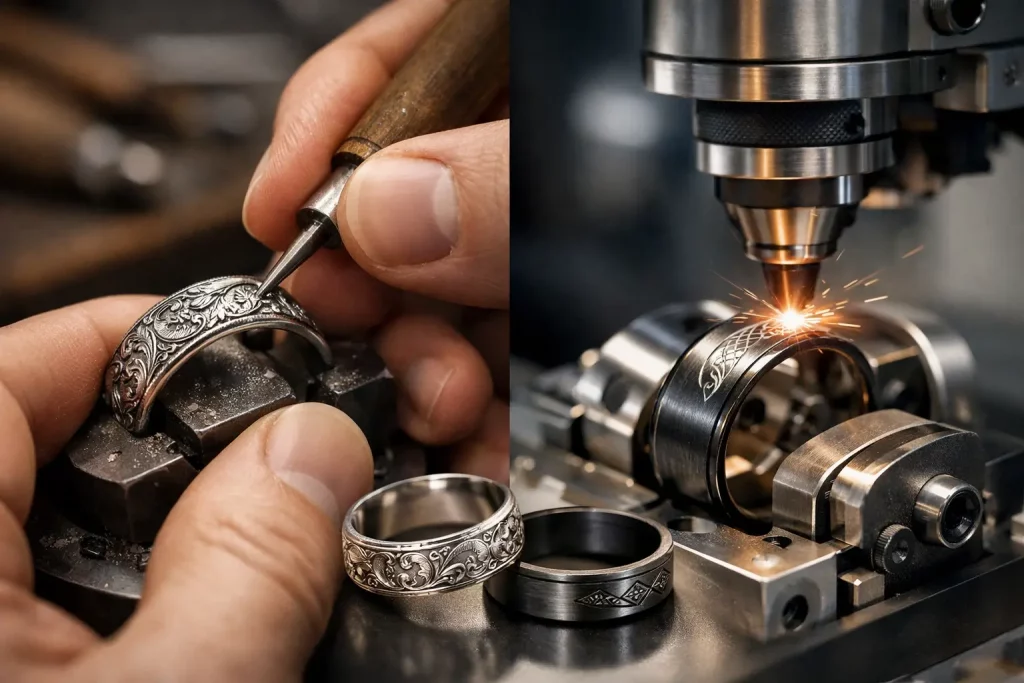
A date tucked inside a wedding band, a line from a favourite song, the coordinates of where you met – the smallest details can hold the greatest meaning. When choosing hand engraving versus laser engraving for your rings, the right answer is not simply about which method is better. It is about the look you love, the message you want to carry and the practical needs of a ring made for everyday life.
For couples designing bespoke wedding rings, engraving is often the final personal touch. It can turn a beautifully made band into something unmistakably yours. Understanding how each technique works makes that decision feel much easier.
Hand Engraving Versus Laser Engraving: The Real Difference
Hand engraving is created by a skilled engraver who cuts the design directly into the metal using traditional tools. Every letter, flourish and line is guided by hand. This creates a mark with physical depth and character, rather than one that has been applied on the surface.
Laser engraving uses a concentrated laser beam controlled by a computer. It removes or alters tiny amounts of material to create lettering, symbols or images. The process is exceptionally precise and can reproduce very fine details that would be difficult, or impractical, to cut by hand.
Both can be beautiful. The important distinction is in their character. Hand engraving has the subtle individuality of a maker’s hand, while laser engraving has clean consistency and allows for a much broader range of imagery.
The Feel and Appearance of Hand Engraving
There is something wonderfully tactile about a hand-engraved ring. The cut lettering catches the light differently as you turn the band, and the slight variation in each stroke gives it warmth. For a classic inscription – initials, a wedding date, a short phrase or a traditional script – it is a particularly romantic choice.
Hand engraving works beautifully on wider bands, where there is enough room for the engraver to give the lettering a pleasing proportion. It is also well suited to designs that are intended to feel timeless: serif fonts, flowing scripts, borders and decorative motifs all benefit from its depth.
It does have limitations, especially on a very slim wedding band or within a tightly curved interior. Extremely small lettering may not be legible when cut by hand, and intricate drawings are usually better suited to a laser. As the work is completed individually by a specialist, hand engraving can also cost more and may add time to a bespoke ring’s production schedule.
Those trade-offs are often worthwhile when you want the engraving itself to feel like part of the craftsmanship of the ring, rather than simply an addition to it.
When Laser Engraving Is the Better Choice
Laser engraving is ideal when your idea goes beyond words. A tiny fingerprint, a handwritten signature, a pet’s paw print, a soundwave, a delicate sketch or a precise family crest can often be recreated with remarkable clarity. It is also excellent for neat, small text where space is limited.
This can be particularly helpful for shaped-to-fit wedding bands. A curved or contoured band may have less usable space inside than a straight ring, so a laser can make the most of a compact area without losing the detail of the design.
Consistency is another advantage. If you would like identical lettering inside both wedding bands, or you are working from a specific typeface, laser engraving gives a very controlled result. It can also be a more cost-effective option for detailed designs because the artwork can be prepared digitally before the ring is engraved.
Laser engraving does not have to look impersonal. A handwritten note from a loved one or your own drawn symbol can be deeply intimate precisely because it preserves the original marks. The technology is simply the method used to place that memory onto the metal.
Will the Engraving Last?
Durability depends less on whether an engraving is hand-cut or laser-made and more on its depth, placement, metal and the way the ring is worn. Wedding rings are exposed to soap, hand sanitiser, gym equipment, gardening and years of gentle knocks. Any engraving can soften gradually over time, particularly on the outer surface of a band.
A deep hand engraving often has the advantage of remaining visible for longer because there is more depth to the cut. However, a well-executed laser engraving inside a ring can also last very well, as the interior receives less direct wear than the outside.
The metal matters too. Platinum is hard-wearing but develops a soft patina over time. Gold alloys vary in hardness, with 9ct gold generally harder than 18ct gold, though both are popular choices for wedding jewellery. Your jeweller can advise on the most suitable engraving depth and placement for the metal and finish you have chosen.
For the best chance of longevity, keep a long inscription on the inside of the band and avoid placing fine engraving on a high-contact area, such as the palm side of the ring. If you choose an exterior design, consider a slightly deeper or bolder motif rather than a very fine line.
Choosing a Message That Fits Your Ring
The most meaningful engraving is not always the longest one. A date written in your own format, a private nickname or a few words only the two of you understand can say more than a full quotation. It also gives the design room to breathe.
Before settling on your wording, think about the width and shape of the band. A narrow ring may suit initials and a date, while a wider design can hold a longer phrase or a decorative script. If your engagement ring and wedding band have been designed to sit closely together, the engraving can be planned alongside the profile, so the finished rings remain comfortable and balanced.
It is worth checking spelling, dates and capitalisation carefully before approving the engraving. It sounds obvious, but these details become permanent. If you are using handwriting, send the clearest version possible and keep the message simple enough to reproduce at ring scale.
Questions to Ask Before You Decide
A good jeweller should make the decision practical as well as personal. Ask to see examples of both methods on a similar metal and band width, rather than comparing engraving on a display piece that bears little resemblance to your chosen ring.
You may also want to ask whether the design will be cut, etched or darkened for contrast, how much space it needs, and whether it can be refreshed in the future. Some finishes make lettering stand out initially but may need occasional attention as the ring is worn. If you are incorporating an heirloom diamond, reshaping a family ring or designing an unusual band, ask how the engraving will work with those individual features.
At BWR London, these conversations form part of the personal design process. A reference image, a sketch or even a rough idea is enough to start. The aim is not to push you towards a standard option, but to help you choose the detail that feels right for the ring you will wear every day.
Let the Method Follow the Meaning
Choose hand engraving if you are drawn to traditional craftsmanship, expressive lettering and the gently individual quality of a hand-cut inscription. Choose laser engraving if your design relies on tiny detail, exact font matching, handwriting or an image that cannot be recreated by hand at a small scale.
Neither choice is more sentimental than the other. A hand-cut date can feel beautifully enduring; a laser-engraved line in a parent’s handwriting can feel like carrying their voice with you. Let the message lead, then choose the technique that gives it the clarity, character and permanence it deserves.
Your wedding rings do not need to tell their whole story to everyone else. They only need to hold the part of it that matters most to you.