

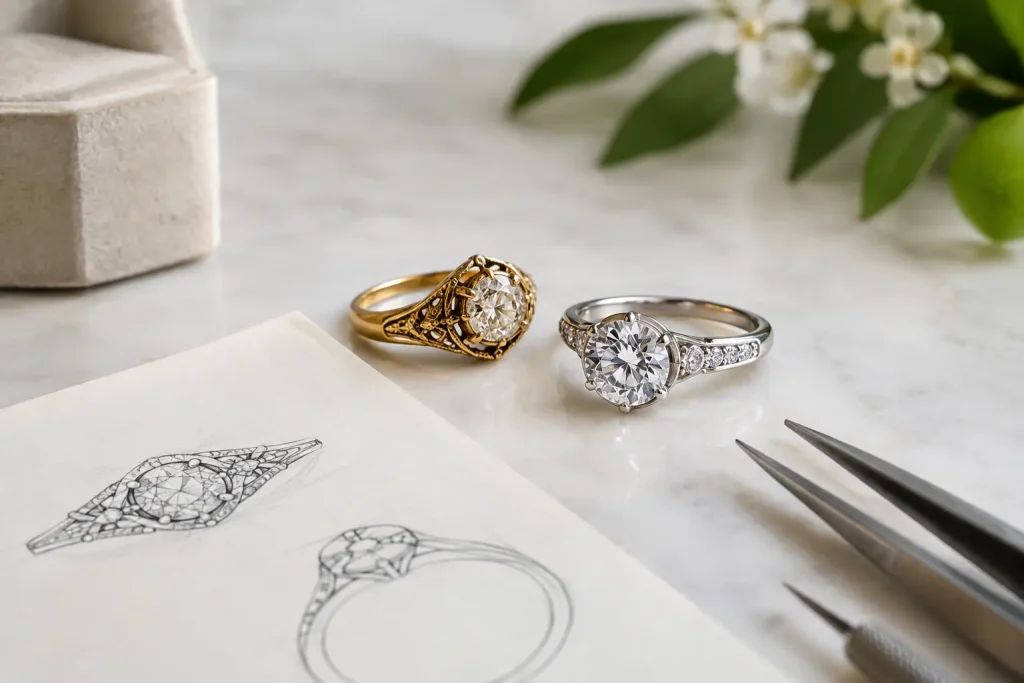
A ring kept in a jewellery box is not always being honoured by staying untouched. Sometimes the most meaningful choice is to give it a new life – one that lets you wear its story every day. Learning how to redesign an heirloom ring is less about replacing the past and more about carrying it forward in a design that feels like you.
Perhaps the ring belonged to a grandmother, carries a stone from a parent’s engagement ring, or no longer suits your lifestyle or hand. Whatever its history, a thoughtful redesign can preserve the details that matter while creating a piece you will genuinely love wearing.
Start with the story, not the setting
Before looking at new designs, take time to understand what makes the ring significant. Is it the centre stone, an engraving inside the band, the original gold, or the fact that it was worn by someone you loved? These answers help shape the redesign and prevent a decision you may later regret.
Photograph the ring from every angle and, if possible, gather any information you have about its age, metal and previous repairs. Family members may also have memories attached to it. You do not need to preserve every element, but knowing the story means you can choose intentionally what stays and what changes.
For some people, retaining the original diamond is essential. For others, melting down the gold to form a new wedding band feels especially personal. A tiny section of an engraved shank might become a hidden detail on a new ring. There is no single right answer, only the balance that feels respectful to you.
How to redesign an heirloom ring for everyday wear
A beautiful redesign should fit your real life, not just a jewellery box. Consider how often you use your hands, whether you work in a practical role, play sport, look after children, or simply prefer jewellery that does not catch on knitwear. A high setting that was perfect for special occasions may not be comfortable for daily wear.
A jeweller can assess the condition of the stone and setting before suggesting what is possible. Older rings can have worn claws, thin bands or stones with chips that are difficult to spot at home. This does not mean the ring cannot be transformed. It means the new design should be made around its true condition, with appropriate protection and care.
If your heirloom diamond is small, it can still have a strong presence. A bezel setting can frame and protect it, while a halo or carefully chosen side stones can add scale without taking attention away from the original gem. Several inherited stones can be arranged in a cluster, toi et moi design or a modern eternity-style ring. The best option depends on their sizes, shapes and condition.
Metal choice matters too. Reusing family gold can be sentimental, but it is not always suitable as the sole metal for a new setting. Antique alloys vary, and old gold can contain impurities or become brittle after repeated heating. In some cases, a jeweller may use the original metal within the new piece or offer a credit towards fresh, responsibly sourced metal. Ask clearly how the metal will be handled before work begins.
Keep the details that make it yours
Sentiment does not have to sit front and centre. An original inscription can be copied into a new band, a date can be re-engraved alongside your own wedding date, or a small inherited stone can be set inside the shank as a private connection to the past.
This is particularly lovely for couples creating wedding rings. An heirloom engagement ring can inspire a shaped-to-fit wedding band, with a gentle curve that sits neatly alongside it. You might repeat its milgrain edge, use the same metal tone, or set a discreet family diamond into the band. The rings do not need to match exactly to belong together.
Choose a design that feels personal, not period-perfect
It is easy to feel pressure to recreate an old ring because it has family history. But a redesign works best when it reflects the person who will wear it now. You may love the romance of an antique-cut diamond but want it in a clean, low-profile setting. Or you may prefer to keep an Art Deco detail while changing an impractical mount.
Bring reference images to your consultation, including rings you like and examples of what you do not like. Think beyond the top view. The side profile, band width, setting height and finish all affect how a ring feels on your hand. A softly rounded court band can feel very different from a flat, angular one, even if both are the same width.
Trying on sample widths is worthwhile, especially if the redesign will become a wedding ring or an everyday engagement ring. Fine bands can look delicate but may not suit a larger stone or busy lifestyle. Wider bands create presence and offer space for engraving, but they can feel more substantial between the fingers. Comfort is not an afterthought. It is part of good design.
Be clear about what can and cannot be changed
A trusted jeweller should be honest about the practical limits of heirloom jewellery. Stones may need to be removed carefully from an old setting, and there is always a small degree of risk when working with historic materials. Certain gems, including emeralds, opals and pearls, need particular consideration because they are more vulnerable to heat, pressure and everyday knocks.
The original setting may also be too worn to reuse safely. If preserving it matters, you could keep it intact as a keepsake while using the stones in a new ring. Alternatively, an old mount may be restored and worn occasionally, while a redesigned piece becomes your everyday version of the family story.
Ask whether the stones will be checked for security, whether their condition will be documented, and how the design will be approved before making begins. A bespoke process should give you time to review proportions and make decisions without feeling rushed. It is your ring, and the details should feel settled before the final work starts.
Set a budget around the work involved
Redesigning an heirloom ring is often more complex than buying a ready-made design. The final cost depends on the condition of the original piece, the number of stones, the new metal, setting style, hand-finishing and any additional diamonds or engraving.
Reusing a stone can reduce the cost of sourcing a new centre diamond, but it does not remove the skilled work required to inspect, unset, reset and secure it. If the inherited stone is small or damaged, adding a new setting or complementary stones may make better use of your budget than attempting to replicate the original ring exactly.
Share your comfortable budget from the beginning. A good bespoke jeweller can explain where to prioritise: perhaps a durable platinum setting, an exceptional engraving, or a design that allows you to add stones later for an anniversary. A staged approach can be sensible when sentiment is high and decisions need time.
Give yourself permission to make it your own
Redesigning family jewellery can bring up unexpected feelings. You may worry that changing it is somehow wasteful, or that relatives will not understand. Yet an heirloom is often most meaningful when it continues to be worn, seen and talked about.
If you are uncertain, begin with a conversation rather than a commitment. Bring the ring in, discuss the possibilities, and look at design ideas alongside your existing engagement ring or wedding band. At BWR London, the focus is on listening first, so the final piece feels considered, comfortable and completely personal.
The right redesign will not erase the ring’s history. It will give that history a place in the moments still to come: held hands, wedding vows, ordinary mornings and every small occasion when you look down and remember where it began.