

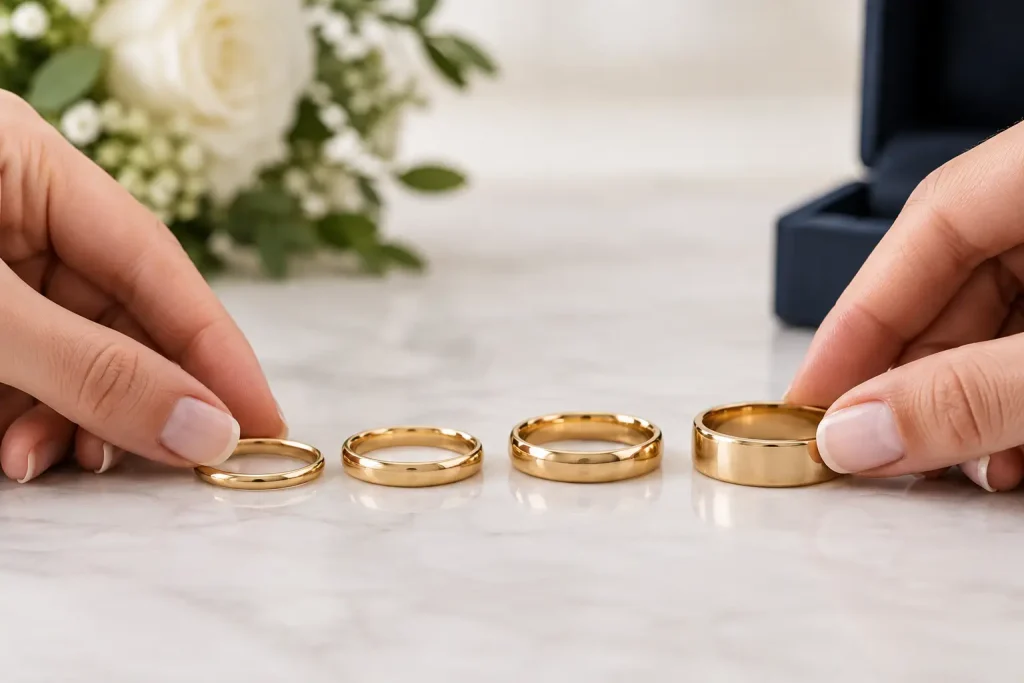
A wedding ring may look beautifully simple, but the smallest measurements can change how it feels every day. A thoughtful wedding band thickness comparison helps you look beyond the photograph and choose a ring with the right balance of comfort, strength and presence – especially when it needs to sit alongside an engagement ring you already love.
Thickness is one of those details that is easy to overlook until you try rings on. A fine band can feel light and elegant, while a deeper one may feel reassuringly substantial. Neither is automatically better. The right choice is the one that suits your hand, your lifestyle and the design you want to wear for a lifetime.
What does wedding band thickness mean?
In jewellery, thickness refers to the depth of the metal from the outside of the band to the inside against your finger. It is different from width, which is the measurement across the top of the ring.
For example, two rings can both be 2mm wide but feel entirely different. One may be 1.3mm thick and have a delicate, low-profile feel. The other may be 2mm thick, with more weight, a stronger side profile and extra room for certain details. When comparing wedding bands, it is worth asking for both measurements rather than relying on width alone.
The interior shape matters too. A court-shaped or comfort-fit band is gently rounded on the inside, so it can feel softer against the finger than a flat interior of the same thickness. This is why trying on samples, or talking through your preferences with a jeweller, is so valuable.
Wedding band thickness comparison: the common choices
Most bespoke wedding bands sit somewhere between around 1.3mm and 2.2mm thick, although the best measurement depends on the style and metal. These ranges are a useful starting point, not a rulebook.
Fine bands: around 1.3mm to 1.5mm
A fine wedding band has an understated, delicate quality. It is often a lovely choice if your engagement ring has a slender band, if you prefer jewellery that feels barely there, or if you want the wedding ring to sit quietly alongside a detailed centre stone.
The trade-off is durability. Very fine rings can be appropriate when they are made with care and worn thoughtfully, but they have less metal to absorb everyday knocks. If you work with your hands, regularly go to the gym, or simply want a ring with more long-term substance, a slightly thicker design may offer greater peace of mind.
Fine bands can also be more difficult to engrave deeply, particularly if you would like a longer message, handwriting or a decorative pattern inside the ring.
Classic everyday bands: around 1.6mm to 1.8mm
For many people, this is the comfortable middle ground. A band in this range usually feels substantial enough for daily wear without looking heavy. It works beautifully for plain gold wedding rings, gentle curves, subtle shaping and many diamond-set designs.
This thickness is particularly useful when creating a shaped-to-fit band around an engagement ring. There is often enough metal to form a graceful contour while keeping the ring elegant from every angle. It can also allow for a meaningful engraving without making the ring feel bulky.
If you are unsure where to begin, this is often a sensible range to explore during a consultation. From there, the design can be adjusted according to your ring size, chosen metal and the proportions of your engagement ring.
Substantial bands: around 1.9mm to 2.2mm and above
A thicker wedding band makes a stronger statement. It has a pleasing weight, a more noticeable profile and can be especially suited to wider designs, signet-inspired bands, hand engraving, textured finishes or rings with a more traditionally masculine feel.
More depth can also be helpful for certain stone settings. Channel-set diamonds, for instance, need enough metal to hold the stones securely and protect their edges. A ring designed to last should never be made thinner simply to meet a visual preference if doing so compromises its structure.
That said, thicker does not always mean more comfortable. On shorter fingers, a deep band can feel more prominent between the fingers. If you love the look of a substantial ring but are concerned about the feel, a comfort-fit interior or a slightly softened outer profile can make a real difference.
How thickness changes the look of a matching set
When a wedding band is worn next to an engagement ring, thickness becomes part of the overall composition. The aim is not always to make both rings identical. Often, a subtle contrast creates the most balanced and personal set.
A fine engagement ring band may suit a wedding ring with a similar depth, particularly if you want the two to read as one continuous design. But a slightly thicker wedding band can also frame a delicate engagement ring beautifully and create a sense of considered contrast.
The profile is just as important as the measurement. A flat band, a softly rounded court band, a knife-edge style and a shaped contour will each catch the light differently. A curved or notched band may need carefully planned thickness through its narrowest point, so it remains strong while following the outline of your engagement ring closely.
This is where a bespoke approach is especially helpful. Working from your ring itself, rather than guessing from an image or a standard size chart, means the shape, depth and fit can be designed around the setting, not forced to work afterwards.
Your lifestyle should guide the decision
A wedding ring is sentimental, but it is also practical jewellery. Think about how you use your hands during an ordinary week, not just how the ring will look in your wedding photographs.
If you are often gardening, cooking, lifting equipment, caring for children or working in a hands-on profession, you may prefer a band with a little more depth and a lower profile. If you are used to fine jewellery and want a light, refined look, a slimmer design may feel completely natural.
Metal choice plays a part too. Platinum is dense and wears in its own distinctive way, developing a soft patina over time. Gold alloys vary in colour and character, and the ideal proportions may change depending on whether you choose yellow, white or rose gold. A good jeweller will consider the metal alongside the measurements, rather than treating thickness as an isolated decision.
Do not let a number decide everything
It is tempting to settle on a measurement quickly: 1.5mm sounds dainty, 2mm sounds durable. In practice, the same thickness can feel very different depending on width, profile, finger size and whether the ring is straight or shaped.
A 2mm-wide court band at 1.7mm thick may feel smooth and balanced. A 4mm-wide flat band at the same thickness will have a very different presence. Likewise, a petite hand may make a 2mm ring appear bold, while the same ring can look delicate on a larger hand.
If possible, compare sample bands on your own finger in a few depths. Notice how they sit when your hand is relaxed, how they feel when you make a fist and whether they leave enough space beside your engagement ring. These quiet, practical observations tend to be more useful than following a trend.
Making room for the details that matter
Thickness can affect the personal touches that make a wedding band yours. A deeper ring may offer more scope for a clear engraving, a hidden birthstone, milgrain edging or a hand-finished texture. A slimmer ring can still carry beautiful details, but they may need to be more refined and carefully placed.
For heirloom remodelling, the available metal and stones may also influence the final proportions. The goal is not to make the ring as heavy as possible, but to preserve its story in a design that feels comfortable and wearable now.
At BWR London, this is why each design conversation begins with how you want your ring to feel as well as how you want it to look. A reference image, a photograph of your engagement ring or a simple idea can be enough to start shaping the right answer.
Your wedding band will become part of your everyday life: seen in the morning rush, held in a loved one’s hand and worn through every ordinary and extraordinary moment. Choose a thickness that feels like you, then let the rest of the design grow around it.