

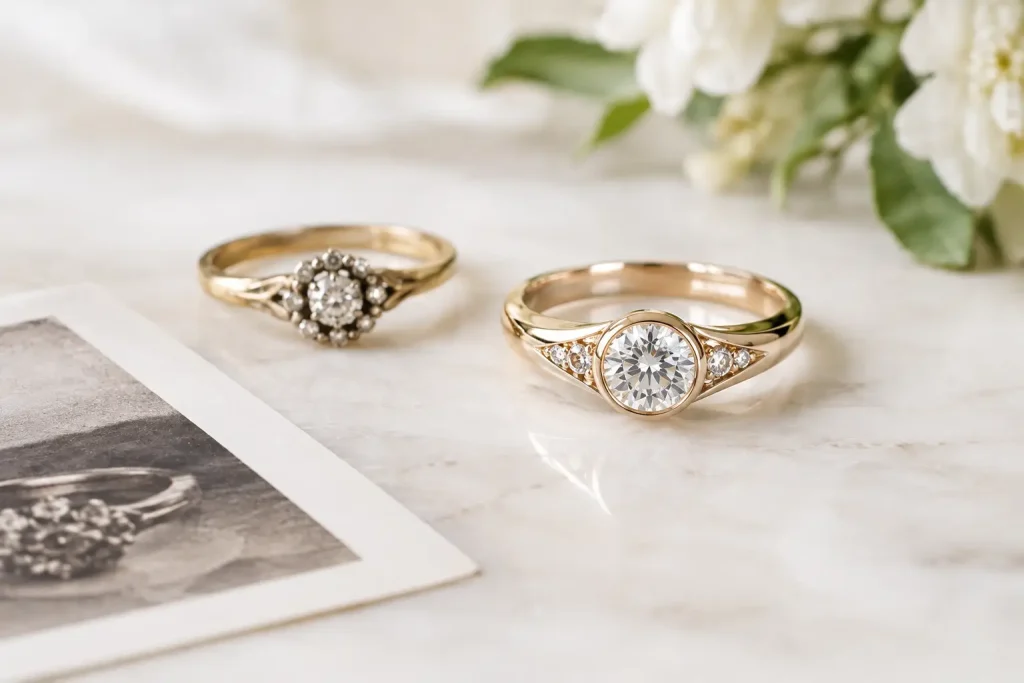
Your grandmother’s ring may be too delicate for daily wear, its setting may catch on knitwear, or it may simply not feel like you. That does not mean it needs to live unseen in a drawer. A family jewellery remake example can show how an inherited piece becomes a wedding ring with a new purpose, while keeping the story that made it precious in the first place.
For couples planning a wedding, this is often more than a style decision. It is a chance to carry someone close into a new chapter, without forcing yourself to wear a design that does not suit your hand, lifestyle or engagement ring.
A family jewellery remake example: from heirloom to fitted band
Imagine a bride with a solitaire engagement ring in yellow gold, set with a round diamond on a slightly raised setting. She has inherited her grandmother’s 1960s yellow-gold dress ring, with three small diamonds and a softly engraved floral detail around the shoulders. She loves the warmth of the gold and the connection to her grandmother, but the ring is too large, too high and not practical for everyday life.
Rather than copying the old ring exactly, the design begins with what matters most. In this case, it is the original gold, the three diamonds and the floral engraving. The aim is a shaped wedding band that sits neatly against the engagement ring, follows its setting without leaving an awkward gap, and feels comfortable enough to wear every day.
The finished ring could be a gently curved yellow-gold band, carefully shaped around the engagement ring’s centre setting. The three inherited diamonds might be set in a fine line along the curve, with the central stone placed at the point closest to the engagement ring. A small section of the original floral pattern could be hand-engraved inside the band, alongside a wedding date or a short message in a loved one’s handwriting.
The result is not a replica. It is a ring that respects the original piece while being designed for the person wearing it now. When the two rings are together, the shaped band looks considered rather than added as an afterthought. When worn alone, it still has its own quiet character.
What can be kept, and what may need to change?
Every heirloom starts with an assessment. A jeweller will look at the metal, the condition of the stones, the quality of the existing settings and any details you hope to preserve. This stage is valuable because it replaces guesswork with clear choices.
Old gold can often be incorporated into a new ring, but it is not always suitable to melt and use on its own. Antique pieces may contain alloys that behave unpredictably during remodelling, and metal that has been worn thin or repaired several times may not offer the strength needed for a wedding band. In those cases, the sentimental gold may be blended with new, ethically sourced metal, or its value can contribute towards the new design. The important thing is that you understand the options before any work begins.
Stones need the same care. Diamonds are generally durable, but their condition, cut and size affect how they can be reset. Vintage sapphires, emeralds, pearls and opals deserve particular attention. Some are more vulnerable to knocks, heat or pressure, which may make them better suited to a protected setting, a pendant, or an occasional-wear piece instead of a ring worn through every part of daily life.
Original engraving can sometimes be retained as an external design feature. If it is too worn to transfer directly, a skilled engraver may recreate its character in a new place. Hallmarks are different: they are part of the original object and cannot simply be moved to a newly made ring. A new precious-metal item must be hallmarked appropriately, which gives you confidence in the metal you are receiving.
Designing around an engagement ring, not against it
A straight wedding band works beautifully with some engagement rings. With others, it leaves a visible gap or presses against the setting. Neither outcome is automatically wrong, but it should be a deliberate choice rather than a surprise on the day.
For a remake using family jewellery, the design becomes especially personal when it is made to fit your engagement ring precisely. A shaped band can curve around a prominent centre stone, dip beneath a gallery, or trace an unusual silhouette. The width, depth and curve should all be considered alongside the engagement ring, not from a standard display tray.
Comfort also matters more than many people expect. A narrow ring with delicate stones may look perfect in a sketch but feel too fine beside a substantial engagement ring. A wide band may provide room for meaningful details but could be less comfortable if you are not used to wearing jewellery. Trying proportions and discussing how you use your hands at work, at the gym or with young children helps shape a ring that suits real life.
At BWR London, this conversation is led one-to-one, so the design can respond to the ring you already wear and the memories you want to bring forward. Reference photographs, images of the heirloom and clear pictures of your engagement ring are a helpful place to begin.
Sentiment does not have to mean using every detail
There can be pressure to include every stone, every flourish and every gram of inherited metal. Usually, a more selective approach produces the strongest design. One diamond may become the focal point of a wedding band, while the remaining stones could be saved for a future pendant, earrings or another family member.
It can also be meaningful to preserve an element that is not immediately visible. A hidden engraving, an initial on the inside of the shank, or a tiny inherited diamond set beneath the band can keep the connection intimate. This is especially lovely if the original ring has a style that does not match your own but carries a memory you do not want to lose.
If more than one family piece is involved, take time before combining them. Two rings may represent two sides of a family, or two people you want to honour equally. That can create a beautiful story, but the design should not become overworked. A pair of stones placed on either side of a central engraving may say more than a band crowded with features.
The practical decisions that protect the finished ring
Before committing to a remake, ask how the ring will be made, what materials will be retained, and whether the inherited stones can safely be removed. A careful jeweller should explain the risks plainly. Older settings can be fragile, and stone removal is skilled work, not a guarantee that every component will emerge unchanged.
Budget also depends on more than the value of the original ring. Bespoke work includes design time, skilled setting, engraving, shaping, finishing and, where needed, additional metal or replacement stones. Reusing materials can be deeply meaningful, but it is not always the cheapest route. Its value lies in creating something personal and properly made for long-term wear.
Allow enough time before the wedding. A custom ring benefits from space for design conversations, stone assessment, fitting and any refinements to the curve. If your engagement ring will be needed to create an exact fit, plan around times when you are comfortable being without it.
Most importantly, give yourself permission to make the piece yours. An heirloom does not become less respectful because it changes form. When it is thoughtfully remade, it moves from being a treasured object from the past to part of the life you are building together – a ring you will reach for every morning, and a story you may one day pass on yourself.